MODULE 04

Climate, Environmental & Economic Outcomes

Which consequences matter, compared with what, and for whom?

Assess carbon, life-cycle burdens, cost, soil, uncertainty and trade-offs with explicit boundaries and counterfactuals.

Open lesson
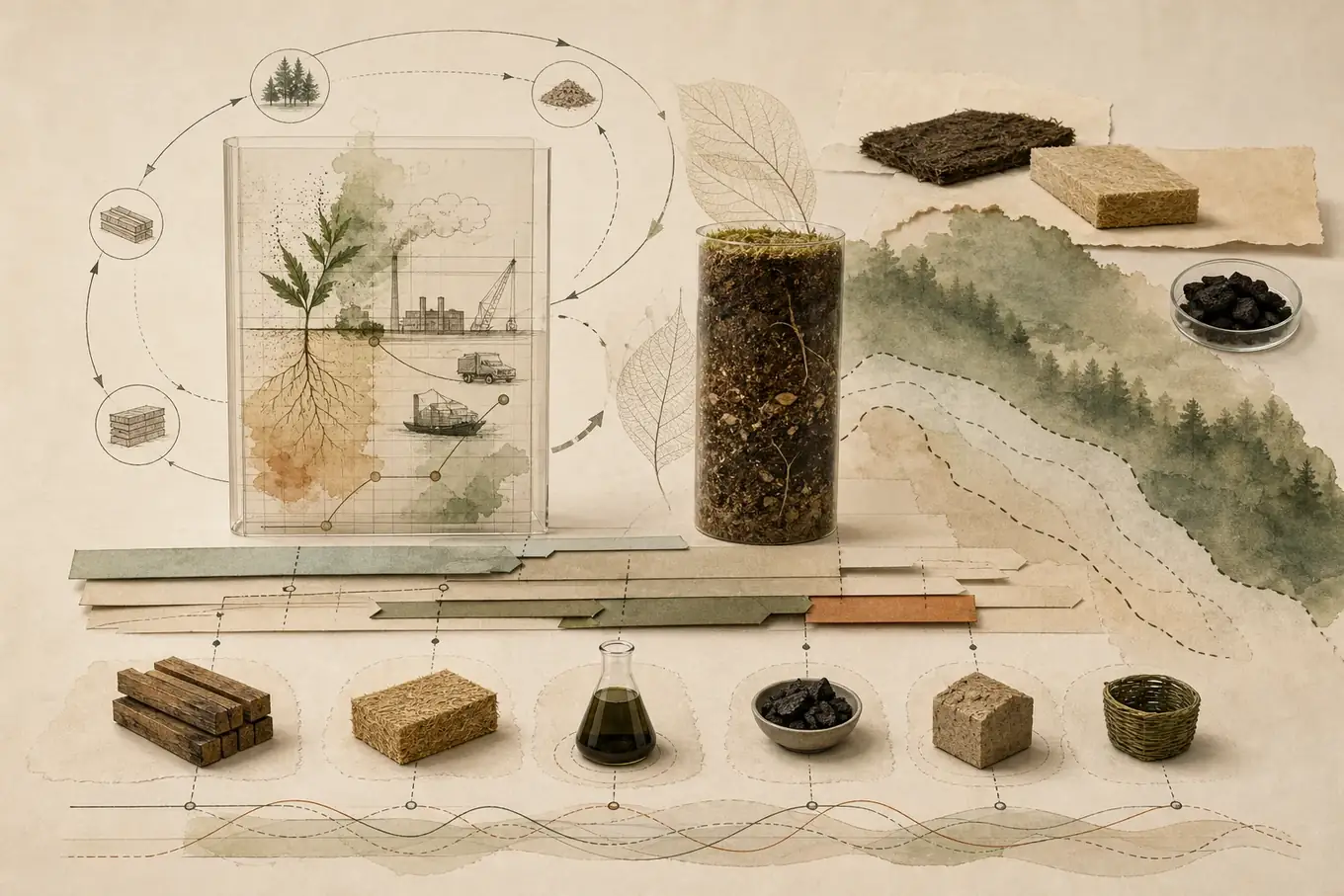
Evidence collage linking carbon cycles, soil core, material samples, time, life-cycle boundaries and alternative outcomes.MODULE 04
01

Accounting

  • Carbon accounting and removal
  • LCA and environmental impacts
  • TEA, cost and cash flow
02

Decision quality

  • Counterfactuals and additionality
  • Uncertainty and sensitivity
  • Multi-objective trade-offs

CURRICULUM

6 lessons

204 min

CONNECTED ROUTES

Learning paths

Bioeconomy 101

A guided first journey through the vocabulary, constraints and full system logic of the bioeconomy.

Carbon Removal from Biomass

Evaluate biomass-based carbon removal from resource constraints and conversion yields to durability, additionality and system outcomes.

Plastic Waste to Renewable Carbon

Follow plastic wastes through classification, selective conversion, circular carbon choices, deployment constraints and life-cycle outcomes.

Sustainable Fuels & SAF

Compare sustainable aviation fuel pathways across feedstocks, process trains, logistics, carbon intensity, cost and scale-up.

EVIDENCE LIBRARY

Research, models & tools

A curated starting shelf for this teaching area.

TOOLS

Related tools

LLNL and partner institutions

Roads to Removal

A regionally explicit assessment of U.S. carbon-dioxide-removal opportunities, capacities and costs.

Use it when
Which removal options may fit particular regions and constraints?
Limits
It is an assessment, not a prescriptive local plan; community and project evidence remain necessary.
Inputs, outputs & scope
Inputs
Regional biomass, soils, geology, transport, energy and socioeconomic context.
Outputs
Regional capacity, cost, infrastructure and impact assessments.
Typical applications
BiCRS, soil carbon, transport networks and regional CDR portfolios.
GreenDelta

openLCA

An open-source desktop platform for constructing life-cycle inventories and impact assessments.

Use it when
How can a product system, exchanges, allocation and impact methods be assembled and audited?
Limits
Software does not supply a defensible boundary or dataset license; modelling choices still require documentation and review.
Inputs, outputs & scope
Inputs
Process inventories, flows, databases, functional unit, system model and impact method.
Outputs
Inventory results, characterized impacts, contribution analysis and scenario comparisons.
Typical applications
Transparent teaching models, product LCA, hotspot analysis and critical-review packages.
Brightway project

Brightway

An open-source Python framework for matrix-based LCA, scenario analysis and advanced computational workflows.

Use it when
How can reproducible LCA calculations be automated, parameterized and extended?
Limits
Requires programming and careful database management; computational flexibility can amplify undocumented assumptions.
Inputs, outputs & scope
Inputs
Technosphere and biosphere matrices, demand, characterization methods and scenario parameters.
Outputs
LCI/LCIA matrices, contribution tables, uncertainty and parameterized scenario results.
Typical applications
Research-grade reproducible LCA, Monte Carlo analysis and coupling with optimization or process models.
U.S. Department of Energy

TECHTEST

A spreadsheet-based early-stage tool combining simplified techno-economic and life-cycle analysis.

Use it when
Which performance factors dominate the potential cost and energy profile of an emerging technology?
Limits
A screening tool does not replace a detailed process design, project finance model or critical review.
Inputs, outputs & scope
Inputs
Technology performance, lifetime, energy and cost assumptions, and a benchmark.
Outputs
Screening-level cost, energy and scenario comparisons.
Typical applications
Early R&D prioritization, benchmark comparison and scenario screening.
USDA NRCS / Colorado State University

COMET-Farm

A web tool for estimating farm-scale greenhouse-gas emissions and soil-carbon changes under management scenarios.

Use it when
How might a farm's current and alternative practices differ in GHG emissions and carbon sequestration?
Limits
Screening estimates depend on user inputs and model applicability; they do not replace project-specific measurement and verification.
Inputs, outputs & scope
Inputs
Location, soils, crops, livestock, energy use and detailed management histories or scenarios.
Outputs
Comparative farm GHG estimates and soil-carbon changes by scenario.
Typical applications
Management screening, farm carbon planning and contextualizing residue or soil-carbon decisions.
Colorado State University

DayCent

A daily time-step ecosystem model for carbon and nitrogen flows among soil, vegetation and atmosphere.

Use it when
How do management and environmental conditions affect soil carbon and greenhouse-gas fluxes?
Limits
Parameterization and validation determine credibility; model structure cannot replace field evidence.
Inputs, outputs & scope
Inputs
Climate, soil properties, vegetation, land use and management schedules.
Outputs
Carbon and nitrogen pools, productivity, water states and trace-gas fluxes.
Typical applications
Soil-carbon baselines, residue-removal scenarios and agricultural GHG accounting.
CASE STUDIES

Examples from Wang Group

2022Outcomes

Novel carbon-negative methane production via integrating anaerobic digestion and pyrolysis of organic fraction of municipal solid waste

Illustrates an integrated organic-waste pathway where process coupling and the counterfactual waste fate determine the carbon claim.

2021Conversion

Synergistic effects in the copyrolysis of municipal sewage sludge digestate and salix: Reaction mechanism, product characterization and char stability

Shows why co-pyrolysis synergy must be read together with product characterization and char stability.

2022Outcomes

Pyrolysis of engineered beach-cast seaweed: Performances and life cycle assessment

A useful LCA case because engineered beach-cast seaweed makes collection, pretreatment and alternative management part of the boundary.

2025Deployment

Assessing the Techno-Economic Feasibility of Bamboo Residue-Derived Hard Carbon

Connects regional bamboo-residue supply, process assumptions and discounted cash flow to a deployability question for hard carbon.

2023Outcomes

Carbon-negative valorization of biomass waste into affordable green hydrogen and battery anodes

A multi-product biomass case that invites separate checks of carbon accounting, coproduct allocation and affordability claims.

REFERENCES

References & further reading

  1. International Organization for Standardization (2006). ISO 14040:2006 Environmental management — Life cycle assessment — Principles and framework.Open source
  2. Leinonen (2022). A general framework for including biogenic carbon emissions and removals in the life cycle assessments for forestry products.https://doi.org/10.1007/s11367-022-02086-1
  3. Intergovernmental Panel on Climate Change (2022). Climate Change 2022: Mitigation of Climate Change — Chapter 6, Energy Systems.Open source
  4. Garcia et al. (2020). Accounting for biogenic carbon and end-of-life allocation in life cycle assessment of multi-output wood cascade systems.https://doi.org/10.1016/j.jclepro.2020.122795
  5. Brunner, Hausfather and Knutti (2024). Durability of carbon dioxide removal is critical for Paris climate goals.https://doi.org/10.1038/s43247-024-01808-7
  6. Lefebvre et al. (2023). Biomass residue to carbon dioxide removal: quantifying the global impact of biochar.https://doi.org/10.1007/s42773-023-00258-2
  7. Lawrence Livermore National Laboratory and partner institutions (2023). Roads to Removal: Options for Carbon Dioxide Removal in the United States.Open source
  8. Matuštík, Pohořelý and Kočí (2022). Is application of biochar to soil really carbon negative? The effect of methodological decisions in Life Cycle Assessment.https://doi.org/10.1016/j.scitotenv.2021.151058
  9. U.S. Environmental Protection Agency (2006). Life Cycle Assessment: Principles and Practice.Open source
  10. GreenDelta (2026). openLCA 2 manual.Open source
  11. Brightway project (2026). Brightway LCA Software Framework documentation.Open source
  12. Bastidas-Oyanedel and Schmidt (2018). Increasing Profits in Food Waste Biorefinery—A Techno-Economic Analysis.https://doi.org/10.3390/en11061551
  13. Yao, Staples, Malina and Tyner (2017). Stochastic techno-economic analysis of alcohol-to-jet fuel production.https://doi.org/10.1186/s13068-017-0702-7
  14. U.S. Department of Energy (2026). Techno-EconomiC Heuristic Tool for Early-Stage Technologies (TECHTEST).Open source
  15. Shule Wang, Yuming Wen, Ziyi Shi, Ilman Nuran Zaini, Pär Göran Jönsson, Weihong Yang (2022). Novel carbon-negative methane production via integrating anaerobic digestion and pyrolysis of organic fraction of municipal solid waste.https://doi.org/10.1016/j.enconman.2021.115042
  16. Shule Wang, Per Mandfloen, Pär Jönsson, Weihong Yang (2021). Synergistic effects in the copyrolysis of municipal sewage sludge digestate and salix: Reaction mechanism, product characterization and char stability.https://doi.org/10.1016/j.apenergy.2021.116687
  17. Yuming Wen, Shule Wang, Ziyi Shi, Yanghao Jin, Jean-Baptiste Thomas, Elias Sebastian Azzi, Daniel Franzén, Fredrik Gröndahl, Andrew Martin, Chuchu Tang, Wangzhong Mu, Pär Göran Jönsson, Weihong Yang (2022). Pyrolysis of engineered beach-cast seaweed: Performances and life cycle assessment.https://doi.org/10.1016/j.watres.2022.118875
  18. Senqiang Qin, Chenghao Yu, Yanghao Jin, Gaoyue Zhang, Wei Xu, Ao Wang, Mengmeng Fan, Kang Sun, Shule Wang (2025). Assessing the Techno-Economic Feasibility of Bamboo Residue-Derived Hard Carbon.https://doi.org/10.3390/app15137113
  19. Hanmin Yang, Anissa Nurdiawati, Ritambhara Gond, Shiwei Chen, Shule Wang, Bin Tang, Yanghao Jin, Ilman Nuran Zaini, Ziyi Shi, Wujun Wang, Andrew Martin, Reza Younesi, Linda Sandström, Pär G Jönsson, Weihong Yang, Tong Han (2023). Carbon-negative valorization of biomass waste into affordable green hydrogen and battery anodes.https://doi.org/10.1016/j.ijhydene.2023.09.096