LEARNING PATH · Advanced
Sustainable Fuels & SAF
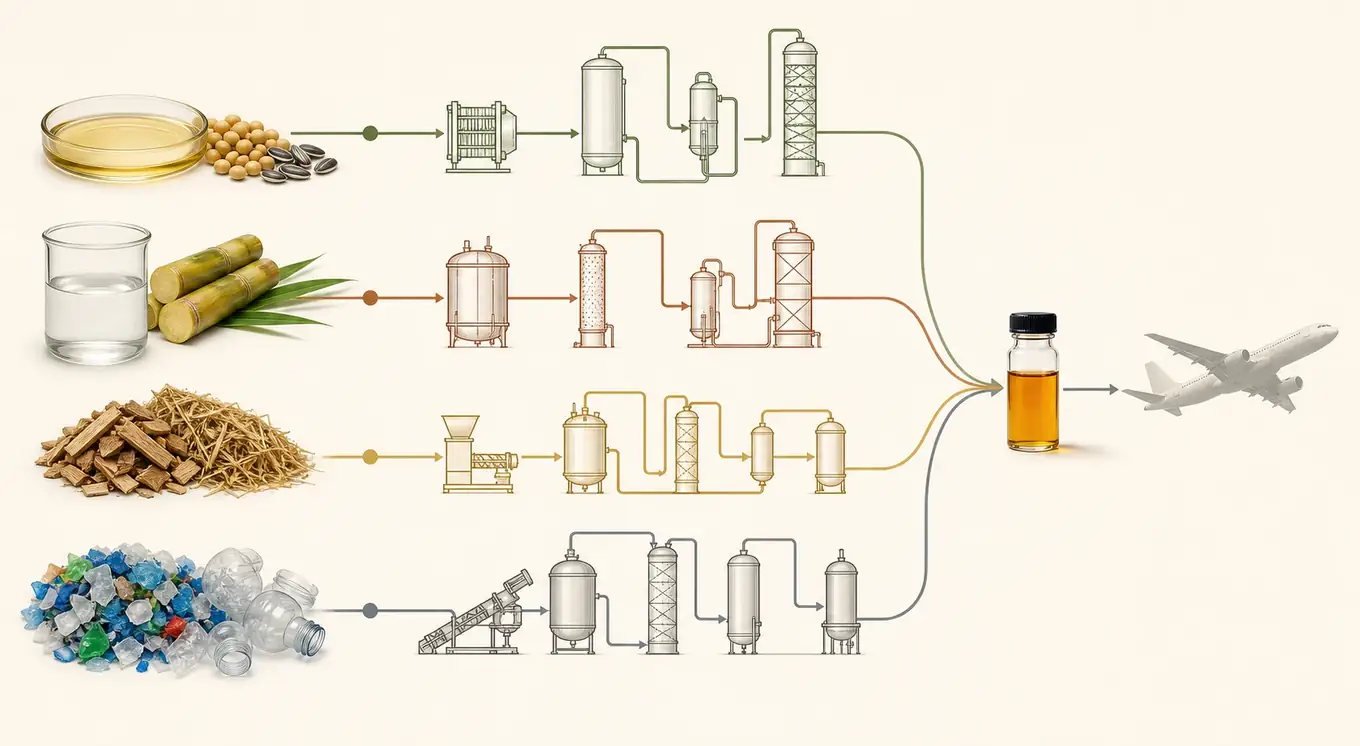
Compare sustainable aviation fuel pathways across feedstocks, process trains, logistics, carbon intensity, cost and scale-up.
4 h8 lessonsAdvanced
Start path →Prerequisites
Conversion and life-cycle basics recommended.
Learning objectives
- Map major SAF pathway families and conversion steps.
- Interpret carbon-intensity and TEA claims with boundaries.
- Identify feedstock, infrastructure and market constraints on scale.
Progress is stored only in this browser.
Visual roadmap
Lesson sequence
246 min
1Feedstock characteristics and conversion fit2Conversion pathways, mass and energy balances3Fermentation, catalysis and upgrading4Sustainable aviation fuel pathways5Supply chains, transport and storage6Life-cycle assessment7Techno-economic analysis, cost and cash flow8Scenario and sensitivity analysis
01Feedstock characteristics and conversion fitBeginner · 26 minWhy moisture, ash, composition, particle form and variability often matter more than nominal resource labels.↗02Conversion pathways, mass and energy balancesBeginner · 26 minA pathway is credible when every input, product, coproduct, emission and loss is accounted for on a common basis.↗03Fermentation, catalysis and upgradingIntermediate · 30 minBiological selectivity and catalytic transformation are both powerful, but they impose different feed purity, operating and separation demands.↗04Sustainable aviation fuel pathwaysAdvanced · 34 minSAF is a specification- and certification-constrained system connecting feedstocks, molecules, hydrogen, refineries, airports and life-cycle accounting.↗05Supply chains, transport and storageIntermediate · 30 minThe physical chain between dispersed resources and steady industrial demand shapes cost, losses, emissions and reliability.↗06Life-cycle assessmentIntermediate · 36 minLCA connects a decision question to a functional unit, system inventory, impact assessment and interpretation across a product life cycle.↗07Techno-economic analysis, cost and cash flowIntermediate · 36 minTEA translates a process design and financing assumptions into cost, price and return metrics while exposing performance and scale drivers.↗08Scenario and sensitivity analysisIntermediate · 28 minSeparate alternative futures, influential assumptions and uncertain values.↗ CASE STUDIES
Examples from Wang Group
2023Resources
Van Krevelen diagrams based on machine learning visualize feedstock-product relationships in thermal conversion processes
Shows how machine learning and Van Krevelen space can make feedstock–product relationships legible without turning the model into the research question itself.
2024Conversion
A novel three-stage ex-situ catalytic pyrolysis process for improved bio-oil yield and quality from lignocellulosic biomass
Illustrates how staged catalytic process design can trade equipment complexity against product yield and quality.
2025Conversion
Breaking the yield–selectivity trade-off in polystyrene waste valorization via tandem depolymerization and hydrogenolysis
Provides a clear conversion example of a yield–selectivity trade-off and the value of tandem process design.
2026Conversion
Ambient-pressure conversion of plastic waste to jet fuel cycloalkanes by tandem hydropyrolysis and vapour-phase hydrogenation
A plastic-to-jet-fuel conversion case for separating molecular feasibility from feedstock supply, hydrogen, certification and deployment questions.
2022Outcomes
Pyrolysis of engineered beach-cast seaweed: Performances and life cycle assessment
A useful LCA case because engineered beach-cast seaweed makes collection, pretreatment and alternative management part of the boundary.
2025Deployment
Assessing the Techno-Economic Feasibility of Bamboo Residue-Derived Hard Carbon
Connects regional bamboo-residue supply, process assumptions and discounted cash flow to a deployability question for hard carbon.