The question
When does a promising process become a financeable project?
Learning objectives
- 01Connect mass-energy balances to equipment, capital, operating costs and revenue.
- 02Distinguish cost metrics, minimum selling price, NPV and cash-flow timing.
- 03Use sensitivity and stage-appropriate assumptions without presenting a screening TEA as bankability.
Core explanation
TEA begins with a process definition: capacity, uptime, yields, balances, equipment, utilities, labor, materials and waste. Equipment design and costing lead to capital investment; production rates and prices lead to operating cost and revenue. The model then applies construction, financing, taxes, depreciation, working capital and project-life assumptions.
Cost of production, minimum selling price, net present value and internal rate of return answer different questions. Cash-flow timing matters: construction outlays occur before revenue, ramp-up can delay throughput, replacement and maintenance occur later, and working capital ties up funds. A single annualized cost can hide liquidity and financing risk.
Early-stage TEA is most useful for learning: identifying cost drivers, required performance and research priorities. It is not a quotation or investment guarantee. Compare consistent maturity, scale and price bases; use ranges for uncertain performance; distinguish nth-of-a-kind from pioneer plants; and test coproduct price and market limits.
Key concepts
Capital expenditure
Investment in equipment, installation, site, engineering and project delivery.
Operating expenditure
Recurring cost of feedstocks, utilities, labor, maintenance and services.
Minimum selling price
Product price that satisfies a defined financial criterion under the model assumptions.
Net present value
Discounted value of future cash inflows minus outflows.
Visual explanation
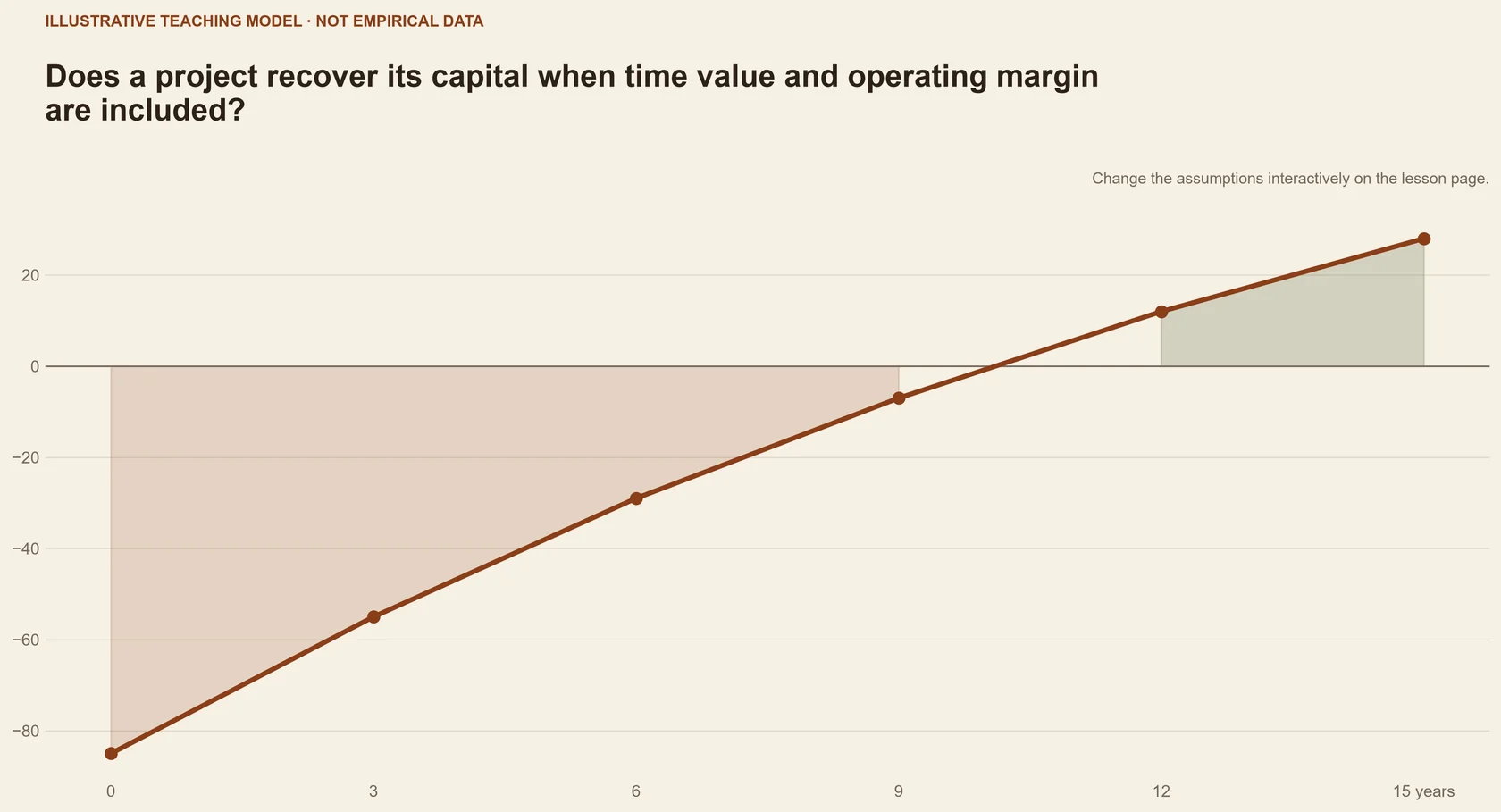
Explore · project cashflow
Place capital, ramp-up, operating cost and revenue on a project timeline.
Compare three project structures and inspect when cash pressure occurs; values are illustrative.
iIllustrative learning model — values are not scientific results or forecasts.
Base build
Two construction years, gradual ramp-up and stable product price.
- Peak funding
- Year 2
- Primary risk
- Ramp-up
Worked example
A process with attractive unit cost but difficult cash flow
A model has low steady-state operating cost but high capital, long construction and slow ramp-up.
- 01
Lay out construction, commissioning, ramp-up, full operation and replacement years.
- 02
Calculate annual revenue, operating cash and financing needs rather than one average year.
- 03
Stress-test delay, lower uptime, feedstock price and coproduct price together.
A favorable long-run cost can coexist with a project that cannot finance or survive its early years.
Case file
Assessing the Techno-Economic Feasibility of Bamboo Residue-Derived Hard Carbon
- Why it is here
- The public study offers a product-specific example of linking technical parameters with economic outcomes.
- What to inspect
- Inspect scale, price, yield and capital assumptions rather than only the headline cost.
- Limitation
- An academic TEA is not a bankable project model or market forecast.
Tool in context
TECHTEST
- Use it for this task
- Screen which performance and cost assumptions dominate an early-stage concept.
- Limitation
- A screening tool does not replace a detailed process design, project finance model or critical review.
Inputs, outputs & scope
- What it is
- A spreadsheet-based early-stage tool combining simplified techno-economic and life-cycle analysis.
- Problem it addresses
- Which performance factors dominate the potential cost and energy profile of an emerging technology?
- Inputs
- Technology performance, lifetime, energy and cost assumptions, and a benchmark.
- Outputs
- Screening-level cost, energy and scenario comparisons.
- Typical applications
- Early R&D prioritization, benchmark comparison and scenario screening.
Core references
- Bastidas-Oyanedel and Schmidt (2018). Increasing Profits in Food Waste Biorefinery—A Techno-Economic Analysis.https://doi.org/10.3390/en11061551 ↗
- Yao, Staples, Malina and Tyner (2017). Stochastic techno-economic analysis of alcohol-to-jet fuel production.https://doi.org/10.1186/s13068-017-0702-7 ↗
Further reading +2
- U.S. Department of Energy (2026). Techno-EconomiC Heuristic Tool for Early-Stage Technologies (TECHTEST).Open source ↗
- Cortes-Peña et al. (2020). BioSTEAM: A Fast and Flexible Platform for the Design, Simulation, and Techno-Economic Analysis of Biorefineries under Uncertainty.https://doi.org/10.1021/acssuschemeng.9b07040 ↗
Knowledge check
Key takeaway
TEA connects technical design to financial consequences; its credibility depends on transparent stage, scale, time and uncertainty.
A low minimum selling price from an early model demonstrates commercial bankability.
Process basis, equipment and cost sources, maturity and scale, financing, cash-flow timeline, coproduct markets and uncertainty.