Before you begin
Conversion pathways, mass and energy balances →The question
Which integration removes a burden—and which merely moves it?
Learning objectives
- 01Explain the biorefinery as a portfolio and integration concept.
- 02Identify heat, water, hydrogen and material integration opportunities and constraints.
- 03Recognize coproduct dependence and operational complexity.
Core explanation
A biorefinery fractionates or converts a biological or secondary feedstock into a portfolio of fuels, chemicals, materials, energy and services. The analogy to a petroleum refinery is useful for integration, but biomass has different oxygen content, moisture, minerals, heterogeneity and seasonal supply. Designs must start from those properties rather than copy a fossil flowsheet.
Integration can reuse heat, water, solvents, hydrogen, carbon dioxide and intermediate streams. It can reduce utilities and waste, but tighter coupling can also propagate disruptions and constrain operating windows. Heat at the right temperature, water at the right quality and gas at the right pressure are not interchangeable quantities.
Economic viability may depend on a small-volume high-value coproduct, while climate value depends on the fate of larger carbon flows. Test market size, price erosion, product qualification and allocation. A design is fragile if every coproduct must simultaneously receive its best-case market and credit.
Key concepts
Biorefinery
An integrated system producing multiple products and services from biological or secondary resources.
Process integration
Coordinated exchange of heat, mass and utilities among operations.
Coproduct
An additional output with economic or functional value.
Pinch
A constraint that limits feasible heat or material integration.
Visual explanation
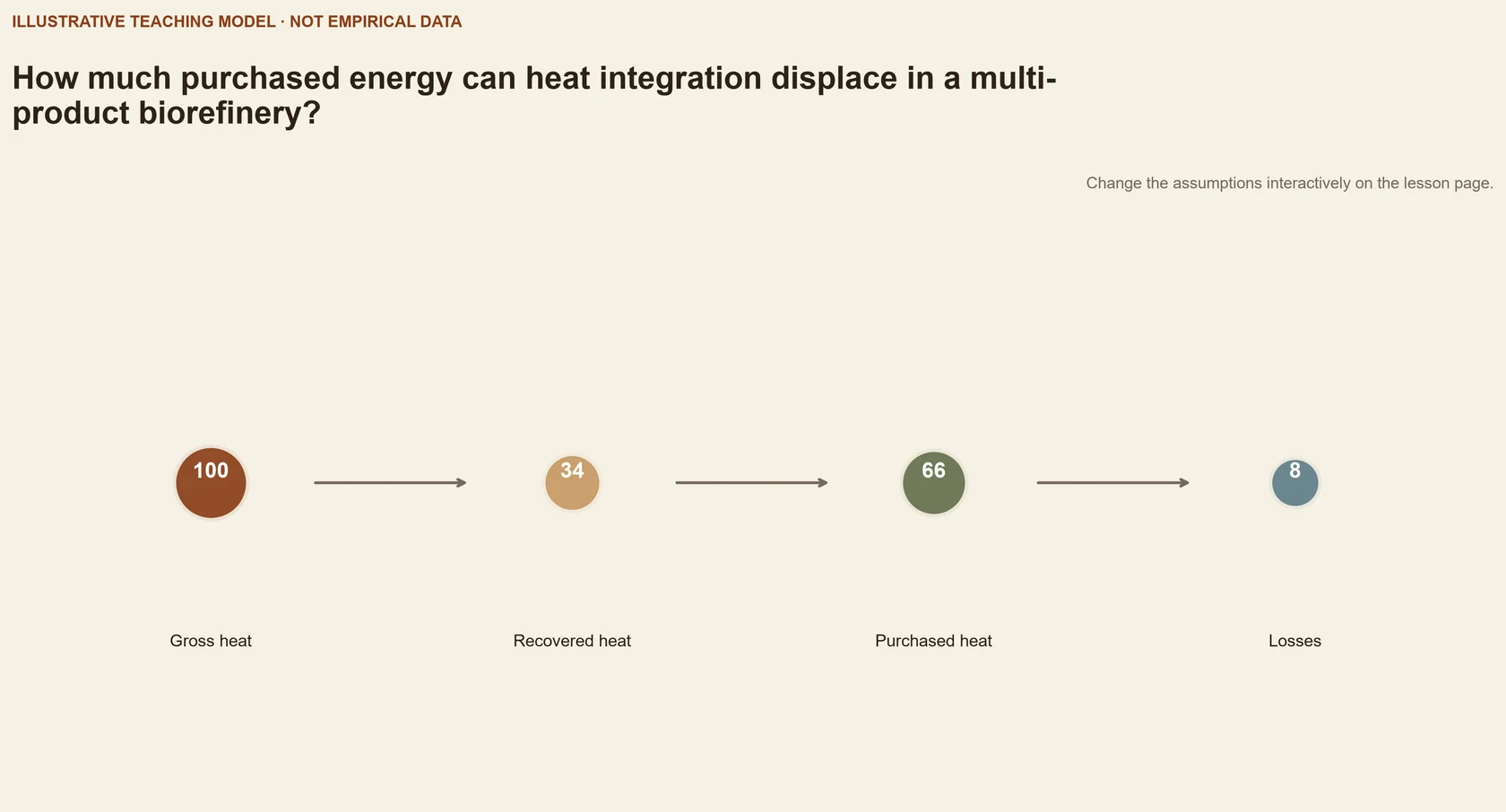
Explore · integration canvas
Connect heat, water, material and co-product loops across a biorefinery.
Add integration links one by one and inspect the new dependency each creates.
Add integration links one by one and inspect the new dependency each creates.
Worked example
A three-product lignocellulosic biorefinery
Carbohydrates become a fermentation product, lignin provides heat or material, and nutrients may be recovered.
- 01
Close each fraction’s mass and carbon destination.
- 02
Match heat sources and sinks by temperature and time.
- 03
Stress-test economics without the highest-value coproduct market.
Integration creates options, but a robust design does not depend on every option performing at its maximum simultaneously.
Case file
Novel carbon-negative methane production via integrating anaerobic digestion and pyrolysis of organic fraction of municipal solid waste
- Why it is here
- The public case connects waste conversion with energy and environmental accounting.
- What to inspect
- Inspect how co-products, energy recovery and the displaced fate are represented.
- Limitation
- Results depend on the selected waste composition and counterfactual.
Tool in context
BioSTEAM
- Use it for this task
- Build a transparent flowsheet and test integration assumptions.
- Limitation
- Outputs are only as credible as property methods, scale-up rules and input evidence.
Inputs, outputs & scope
- What it is
- An open-source process simulation framework with integrated TEA, LCA and uncertainty workflows.
- Problem it addresses
- How do unit operations combine into material, energy, cost and impact results?
- Inputs
- Thermodynamics, streams, reactions, unit operations, design and economic assumptions.
- Outputs
- Flowsheets, mass and energy balances, equipment sizes, costs and life-cycle indicators.
- Typical applications
- Biorefineries, separation trains, plastic upcycling and early-stage process comparison.
Core references
- Cortes-Peña et al. (2020). BioSTEAM: A Fast and Flexible Platform for the Design, Simulation, and Techno-Economic Analysis of Biorefineries under Uncertainty.https://doi.org/10.1021/acssuschemeng.9b07040 ↗
- Oliveira et al. (2018). Process integration of a multiperiod sugarcane biorefinery.https://doi.org/10.1016/j.apenergy.2017.11.020 ↗
Further reading +2
- Préat et al. (2020). Identification of microalgae biorefinery scenarios and development of mass and energy balance flowsheets.https://doi.org/10.1016/j.algal.2019.101737 ↗
- BioSTEAM project (2026). BioSTEAM process simulation, TEA and LCA documentation.Open source ↗
Knowledge check
Key takeaway
A biorefinery is an integrated resource-allocation system, not simply several products drawn beside one reactor.
Adding more coproducts always improves economics and environmental performance.
Integrated balances, utility quality, market size, product specifications, coupling risks and allocation choices.