The question
Which SAF route fits a feedstock, product specification and evidence boundary?
Learning objectives
- 01Describe SAF as a family of certified pathways rather than one fuel.
- 02Trace feedstock, conversion, upgrading, distribution and use.
- 03Separate drop-in compatibility from life-cycle climate performance and scale.
Core explanation
Sustainable aviation fuel is a jet-fuel blend component made through approved pathways from non-petroleum or recycled-carbon feedstocks. Pathways can involve lipids, alcohols, sugars, lignocellulosic biomass, wastes, captured carbon and hydrogen. They differ in feed requirements, carbon efficiency, hydrogen and electricity demand, product slate and readiness.
A molecule can meet fuel properties without delivering the same climate result in every pathway. Feedstock counterfactuals, land effects, process energy, hydrogen source, coproducts and distribution shape life-cycle performance. Certification for safe aircraft use and eligibility under a policy scheme are separate questions from environmental assessment.
Deployment adds an unusually demanding scale problem: large, concentrated demand; strict quality; blending and logistics; long-lived infrastructure; and competition for limited feedstocks. A portfolio view compares routes across regions and time instead of assuming one pathway supplies all demand.
Key concepts
SAF
A qualified aviation-fuel component produced through an approved non-conventional pathway.
Drop-in fuel
Fuel compatible with specified existing engines and distribution within approved conditions.
Pathway certification
Technical qualification of a production route and resulting fuel for aviation use.
Hydrogen intensity
Hydrogen required per unit feedstock or fuel, with source affecting cost and emissions.
Visual explanation
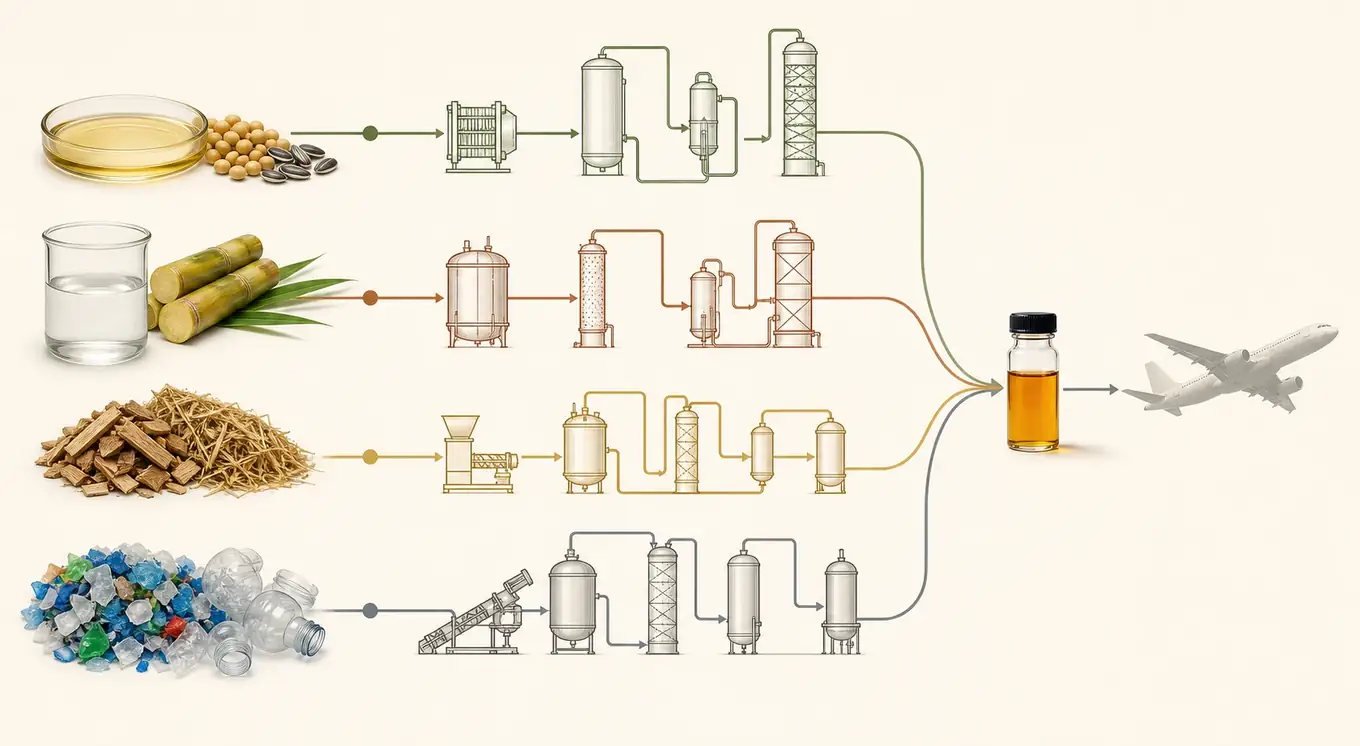
Explore · saf pathway passports
Compare pathway families by conversion logic rather than by a single headline carbon number.
Open each pathway passport; compare feed, key transformations, co-products and certification questions.
HEFA
Lipid upgrading; feedstock availability and co-product allocation matter.
Worked example
Comparing three SAF routes
A region considers lipid, lignocellulosic and captured-carbon routes.
- 01
Match each route to realistic local feedstock and energy supply.
- 02
Compare carbon efficiency, hydrogen/electricity demand, coproducts and certification status.
- 03
Add refinery, blending, airport logistics and feedstock competition to the scale scenario.
The route with the best plant yield may not be the route with the strongest regional deployment case.
Case file
Ambient-pressure conversion of plastic waste to jet fuel cycloalkanes by tandem hydropyrolysis and vapour-phase hydrogenation
- Why it is here
- This public paper provides a non-traditional waste-carbon route for examining full-chain claims.
- What to inspect
- Inspect feed definition, product slate, energy inputs and carbon-accounting boundary.
- Limitation
- It should not be treated as representative of all plastics, reactors or SAF certification outcomes.
Tool in context
GREET
- Use it for this task
- Compare pathway life-cycle inventories with a documented boundary and version.
- Limitation
- Results depend on pathway version, geography, allocation and counterfactual assumptions.
Inputs, outputs & scope
- What it is
- A life-cycle model for energy use, emissions, fuels, vehicles and material pathways.
- Problem it addresses
- How do fuel and vehicle pathways compare on a consistent life-cycle basis?
- Inputs
- Feedstocks, process energy, transport, conversion efficiencies and pathway assumptions.
- Outputs
- Life-cycle energy use, greenhouse gases and regulated air emissions.
- Typical applications
- Transport fuels, SAF, hydrogen, biofuels and materials comparisons.
Core references
- U.S. Department of Energy, U.S. Department of Transportation and U.S. Department of Agriculture (2022). Sustainable Aviation Fuel Grand Challenge Roadmap.Open source ↗
- Yao, Staples, Malina and Tyner (2017). Stochastic techno-economic analysis of alcohol-to-jet fuel production.https://doi.org/10.1186/s13068-017-0702-7 ↗
- Batten, Karanjikar and Spatari (2024). A sustainable aviation fuel pathway from biomass: life cycle environmental and cost evaluation for dimethylcyclooctane jet fuel.https://doi.org/10.1039/d3se01470c ↗
Further reading +2
- Argonne National Laboratory (2026). GREET Model.Open source ↗
- Yoo, Lee and Wang (2022). Life-Cycle Greenhouse Gas Emissions of Sustainable Aviation Fuel through a Net-Zero Carbon Biofuel Plant Design.https://doi.org/10.1021/acssuschemeng.2c00977 ↗
Knowledge check
Key takeaway
SAF is a certified pathway-and-supply-chain problem, not merely a jet-range molecule.
Any renewable-carbon liquid with jet-range molecules is automatically deployable SAF.
Approved pathway and specification, feedstock scale, energy and hydrogen sources, life-cycle boundary, logistics and market constraints.