MODULE 02

Conversion & Circular Valorization

How do resources become fuels, chemicals, materials and services?

Compare biological, thermochemical and catalytic routes through mass, carbon and energy balances—not technology labels alone.

Open lesson
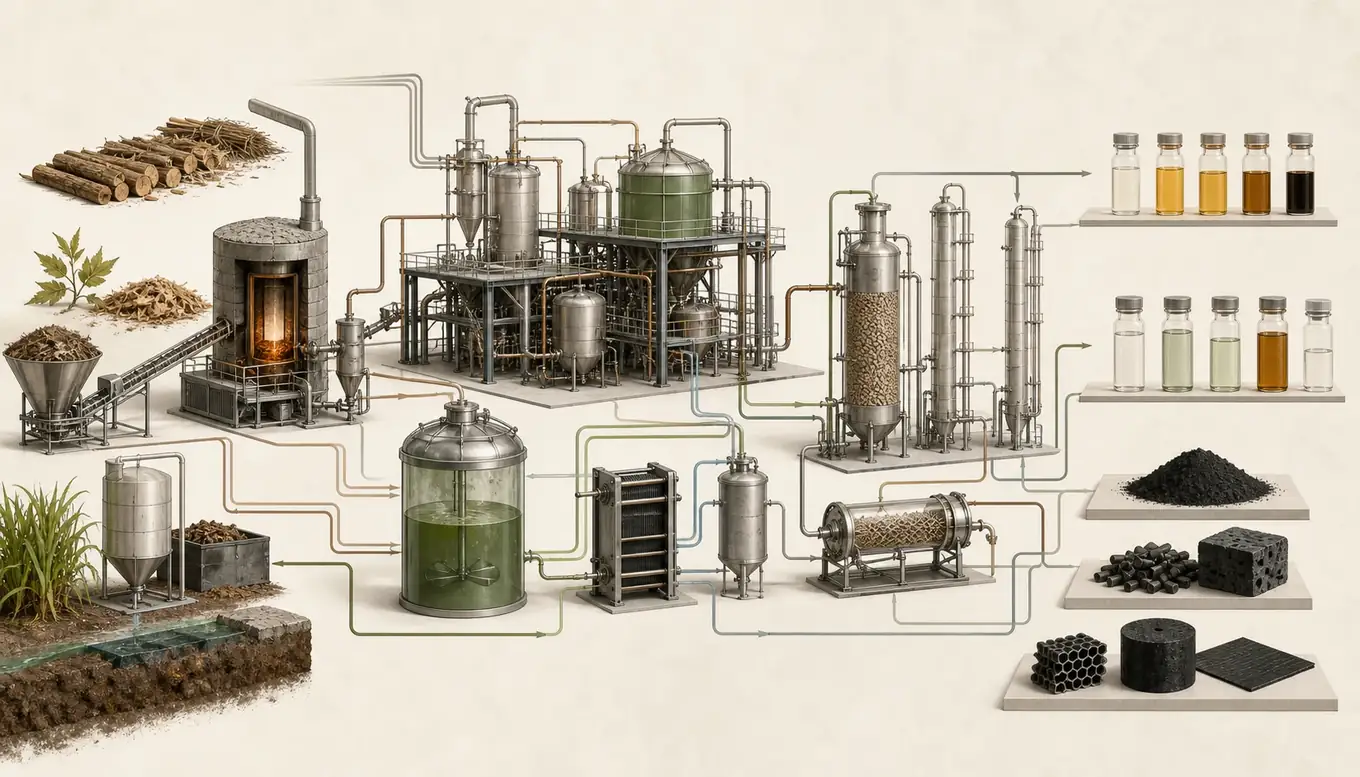
Integrated conversion landscape with thermochemical, biochemical, catalytic and separation equipment leading to fuels and carbon materials.MODULE 02
01

Pathways

  • Pyrolysis and gasification
  • Fermentation and catalysis
  • Separation and upgrading
02

Performance

  • Mass and energy balances
  • Carbon and process efficiency
  • Integration and co-products

CURRICULUM

6 lessons

182 min

CONNECTED ROUTES

Learning paths

Bioeconomy 101

A guided first journey through the vocabulary, constraints and full system logic of the bioeconomy.

Carbon Removal from Biomass

Evaluate biomass-based carbon removal from resource constraints and conversion yields to durability, additionality and system outcomes.

Plastic Waste to Renewable Carbon

Follow plastic wastes through classification, selective conversion, circular carbon choices, deployment constraints and life-cycle outcomes.

Sustainable Fuels & SAF

Compare sustainable aviation fuel pathways across feedstocks, process trains, logistics, carbon intensity, cost and scale-up.

EVIDENCE LIBRARY

Research, models & tools

A curated starting shelf for this teaching area.

TOOLS

Related tools

BioSTEAM project

BioSTEAM

An open-source process simulation framework with integrated TEA, LCA and uncertainty workflows.

Use it when
How do unit operations combine into material, energy, cost and impact results?
Limits
Outputs are only as credible as property methods, scale-up rules and input evidence.
Inputs, outputs & scope
Inputs
Thermodynamics, streams, reactions, unit operations, design and economic assumptions.
Outputs
Flowsheets, mass and energy balances, equipment sizes, costs and life-cycle indicators.
Typical applications
Biorefineries, separation trains, plastic upcycling and early-stage process comparison.
Argonne National Laboratory

GREET

A life-cycle model for energy use, emissions, fuels, vehicles and material pathways.

Use it when
How do fuel and vehicle pathways compare on a consistent life-cycle basis?
Limits
Results depend on pathway version, geography, allocation and counterfactual assumptions.
Inputs, outputs & scope
Inputs
Feedstocks, process energy, transport, conversion efficiencies and pathway assumptions.
Outputs
Life-cycle energy use, greenhouse gases and regulated air emissions.
Typical applications
Transport fuels, SAF, hydrogen, biofuels and materials comparisons.
CASE STUDIES

Examples from Wang Group

2024Conversion

A novel three-stage ex-situ catalytic pyrolysis process for improved bio-oil yield and quality from lignocellulosic biomass

Illustrates how staged catalytic process design can trade equipment complexity against product yield and quality.

2021Conversion

Synergistic effects in the copyrolysis of municipal sewage sludge digestate and salix: Reaction mechanism, product characterization and char stability

Shows why co-pyrolysis synergy must be read together with product characterization and char stability.

2025Conversion

Breaking the yield–selectivity trade-off in polystyrene waste valorization via tandem depolymerization and hydrogenolysis

Provides a clear conversion example of a yield–selectivity trade-off and the value of tandem process design.

2022Outcomes

Novel carbon-negative methane production via integrating anaerobic digestion and pyrolysis of organic fraction of municipal solid waste

Illustrates an integrated organic-waste pathway where process coupling and the counterfactual waste fate determine the carbon claim.

2026Conversion

Ambient-pressure conversion of plastic waste to jet fuel cycloalkanes by tandem hydropyrolysis and vapour-phase hydrogenation

A plastic-to-jet-fuel conversion case for separating molecular feasibility from feedstock supply, hydrogen, certification and deployment questions.

REFERENCES

References & further reading

  1. U.S. Department of Energy (2024). Feedstock-Conversion Interface Consortium: Crosscutting Analysis Research.Open source
  2. Préat et al. (2020). Identification of microalgae biorefinery scenarios and development of mass and energy balance flowsheets.https://doi.org/10.1016/j.algal.2019.101737
  3. Cortes-Peña et al. (2020). BioSTEAM: A Fast and Flexible Platform for the Design, Simulation, and Techno-Economic Analysis of Biorefineries under Uncertainty.https://doi.org/10.1021/acssuschemeng.9b07040
  4. Sahoo and Remya (2020). Influence of operating parameters on the microwave pyrolysis of rice husk: biochar yield, energy yield, and property of biochar.https://doi.org/10.1007/s13399-020-00914-8
  5. Kundu et al. (2024). Obtaining high H2-rich syngas yield and carbon conversion efficiency from biomass gasification: From characterization to process optimization using machine learning with experimental validation.https://doi.org/10.1016/j.fuel.2024.132931
  6. Intergovernmental Panel on Climate Change (2022). Climate Change 2022: Mitigation of Climate Change — Chapter 6, Energy Systems.Open source
  7. Wyman, Spindler and Grohmann (1992). Simultaneous saccharification and fermentation of several lignocellulosic feedstocks to fuel ethanol.https://doi.org/10.1016/0961-9534(92)90001-7
  8. Oliveira et al. (2018). Process integration of a multiperiod sugarcane biorefinery.https://doi.org/10.1016/j.apenergy.2017.11.020
  9. BioSTEAM project (2026). BioSTEAM process simulation, TEA and LCA documentation.Open source
  10. U.S. Department of Energy, U.S. Department of Transportation and U.S. Department of Agriculture (2022). Sustainable Aviation Fuel Grand Challenge Roadmap.Open source
  11. Yao, Staples, Malina and Tyner (2017). Stochastic techno-economic analysis of alcohol-to-jet fuel production.https://doi.org/10.1186/s13068-017-0702-7
  12. Batten, Karanjikar and Spatari (2024). A sustainable aviation fuel pathway from biomass: life cycle environmental and cost evaluation for dimethylcyclooctane jet fuel.https://doi.org/10.1039/d3se01470c
  13. Argonne National Laboratory (2026). GREET Model.Open source
  14. Yoo, Lee and Wang (2022). Life-Cycle Greenhouse Gas Emissions of Sustainable Aviation Fuel through a Net-Zero Carbon Biofuel Plant Design.https://doi.org/10.1021/acssuschemeng.2c00977
  15. Yanghao Jin, Sirui Liu, Ziyi Shi, Shule Wang, Ilman Nuran Zaini, Chuchu Tang, Sibudjing Kawi, Chi-Hwa Wang, Mikael Hedenqvist, Xincheng Lu, Yuming Wen, Jianchun Jiang, Pär Göran Jönsson, Weihong Yang (2024). A novel three-stage ex-situ catalytic pyrolysis process for improved bio-oil yield and quality from lignocellulosic biomass.https://doi.org/10.1016/j.energy.2024.131029
  16. Shule Wang, Per Mandfloen, Pär Jönsson, Weihong Yang (2021). Synergistic effects in the copyrolysis of municipal sewage sludge digestate and salix: Reaction mechanism, product characterization and char stability.https://doi.org/10.1016/j.apenergy.2021.116687
  17. Jia Wang, Zedong Zhang, Yan Zhang, Dongxian Li, Zechao Zhuang, Wei Liao, Tong Han, Lin Dong, Shule Wang, Dingsheng Wang, Jianchun Jiang (2025). Breaking the yield–selectivity trade-off in polystyrene waste valorization via tandem depolymerization and hydrogenolysis.https://doi.org/10.1038/s41565-025-02069-x
  18. Shule Wang, Yuming Wen, Ziyi Shi, Ilman Nuran Zaini, Pär Göran Jönsson, Weihong Yang (2022). Novel carbon-negative methane production via integrating anaerobic digestion and pyrolysis of organic fraction of municipal solid waste.https://doi.org/10.1016/j.enconman.2021.115042
  19. Jia Wang, Zedong Zhang, Shule Wang, Ya-Fei Jiang, He Zhou, Wenhui Zhong, Yiyun Zhang, Dongxian Li, Wenjun Zhong, Shiyao Li, Daniel Sanchez, Dingsheng Wang, Jun Li, Jianchun Jiang, Yadong Li (2026). Ambient-pressure conversion of plastic waste to jet fuel cycloalkanes by tandem hydropyrolysis and vapour-phase hydrogenation.https://doi.org/10.1038/s41560-026-02078-7