LEARNING PATH · Advanced

Carbon Removal from Biomass

Evaluate biomass-based carbon removal from resource constraints and conversion yields to durability, additionality and system outcomes.

3.8 h8 lessonsAdvanced
Start path
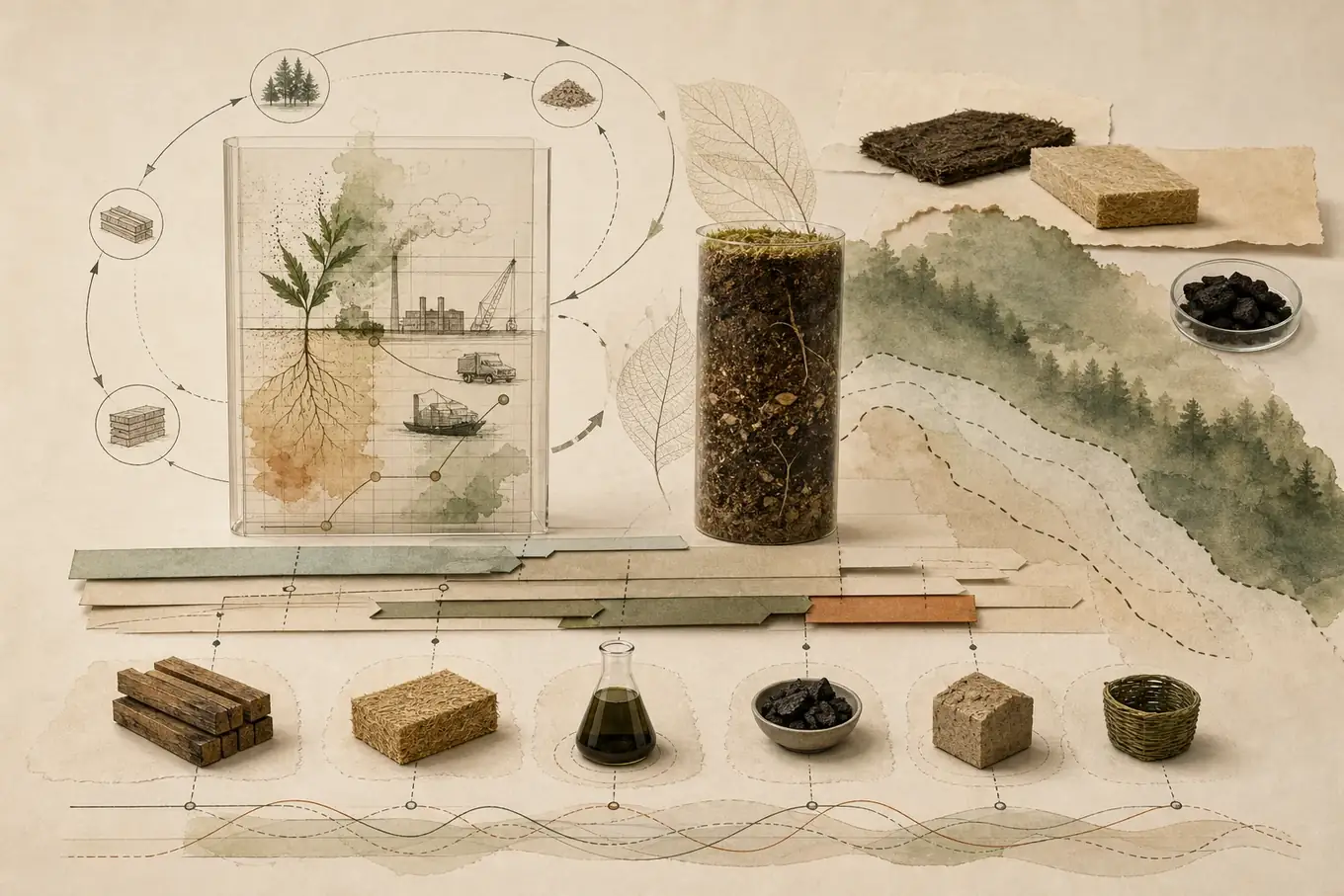
Evidence collage linking carbon cycles, soil core, material samples, time, life-cycle boundaries and alternative outcomes.CRfResources → Outcomes

Prerequisites

Basic carbon accounting and conversion knowledge recommended.

Learning objectives

  • Construct a transparent carbon ledger and counterfactual.
  • Evaluate durability, leakage and additionality.
  • Connect soil, logistics, cost and uncertainty to removal claims.

Progress is stored only in this browser.

0 / 80%
Progress is stored only in this browser.

Visual roadmap

Lesson sequence

252 min

01Soil, land and nutrient constraintsIntermediate · 30 minResidue removal and dedicated biomass must be read through soil cover, organic matter, nutrients, erosion, water and land competition.02Pyrolysis, gasification and thermochemical routesIntermediate · 30 minHow temperature, heating, atmosphere and residence time distribute carbon among solids, liquids and gases.03Supply chains, transport and storageIntermediate · 30 minThe physical chain between dispersed resources and steady industrial demand shapes cost, losses, emissions and reliability.04Carbon accounting, boundaries and counterfactualsIntermediate · 32 minCarbon claims depend on what flows are counted, over what time, compared with which alternative and under whose attribution.05Carbon removal, additionality and durabilityAdvanced · 34 minRemoval requires atmospheric origin, additional net transfer into storage, quantified leakage and credible durability with reversal management.06Life-cycle assessmentIntermediate · 36 minLCA connects a decision question to a functional unit, system inventory, impact assessment and interpretation across a product life cycle.07Soil carbon and greenhouse-gas mitigationIntermediate · 32 minSoil outcomes depend on carbon inputs and decomposition together with nitrous oxide, methane, yields, nutrients, water and management history.08Scenario and sensitivity analysisIntermediate · 28 minSeparate alternative futures, influential assumptions and uncertain values.
TOOLS

Related tools

USDA NRCS / Colorado State University

COMET-Farm

A web tool for estimating farm-scale greenhouse-gas emissions and soil-carbon changes under management scenarios.

Use it when
How might a farm's current and alternative practices differ in GHG emissions and carbon sequestration?
Limits
Screening estimates depend on user inputs and model applicability; they do not replace project-specific measurement and verification.
Inputs, outputs & scope
Inputs
Location, soils, crops, livestock, energy use and detailed management histories or scenarios.
Outputs
Comparative farm GHG estimates and soil-carbon changes by scenario.
Typical applications
Management screening, farm carbon planning and contextualizing residue or soil-carbon decisions.
Colorado State University

DayCent

A daily time-step ecosystem model for carbon and nitrogen flows among soil, vegetation and atmosphere.

Use it when
How do management and environmental conditions affect soil carbon and greenhouse-gas fluxes?
Limits
Parameterization and validation determine credibility; model structure cannot replace field evidence.
Inputs, outputs & scope
Inputs
Climate, soil properties, vegetation, land use and management schedules.
Outputs
Carbon and nitrogen pools, productivity, water states and trace-gas fluxes.
Typical applications
Soil-carbon baselines, residue-removal scenarios and agricultural GHG accounting.
LLNL and partner institutions

Roads to Removal

A regionally explicit assessment of U.S. carbon-dioxide-removal opportunities, capacities and costs.

Use it when
Which removal options may fit particular regions and constraints?
Limits
It is an assessment, not a prescriptive local plan; community and project evidence remain necessary.
Inputs, outputs & scope
Inputs
Regional biomass, soils, geology, transport, energy and socioeconomic context.
Outputs
Regional capacity, cost, infrastructure and impact assessments.
Typical applications
BiCRS, soil carbon, transport networks and regional CDR portfolios.
GreenDelta

openLCA

An open-source desktop platform for constructing life-cycle inventories and impact assessments.

Use it when
How can a product system, exchanges, allocation and impact methods be assembled and audited?
Limits
Software does not supply a defensible boundary or dataset license; modelling choices still require documentation and review.
Inputs, outputs & scope
Inputs
Process inventories, flows, databases, functional unit, system model and impact method.
Outputs
Inventory results, characterized impacts, contribution analysis and scenario comparisons.
Typical applications
Transparent teaching models, product LCA, hotspot analysis and critical-review packages.
Brightway project

Brightway

An open-source Python framework for matrix-based LCA, scenario analysis and advanced computational workflows.

Use it when
How can reproducible LCA calculations be automated, parameterized and extended?
Limits
Requires programming and careful database management; computational flexibility can amplify undocumented assumptions.
Inputs, outputs & scope
Inputs
Technosphere and biosphere matrices, demand, characterization methods and scenario parameters.
Outputs
LCI/LCIA matrices, contribution tables, uncertainty and parameterized scenario results.
Typical applications
Research-grade reproducible LCA, Monte Carlo analysis and coupling with optimization or process models.
SALib project

SALib

An open-source Python library for global sensitivity analysis, including Sobol, Morris and FAST methods.

Use it when
Which uncertain inputs drive model-output variation, interactions or screening priorities?
Limits
Method choice, sampling design, model cost and correlated inputs require deliberate treatment; rankings are conditional on specified ranges.
Inputs, outputs & scope
Inputs
A defined parameter problem, sampled input sets and corresponding model outputs.
Outputs
Method-specific sensitivity indices, confidence intervals and screening rankings.
Typical applications
Global sensitivity analysis for process, TEA, LCA and system models.
CASE STUDIES

Examples from Wang Group

2021Conversion

Synergistic effects in the copyrolysis of municipal sewage sludge digestate and salix: Reaction mechanism, product characterization and char stability

Shows why co-pyrolysis synergy must be read together with product characterization and char stability.

2022Outcomes

Novel carbon-negative methane production via integrating anaerobic digestion and pyrolysis of organic fraction of municipal solid waste

Illustrates an integrated organic-waste pathway where process coupling and the counterfactual waste fate determine the carbon claim.

2022Outcomes

Pyrolysis of engineered beach-cast seaweed: Performances and life cycle assessment

A useful LCA case because engineered beach-cast seaweed makes collection, pretreatment and alternative management part of the boundary.