The question
How much removal remains after time and reversal risk?
Learning objectives
- 01Distinguish emission reduction, avoided emission and carbon removal.
- 02Apply additionality, durability, leakage and reversal tests.
- 03Read biomass carbon removal as a coupled resource–conversion–storage system.
Core explanation
Carbon removal transfers carbon dioxide from the atmosphere into a storage pool in addition to what would have occurred. Avoiding a fossil emission is valuable mitigation but is not the same physical service. Biomass routes rely on prior biological uptake, then retain carbon in geological storage, durable products, biochar or other pools while accounting for the remaining carbon and energy.
Additionality asks whether the storage and project occur because of the intervention. Durability asks how long carbon remains stored and with what confidence. Reversal risk covers fire, decay, leakage, disturbance or product disposal. Monitoring, buffer reserves, liability and replacement can manage risk but do not make all storage durations equivalent.
Leakage includes displaced land use, resource demand, energy, transport and market responses outside the project boundary. Biomass availability and soil-carbon effects can limit removal before storage capacity does. Regional assessments such as Roads to Removal connect biomass, transport and storage geography, while project claims still need site-specific evidence.
Key concepts
Additionality
Net climate effect that would not have occurred without the intervention.
Durability
Expected storage duration together with uncertainty and risk management.
Reversal
Release of previously stored carbon back to the atmosphere or a less durable pool.
Leakage
Emissions or losses shifted outside the assessed project boundary.
Visual explanation
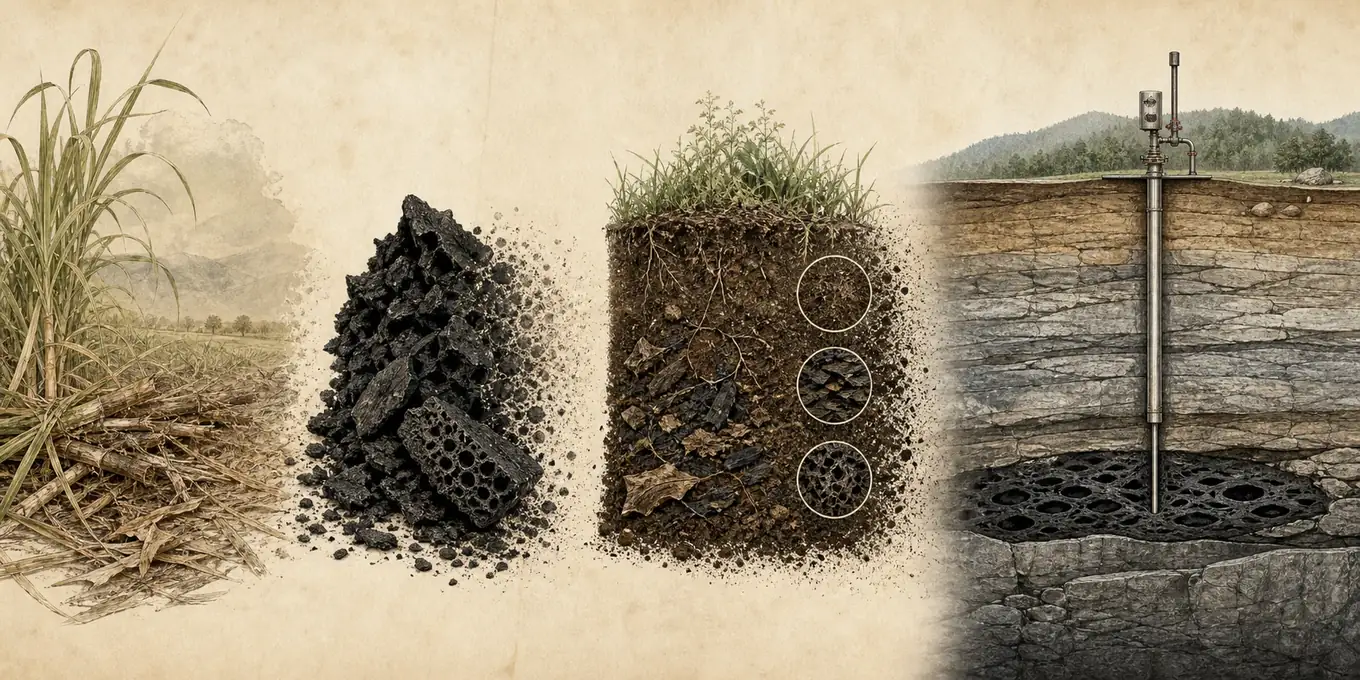
Explore · durability timeline
Separate initial storage, decay, monitoring and reversal across time.
Compare durability profiles and inspect which monitoring claim each profile can support.
iIllustrative learning model — values are not scientific results or forecasts.
Short-lived storage
Most carbon returns within decades; timing still matters but does not equal durable removal.
- Illustrative horizon
- 20–50 y
- Monitoring
- Frequent
Worked example
Biochar as a removal claim
Residue is pyrolyzed and a char product is applied to soil.
- 01
Establish baseline residue fate and sustainable sourcing.
- 02
Account for stable and labile carbon, energy, coproducts, transport and soil interactions.
- 03
Define monitoring, end use, durability evidence and reversal responsibility.
A char yield is not a removal quantity; the claim is a net, additional and durable system result.
Case file
Synergistic effects in the copyrolysis of municipal sewage sludge digestate and salix: Reaction mechanism, product characterization and char stability
- Why it is here
- The public char study offers material evidence relevant to—but not sufficient for—durability claims.
- What to inspect
- Inspect the stability indicator, test method and conversion conditions.
- Limitation
- Material stability is only one part of project-level removal durability and monitoring.
Tool in context
Roads to Removal
- Use it for this task
- Compare nationally assessed removal pathways, constraints and regional context.
- Limitation
- It is an assessment, not a prescriptive local plan; community and project evidence remain necessary.
Inputs, outputs & scope
- What it is
- A regionally explicit assessment of U.S. carbon-dioxide-removal opportunities, capacities and costs.
- Problem it addresses
- Which removal options may fit particular regions and constraints?
- Inputs
- Regional biomass, soils, geology, transport, energy and socioeconomic context.
- Outputs
- Regional capacity, cost, infrastructure and impact assessments.
- Typical applications
- BiCRS, soil carbon, transport networks and regional CDR portfolios.
Core references
- Brunner, Hausfather and Knutti (2024). Durability of carbon dioxide removal is critical for Paris climate goals.https://doi.org/10.1038/s43247-024-01808-7 ↗
- Lefebvre et al. (2023). Biomass residue to carbon dioxide removal: quantifying the global impact of biochar.https://doi.org/10.1007/s42773-023-00258-2 ↗
Further reading +2
- Lawrence Livermore National Laboratory and partner institutions (2023). Roads to Removal: Options for Carbon Dioxide Removal in the United States.Open source ↗
- Matuštík, Pohořelý and Kočí (2022). Is application of biochar to soil really carbon negative? The effect of methodological decisions in Life Cycle Assessment.https://doi.org/10.1016/j.scitotenv.2021.151058 ↗
Knowledge check
Key takeaway
Carbon removal is a verified atmospheric service with a baseline and storage obligation, not a synonym for biogenic carbon or avoided emissions.
Any process that produces a stable carbon-rich solid is automatically carbon removal.
Atmospheric origin, baseline, additionality, full net balance, leakage, durability, monitoring and reversal responsibility.