The question
What exactly is counted—and compared with what?
Learning objectives
- 01Distinguish physical carbon flow from attributed climate benefit.
- 02Define baseline, boundary, time horizon and allocation before calculation.
- 03Avoid double counting across products, actors and carbon credits.
Core explanation
A physical carbon balance follows biogenic, fossil and other carbon through feedstocks, products, emissions, storage and losses. Climate accounting then compares a project or pathway with a baseline: what would have happened without it. The same physical flow can receive different attributed effects under different valid questions, so the accounting purpose must be stated.
Boundaries decide whether cultivation, land effects, collection, transport, process energy, infrastructure, product use, end-of-life and displaced systems are included. Time decides how delayed emissions, regrowth, storage and reversals are represented. A narrow boundary can answer a process question but cannot support a broad net-carbon claim.
Attribution rules include allocation among coproducts, substitution credits, ownership of renewable energy and claims for stored carbon. Double counting occurs when two products or actors claim the same avoided emission or removal. Maintain a carbon ledger with unique flow identities, claims and retirement or transfer rules.
Key concepts
Counterfactual
The defensible alternative state expected without the assessed decision.
Biogenic carbon
Carbon recently exchanged through biological systems, whose timing and land context still matter.
Allocation
Rule assigning burdens or benefits among multiple products or functions.
Double counting
More than one claim assigned to the same underlying reduction, removal or attribute.
Visual explanation
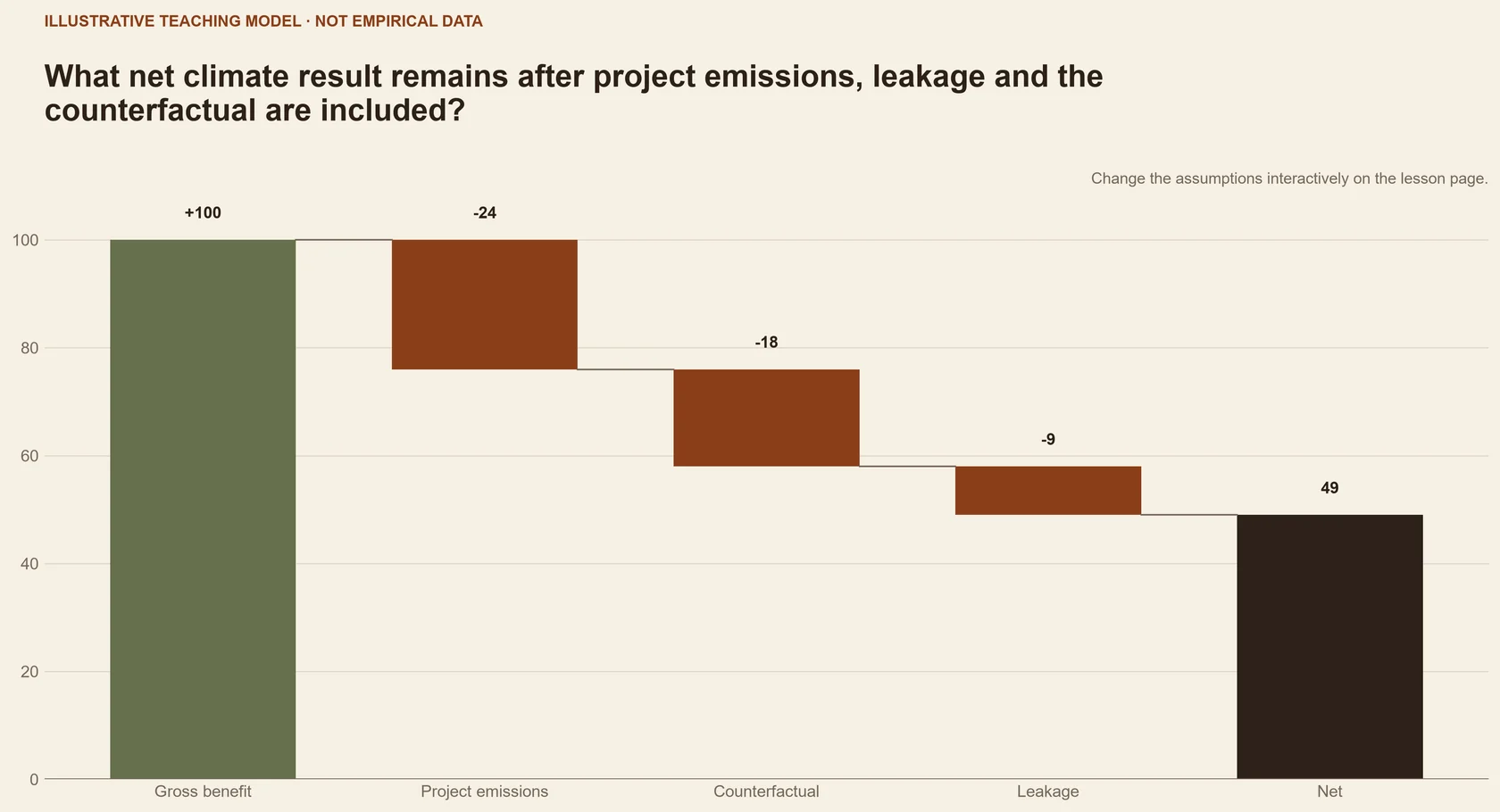
Explore · boundary counterfactual builder
Construct a transparent carbon claim from boundary, baseline, flows and time.
Choose one option in each ledger row; incomplete rows keep the claim provisional.
Choose one option in each ledger row; incomplete rows keep the claim provisional.
Worked example
A residue converted to a durable product
The project stores some biogenic carbon in a product and uses energy while displacing another material.
- 01
Close the physical carbon balance including process losses and end-of-life.
- 02
Define the residue’s baseline fate and the displaced product.
- 03
Assign each avoided emission or stored-carbon claim once and record duration.
Stored carbon, avoided production and process emissions are distinct ledger entries, not one combined headline.
Case file
Novel carbon-negative methane production via integrating anaerobic digestion and pyrolysis of organic fraction of municipal solid waste
- Why it is here
- Waste-to-energy claims depend strongly on the avoided waste fate.
- What to inspect
- Inspect the baseline waste treatment and treatment of recovered energy.
- Limitation
- A counterfactual appropriate to one jurisdiction may be inappropriate elsewhere.
Core references
- International Organization for Standardization (2006). ISO 14040:2006 Environmental management — Life cycle assessment — Principles and framework.Open source ↗
- Leinonen (2022). A general framework for including biogenic carbon emissions and removals in the life cycle assessments for forestry products.https://doi.org/10.1007/s11367-022-02086-1 ↗
Further reading +2
- Intergovernmental Panel on Climate Change (2022). Climate Change 2022: Mitigation of Climate Change — Chapter 6, Energy Systems.Open source ↗
- Garcia et al. (2020). Accounting for biogenic carbon and end-of-life allocation in life cycle assessment of multi-output wood cascade systems.https://doi.org/10.1016/j.jclepro.2020.122795 ↗
Knowledge check
Key takeaway
A carbon number is inseparable from its boundary, baseline, time horizon and claim rules.
Biogenic carbon emissions and storage can be treated as automatically neutral without timing or baseline analysis.
Physical flow ledger, baseline, boundary, time profile, allocation, substitution and claim ownership.