Before you begin
Technical → sustainable → economic → deployable potential →The question
Where is the missing link in a bioeconomy claim?
Learning objectives
- 01Trace a pathway through all four modules.
- 02Separate system questions from the methods used to answer them.
- 03Locate missing links before evaluating a headline claim.
Core explanation
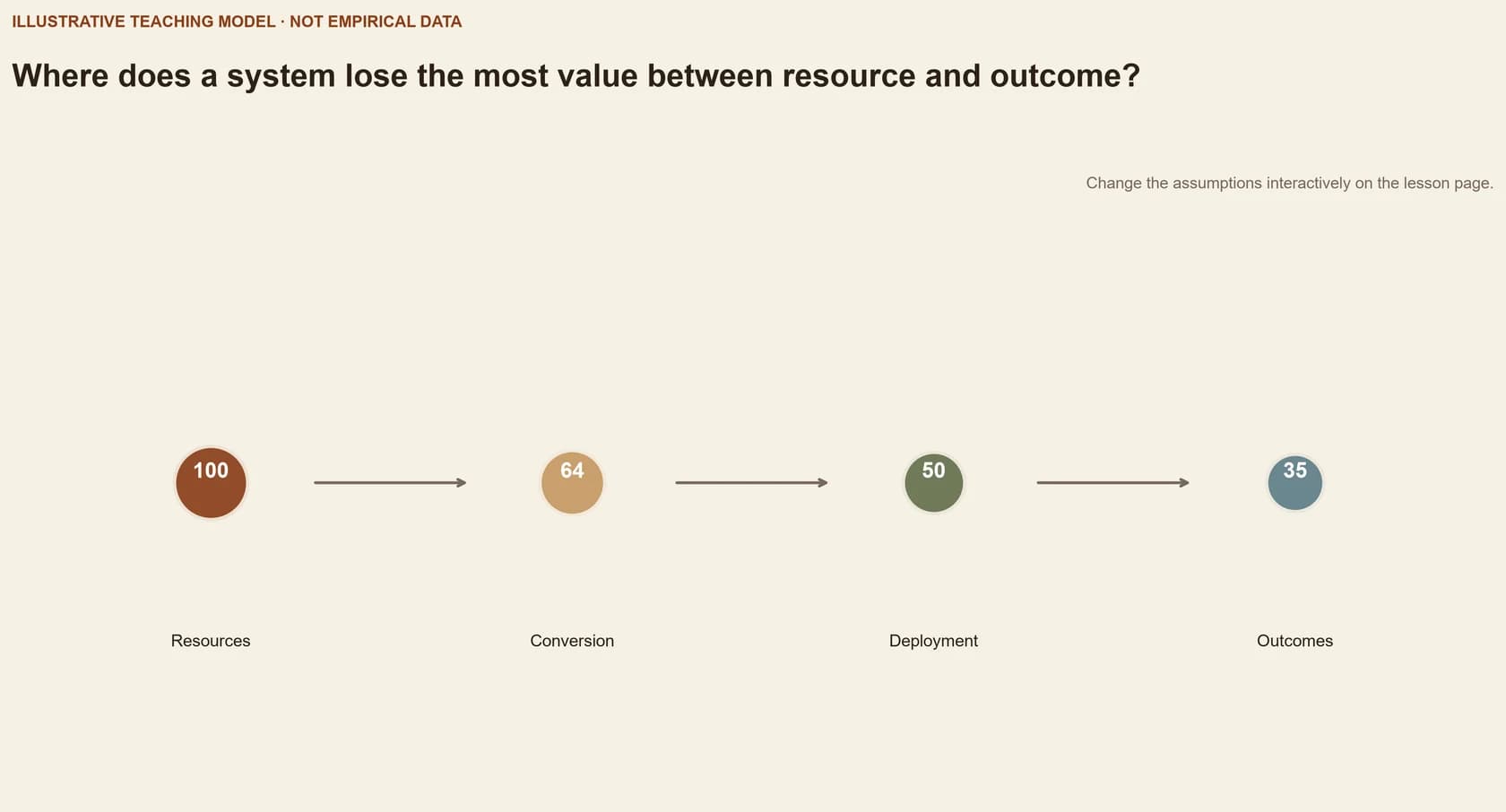
Resources asks what primary and secondary materials exist, their quality, location, timing, current uses and sustainability limits. Conversion asks which physical, chemical or biological processes turn those materials into products and at what mass, energy and carbon efficiency. Neither answer yet determines whether the pathway can operate at system scale.
Deployment asks where facilities sit, how resources move, which users compete, what scale and infrastructure are feasible, and how decisions behave under market, institutional and community constraints. Outcomes then tests climate, environmental, economic and resource-efficiency consequences against a clearly defined alternative.
Methods & Tools is a horizontal layer. GIS can connect resource and deployment geography; process simulation connects conversion to balances; LCA and TEA connect design choices to outcomes; optimization can compare allocations. A method should be chosen because it answers a specified question—not because it is fashionable or available.
Key concepts
Pathway
A connected chain from resource origin through processing and use to consequences.
Decision point
A place where one actor must choose among feasible alternatives.
Flow
Material, energy, carbon, money or information moving through the system.
Cross-cutting method
An analytical approach that can inform more than one module.
Visual explanation
Explore · missing link detective
Diagnose claims by checking all four system stages and their interfaces.
Follow the evidence questions; the guide will identify the first unsupported link.
Is realistic resource availability shown?
Worked example
From plastic waste to aviation fuel
A laboratory reports a promising conversion from plastic waste to jet-range molecules.
- 01
Resources: specify polymer mix, contamination, collection and current recycling or disposal.
- 02
Conversion and deployment: close balances, hydrogen demand, upgrading, scale, logistics and certification.
- 03
Outcomes: compare life-cycle emissions, costs and material alternatives with a defined baseline.
The molecular result is one necessary link; the system claim requires the other links to be tested.
Case file
Ambient-pressure conversion of plastic waste to jet fuel cycloalkanes by tandem hydropyrolysis and vapour-phase hydrogenation
- Why it is here
- This public study is useful for tracing a waste-to-fuel claim across the whole chain.
- What to inspect
- Inspect where conversion performance meets system-level carbon and deployment assumptions.
- Limitation
- One published pathway does not establish universal performance across wastes or regions.
Core references
- Intergovernmental Panel on Climate Change (2022). Climate Change 2022: Mitigation of Climate Change — Chapter 6, Energy Systems.Open source ↗
- U.S. Department of Energy (2024). Feedstock-Conversion Interface Consortium: Crosscutting Analysis Research.Open source ↗
Further reading +1
- International Organization for Standardization (2006). ISO 14040:2006 Environmental management — Life cycle assessment — Principles and framework.Open source ↗
Knowledge check
Key takeaway
A complete bioeconomy explanation connects what exists, what can be made, what can be deployed and what changes as a result.
A strong result in one module is enough to establish whole-system value.
At least one explicit question, boundary and evidence chain for each module, plus the chosen counterfactual.