Before you begin
Conversion pathways, mass and energy balances →The question
Which operating regime produces the function you need?
Learning objectives
- 01Distinguish pyrolysis from gasification by reaction environment and products.
- 02Connect operating conditions to product distribution and upgrading needs.
- 03Identify scale-up issues beyond peak laboratory yield.
Core explanation
Pyrolysis heats organic material with little or no oxygen, producing char, condensable vapours and permanent gases. The distribution depends on feedstock, temperature, heating rate, vapour residence, pressure, reactor type and catalysts. ‘Bio-oil’, ‘char’ and ‘gas’ are families whose composition and quality vary widely.
Gasification uses controlled oxidants such as air, oxygen, steam or carbon dioxide to convert much of the feed into a combustible or synthesis gas. Gas composition, tar, particulates, ash behavior and cleaning determine downstream feasibility. Supplying oxygen, steam, heat and gas cleanup can dominate the plant beyond the reactor.
Scale-up requires heat and mass transfer, continuous feeding, residence-time distribution, material compatibility, emissions control and stable product specifications. The appropriate route depends on desired products and system integration; neither pyrolysis nor gasification is inherently superior.
Key concepts
Pyrolysis
Thermal decomposition with little or no oxygen.
Gasification
Partial oxidation that converts carbonaceous feedstocks mainly into gas.
Syngas
A gas mixture rich in carbon monoxide and hydrogen, with composition set by route and cleanup.
Tar
Condensable heavy compounds that can carry value or create severe downstream problems.
Visual explanation
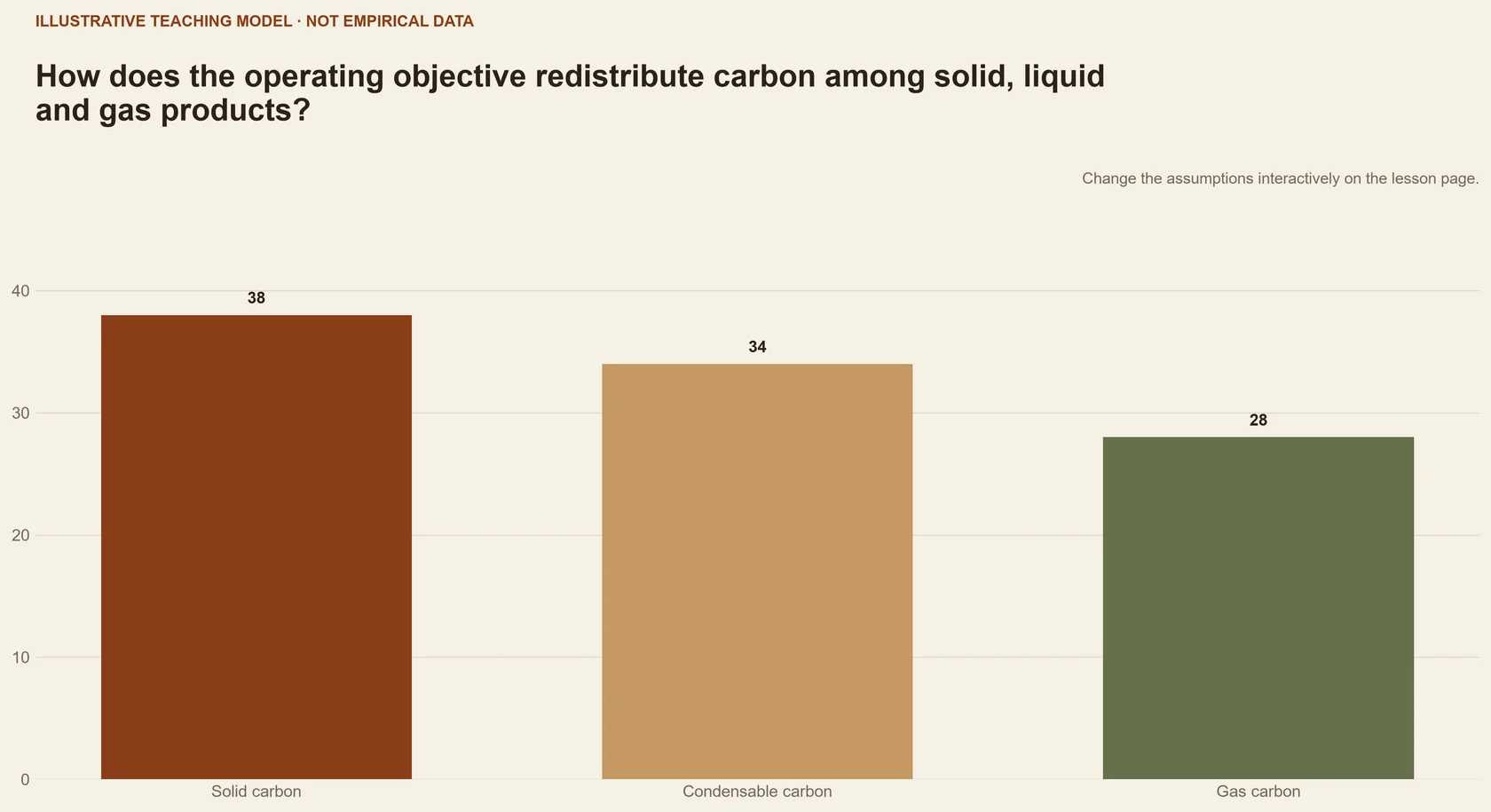
Explore · operating regime map
Compare product emphasis across thermochemical regimes without implying universal yields.
Select a regime and read the coupled changes in residence time, oxygen environment and product emphasis.
Slow pyrolysis
Longer solid residence; often selected when char is a priority.
- Primary lens
- Solid function
- Oxygen
- Limited
Worked example
Choosing between char and syngas emphasis
A dry lignocellulosic residue could enter slow pyrolysis, fast pyrolysis or gasification.
- 01
Define the required product function and specification first.
- 02
Compare full-process balances including drying, heat, oxygen or steam and cleanup.
- 03
Test markets and residual management for every coproduct.
The best reactor yield may not produce the best integrated pathway.
Case file
Synergistic effects in the copyrolysis of municipal sewage sludge digestate and salix: Reaction mechanism, product characterization and char stability
- Why it is here
- This published case links conversion conditions to a char property relevant beyond yield.
- What to inspect
- Inspect how operating conditions and feed mixture relate to stability indicators.
- Limitation
- Stability indicators are material- and method-specific; they are not a universal permanence claim.
Core references
- Sahoo and Remya (2020). Influence of operating parameters on the microwave pyrolysis of rice husk: biochar yield, energy yield, and property of biochar.https://doi.org/10.1007/s13399-020-00914-8 ↗
- Kundu et al. (2024). Obtaining high H2-rich syngas yield and carbon conversion efficiency from biomass gasification: From characterization to process optimization using machine learning with experimental validation.https://doi.org/10.1016/j.fuel.2024.132931 ↗
Further reading +1
- Intergovernmental Panel on Climate Change (2022). Climate Change 2022: Mitigation of Climate Change — Chapter 6, Energy Systems.Open source ↗
Knowledge check
Key takeaway
Operating conditions distribute carbon; downstream specifications decide whether that distribution creates value.
A high product yield at one condition identifies the best scalable thermochemical route.
Feedstock window, continuous balances, product specifications, heat integration, cleanup and long-duration operation.