Before you begin
Carbon accounting, boundaries and counterfactuals →The question
Can two alternatives be compared on the same function and boundary?
Learning objectives
- 01Describe the four core phases of LCA.
- 02Choose a functional unit and boundary that support a comparison.
- 03Interpret multiple impact categories, allocation and uncertainty without claiming a universal winner.
Core explanation
LCA begins with goal and scope: the decision context, audience, functional unit, reference flow, boundary and comparison. The inventory then quantifies inputs and outputs. Impact assessment translates inventory flows into indicators. Interpretation checks completeness, consistency, sensitivity and conclusions. ISO 14040 provides this framework; a database or software run is only part of the work.
The functional unit defines the service being compared, such as one unit of material performance or transport service. Equal mass may not provide equal function. Attributional LCA describes burdens associated with a product system under rules; consequential LCA asks how broader systems change in response to a decision. The choice should match the question.
Climate change is one impact category, not the whole environment. Land, water, eutrophication, acidification, particulate matter, toxicity and resource use may reveal trade-offs. Data quality, spatial and temporal fit, allocation, avoided burdens and uncertainty should be visible in results. Comparative public claims may require critical review.
Key concepts
Functional unit
Quantified performance or service to which inputs and impacts are related.
Life-cycle inventory
Quantified input and output flows for processes inside the boundary.
Impact category
Environmental concern represented by a characterized indicator.
Critical review
Independent check of methods, data, interpretation and consistency for the intended use.
Visual explanation
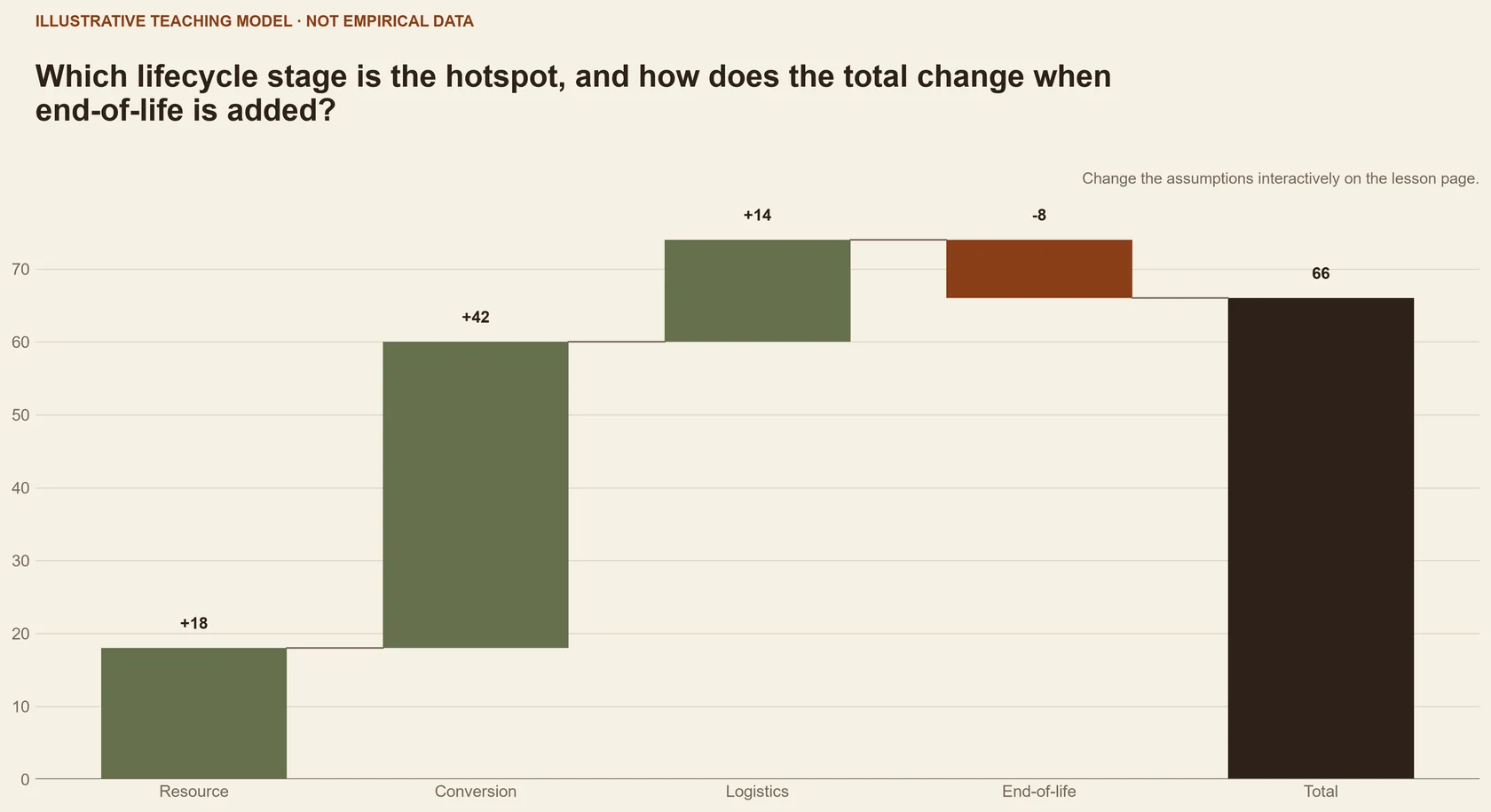
Explore · functional unit boundary challenge
Build a comparable LCA question before choosing data or software.
Complete the functional-unit and boundary ledger; conflicting choices are flagged.
Complete the functional-unit and boundary ledger; conflicting choices are flagged.
Worked example
Comparing two packaging options
One package is lighter; the other is reusable and lasts multiple trips.
- 01
Define the functional unit as delivering a specified product safely over a stated number of trips.
- 02
Include manufacturing, washing, return logistics, losses and end-of-life.
- 03
Test break-even reuse, electricity mix and return-rate sensitivity across impact categories.
A mass-based comparison would miss the service and reuse conditions that determine the result.
Case file
Pyrolysis of engineered beach-cast seaweed: Performances and life cycle assessment
- Why it is here
- This public LCA case makes functional unit, process boundary and wastewater context tangible.
- What to inspect
- Inspect inventory boundary, comparison basis and dominant contributors.
- Limitation
- Results are specific to the studied process configuration and data context.
Tool in context
openLCA
- Use it for this task
- Construct and audit a transparent product system after the question is defined.
- Limitation
- Software does not supply a defensible boundary or dataset license; modelling choices still require documentation and review.
Inputs, outputs & scope
- What it is
- An open-source desktop platform for constructing life-cycle inventories and impact assessments.
- Problem it addresses
- How can a product system, exchanges, allocation and impact methods be assembled and audited?
- Inputs
- Process inventories, flows, databases, functional unit, system model and impact method.
- Outputs
- Inventory results, characterized impacts, contribution analysis and scenario comparisons.
- Typical applications
- Transparent teaching models, product LCA, hotspot analysis and critical-review packages.
Brightway
- Use it for this task
- Use for reproducible, programmable scenario and uncertainty workflows.
- Limitation
- Requires programming and careful database management; computational flexibility can amplify undocumented assumptions.
Inputs, outputs & scope
- What it is
- An open-source Python framework for matrix-based LCA, scenario analysis and advanced computational workflows.
- Problem it addresses
- How can reproducible LCA calculations be automated, parameterized and extended?
- Inputs
- Technosphere and biosphere matrices, demand, characterization methods and scenario parameters.
- Outputs
- LCI/LCIA matrices, contribution tables, uncertainty and parameterized scenario results.
- Typical applications
- Research-grade reproducible LCA, Monte Carlo analysis and coupling with optimization or process models.
Core references
- International Organization for Standardization (2006). ISO 14040:2006 Environmental management — Life cycle assessment — Principles and framework.Open source ↗
- U.S. Environmental Protection Agency (2006). Life Cycle Assessment: Principles and Practice.Open source ↗
- Matuštík, Pohořelý and Kočí (2022). Is application of biochar to soil really carbon negative? The effect of methodological decisions in Life Cycle Assessment.https://doi.org/10.1016/j.scitotenv.2021.151058 ↗
Further reading +2
- GreenDelta (2026). openLCA 2 manual.Open source ↗
- Brightway project (2026). Brightway LCA Software Framework documentation.Open source ↗
Knowledge check
Key takeaway
LCA is a structured comparison of services and consequences; its conclusions are conditional on purpose, boundary, data and method.
An LCA score is an intrinsic environmental property of a product independent of functional unit, geography and scenario.
Goal and scope, functional unit, inventory provenance, impact methods, allocation, uncertainty and interpretation limits.