Before you begin
Biomass, wastes and secondary carbon →The question
Which feedstock property becomes a pathway constraint?
Learning objectives
- 01Connect feedstock properties to pretreatment and pathway choice.
- 02Distinguish average quality from variability and specification risk.
- 03Use a property screen before comparing conversion yields.
Core explanation
Mass alone does not describe a feedstock. Moisture affects drying, transport and biological stability. Ash and minerals influence fouling, catalysis and product purity. Structural carbohydrates, lignin, proteins, lipids and polymer types determine which reactions are plausible. Bulk density and particle form shape storage, handling and reactor feeding.
Variability is a system property. Seasonal changes, suppliers, contamination and upstream management create distributions rather than single values. A process designed around an average may fail during wet, ash-rich or contaminated periods. Specifications, blending, preprocessing and flexible operation are possible responses, each with cost and impact consequences.
Conversion fit should be expressed as a property window and uncertainty range. This makes mismatches visible early and prevents a high laboratory yield on a selected sample from being generalized to the full territorial resource base.
Key concepts
Moisture content
Water fraction that affects useful mass, energy demand, storage and conversion behavior.
Ash
Inorganic residue that can contain useful minerals or create operational and quality problems.
Specification
An acceptable property range for purchasing, handling or processing.
Feedstock variability
Change in composition or physical properties across time, space and suppliers.
Visual explanation
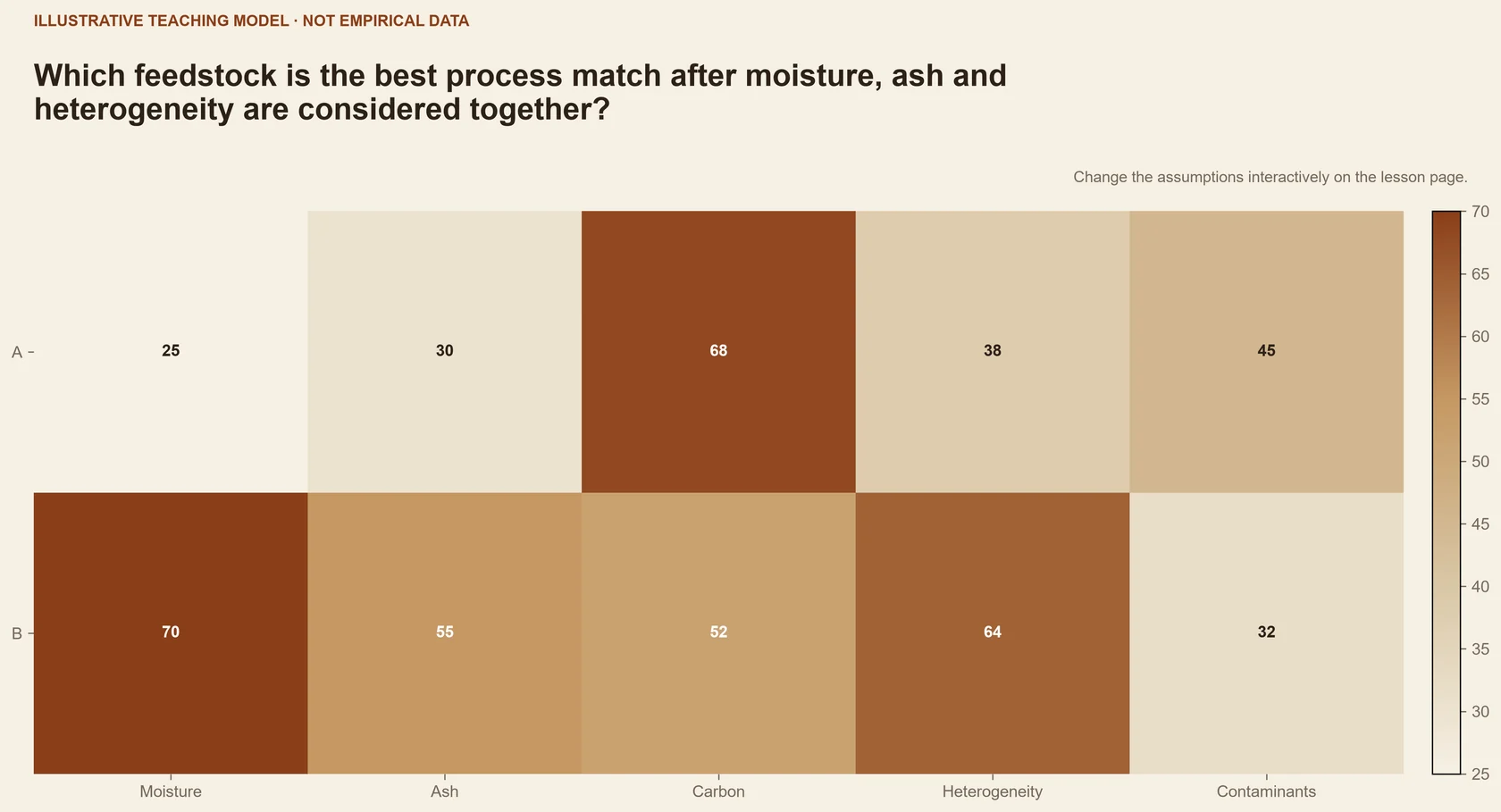
Explore · feedstock pathway matrix
Match feedstock properties to conversion requirements before choosing a technology.
Place each property beside the pathway it most directly changes, then reveal cross-effects.
Moisture
Changes drying duty, storage risk and usable energy.
Worked example
Wet digestate versus dry forestry residue
Both are labelled biomass, but their water, ash, structure and logistics differ.
- 01
List the property window required by biological and thermochemical options.
- 02
Add conditioning steps and their mass-energy consequences.
- 03
Compare delivered usable solids, not wet tonnes alone.
A lower-cost wet tonne may become the more expensive or less suitable usable feedstock after conditioning.
Case file
Van Krevelen diagrams based on machine learning visualize feedstock-product relationships in thermal conversion processes
- Why it is here
- The public paper connects measurable biomass properties with product-relevant carbon behaviour.
- What to inspect
- Inspect which descriptors carry chemical meaning, not only predictive power.
- Limitation
- A dataset-derived map is limited by the represented feedstocks and measurements.
Core references
- U.S. Department of Energy (2024). Feedstock-Conversion Interface Consortium: Crosscutting Analysis Research.Open source ↗
- U.S. Department of Energy (2024). 2023 Billion-Ton Report: An Assessment of U.S. Renewable Carbon Resources.https://doi.org/10.23720/BT2023/2316165 ↗
Further reading +1
- Zhu, Li and Wang (2019). Machine learning prediction of biochar yield and carbon contents in biochar based on biomass characteristics and pyrolysis conditions.https://doi.org/10.1016/j.biortech.2019.121527 ↗
Knowledge check
Key takeaway
Feedstock names describe origin; property distributions determine engineering fit.
A conversion yield measured on one prepared sample applies to the whole resource category.
Sampling plan, property distributions, specifications, preprocessing burdens and off-spec behavior.