MODULE 01

Resource Supply & Secondary Feedstocks

What carbon and material resources are actually available?

Move from resource inventories to constrained, spatial and seasonal supply. Biomass is one resource family; wastes, secondary carbon and industrial by-products are first-class parts of the system.

Open lesson
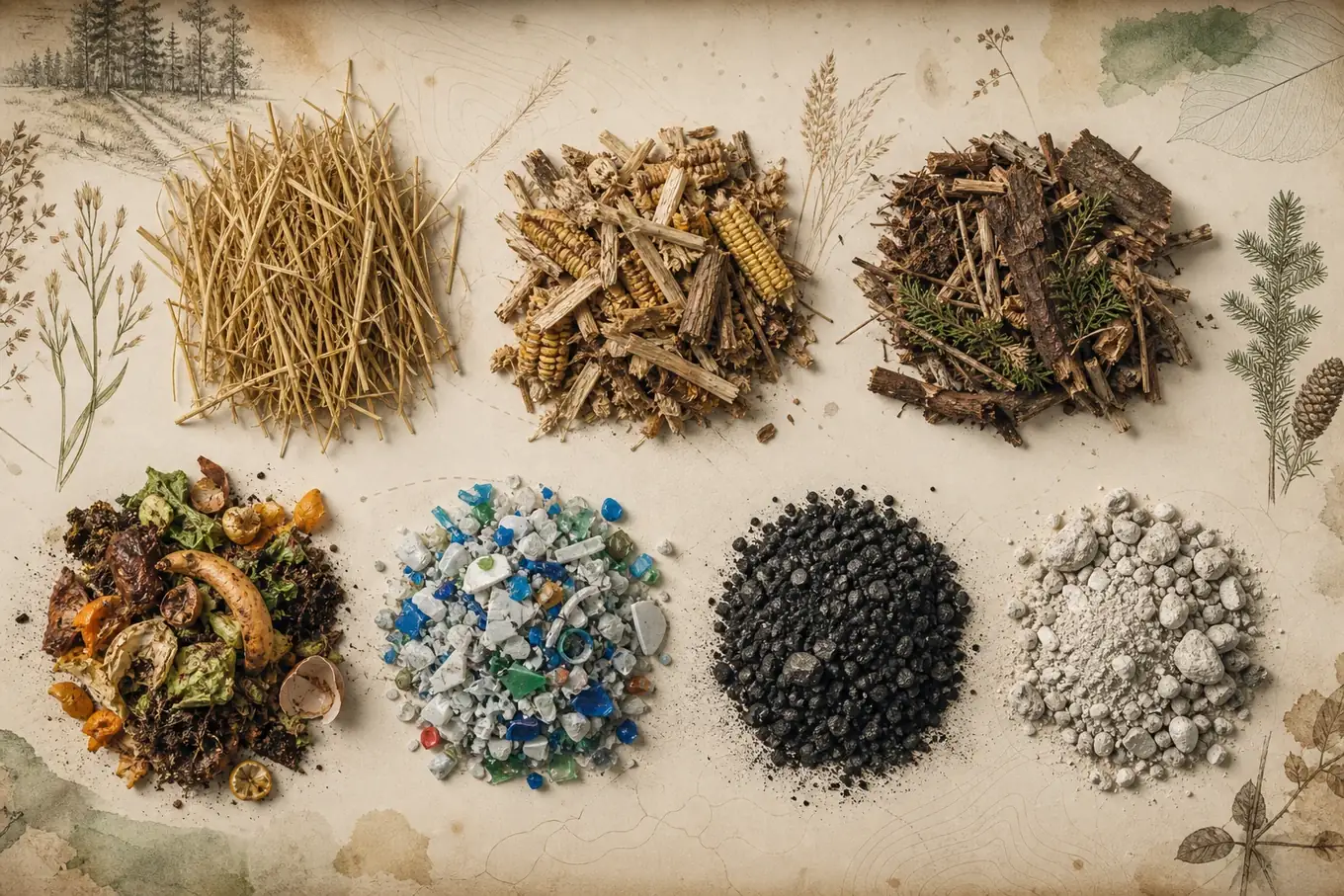
Specimen-table taxonomy of straw, crop and forest residues, organic waste, post-use plastic, industrial carbonaceous material and mineral residue.MODULE 01
01

Resource families

  • Biomass and residues
  • Organic and plastic wastes
  • Industrial, secondary and alkaline materials
02

Availability

  • Spatial and seasonal supply
  • Technical to deployable potential
  • Soil, land and nutrient constraints

CURRICULUM

6 lessons

165 min

CONNECTED ROUTES

Learning paths

Bioeconomy 101

A guided first journey through the vocabulary, constraints and full system logic of the bioeconomy.

Territorial Bioeconomy

Design bioeconomy systems around place: spatial supply, networks, competing uses, infrastructure, institutions and outcomes.

Carbon Removal from Biomass

Evaluate biomass-based carbon removal from resource constraints and conversion yields to durability, additionality and system outcomes.

Plastic Waste to Renewable Carbon

Follow plastic wastes through classification, selective conversion, circular carbon choices, deployment constraints and life-cycle outcomes.

Sustainable Fuels & SAF

Compare sustainable aviation fuel pathways across feedstocks, process trains, logistics, carbon intensity, cost and scale-up.

EVIDENCE LIBRARY

Research, models & tools

A curated starting shelf for this teaching area.

TOOLS

Related tools

ORNL / U.S. DOE

BioenergyKDF

A discovery portal for U.S. biomass resource data, analyses and bioenergy tools.

Use it when
Where can analysts find documented resource and pathway data?
Limits
Datasets differ in date, resolution and assumptions and must be reconciled before use.
Inputs, outputs & scope
Inputs
Search terms, geography, resource classes and analysis needs.
Outputs
Datasets, metadata, reports and links to analysis tools.
Typical applications
Resource assessments, supply curves, scenario framing and provenance discovery.
USDA NRCS / Colorado State University

COMET-Farm

A web tool for estimating farm-scale greenhouse-gas emissions and soil-carbon changes under management scenarios.

Use it when
How might a farm's current and alternative practices differ in GHG emissions and carbon sequestration?
Limits
Screening estimates depend on user inputs and model applicability; they do not replace project-specific measurement and verification.
Inputs, outputs & scope
Inputs
Location, soils, crops, livestock, energy use and detailed management histories or scenarios.
Outputs
Comparative farm GHG estimates and soil-carbon changes by scenario.
Typical applications
Management screening, farm carbon planning and contextualizing residue or soil-carbon decisions.
Colorado State University

DayCent

A daily time-step ecosystem model for carbon and nitrogen flows among soil, vegetation and atmosphere.

Use it when
How do management and environmental conditions affect soil carbon and greenhouse-gas fluxes?
Limits
Parameterization and validation determine credibility; model structure cannot replace field evidence.
Inputs, outputs & scope
Inputs
Climate, soil properties, vegetation, land use and management schedules.
Outputs
Carbon and nitrogen pools, productivity, water states and trace-gas fluxes.
Typical applications
Soil-carbon baselines, residue-removal scenarios and agricultural GHG accounting.
CASE STUDIES

Examples from Wang Group

2023Conversion

Mixed plastics wastes upcycling with high-stability single-atom Ru catalyst

A conversion case for discussing mixed-plastic heterogeneity, catalyst stability and why selectivity must be read with feedstock composition.

2023Resources

Van Krevelen diagrams based on machine learning visualize feedstock-product relationships in thermal conversion processes

Shows how machine learning and Van Krevelen space can make feedstock–product relationships legible without turning the model into the research question itself.

2025Deployment

Assessing the Techno-Economic Feasibility of Bamboo Residue-Derived Hard Carbon

Connects regional bamboo-residue supply, process assumptions and discounted cash flow to a deployability question for hard carbon.

REFERENCES

References & further reading

  1. Food and Agriculture Organization of the United Nations (2026). Sustainable and circular bioeconomy: glossary and key terms.Open source
  2. U.S. Department of Energy (2024). 2023 Billion-Ton Report: An Assessment of U.S. Renewable Carbon Resources.https://doi.org/10.23720/BT2023/2316165
  3. European Commission (2018). Guidance on cascading use of biomass with selected good practice examples on woody biomass.https://doi.org/10.2873/68553
  4. U.S. Department of Energy (2024). Feedstock-Conversion Interface Consortium: Crosscutting Analysis Research.Open source
  5. Zhu, Li and Wang (2019). Machine learning prediction of biochar yield and carbon contents in biochar based on biomass characteristics and pyrolysis conditions.https://doi.org/10.1016/j.biortech.2019.121527
  6. Noon and Daly (1996). GIS-based biomass resource assessment with BRAVO.https://doi.org/10.1016/0961-9534(95)00065-8
  7. Welfle, Gilbert and Thornley (2014). Increasing biomass resource availability through supply chain analysis.https://doi.org/10.1016/j.biombioe.2014.08.001
  8. Oak Ridge National Laboratory / U.S. Department of Energy (2026). Bioenergy Knowledge Discovery Framework.Open source
  9. Stetson et al. (2012). Corn Residue Removal Impact on Topsoil Organic Carbon in a Corn-Soybean Rotation.https://doi.org/10.2136/sssaj2011.0420
  10. Guzman and Al-Kaisi (2014). Residue Removal and Management Practices Effects on Soil Environment and Carbon Budget.https://doi.org/10.2136/sssaj2013.10.0426
  11. Barrios Latorre et al. (2024). Exploring the benefits of intermediate crops: Is it possible to offset soil organic carbon losses caused by crop residue removal?.https://doi.org/10.1016/j.agsy.2024.103873
  12. Hakala et al. (2016). Field trial results of straw yield with different harvesting methods, and modelled effects on soil organic carbon.https://doi.org/10.1016/j.biombioe.2016.08.021
  13. Natural Resource Ecology Laboratory, Colorado State University (2026). DayCent Model.Open source
  14. Natural Resource Ecology Laboratory, Colorado State University (2026). CENTURY Model.Open source
  15. Zedong Zhang, Jia Wang, Xiaohu Ge, Shule Wang, Ang Li, Runze Li, Ji Shen, Xiao Liang, Tao Gan, Xiaodong Han, Xusheng Zheng, Xuezhi Duan, Dingsheng Wang, Jianchun Jiang, Yadong Li (2023). Mixed plastics wastes upcycling with high-stability single-atom Ru catalyst.https://doi.org/10.1021/jacs.3c09338
  16. Shule Wang, Yiying Wang, Ziyi Shi, Kang Sun, Yuming Wen, Lukasz Niedzwiecki, Ruming Pan, Yongdong Xu, Ilman Nuran Zaini, Katarzyna Jagodzińska, Christian Aragon-Briceno, Chuchu Tang, Thossaporn Onsree, Nakorn Tippayawong, Halina Pawlak-Kruczek, Pär Göran Jönsson, Weihong Yang, Jianchun Jiang, Sibudjing Kawi, Chi-Hwa Wang (2023). Van Krevelen diagrams based on machine learning visualize feedstock-product relationships in thermal conversion processes.https://doi.org/10.1038/s42004-023-01077-z
  17. Senqiang Qin, Chenghao Yu, Yanghao Jin, Gaoyue Zhang, Wei Xu, Ao Wang, Mengmeng Fan, Kang Sun, Shule Wang (2025). Assessing the Techno-Economic Feasibility of Bamboo Residue-Derived Hard Carbon.https://doi.org/10.3390/app15137113