The question
Is a soil-carbon change a stock, a flux, or an avoided emission?
Learning objectives
- 01Separate soil-carbon stock change from annual greenhouse-gas fluxes.
- 02Identify baseline, depth, duration and management controls in soil comparisons.
- 03Use measurements and models as complementary evidence.
Core explanation
Soil organic carbon is a stock shaped by plant inputs, organic amendments, roots, erosion, decomposition and movement through the profile. A stock change requires consistent area, depth, bulk density and equivalent soil mass where appropriate. Short-term concentration changes or surface-only samples may not represent whole-profile storage.
Greenhouse-gas mitigation includes carbon dioxide, nitrous oxide and methane effects as well as upstream inputs and yield responses. A practice that raises soil carbon can also change fertilizer needs, N₂O, fuel, water or productivity. Climate benefit is the net difference from a management baseline over a stated horizon.
Field measurements provide local stocks and fluxes but are limited in duration and coverage. Models such as DayCent and CENTURY can integrate processes and explore scenarios, but require calibration, validation and uncertainty analysis. Triangulation across measurements, models and management records is stronger than either alone.
Key concepts
Stock
Quantity held in a pool at a specified time and boundary.
Flux
Rate of transfer into, out of or between pools.
Equivalent soil mass
Comparison basis controlling for changes in soil mass within sampled depths.
Nitrous oxide
A potent greenhouse gas linked to nitrogen cycling and management.
Visual explanation
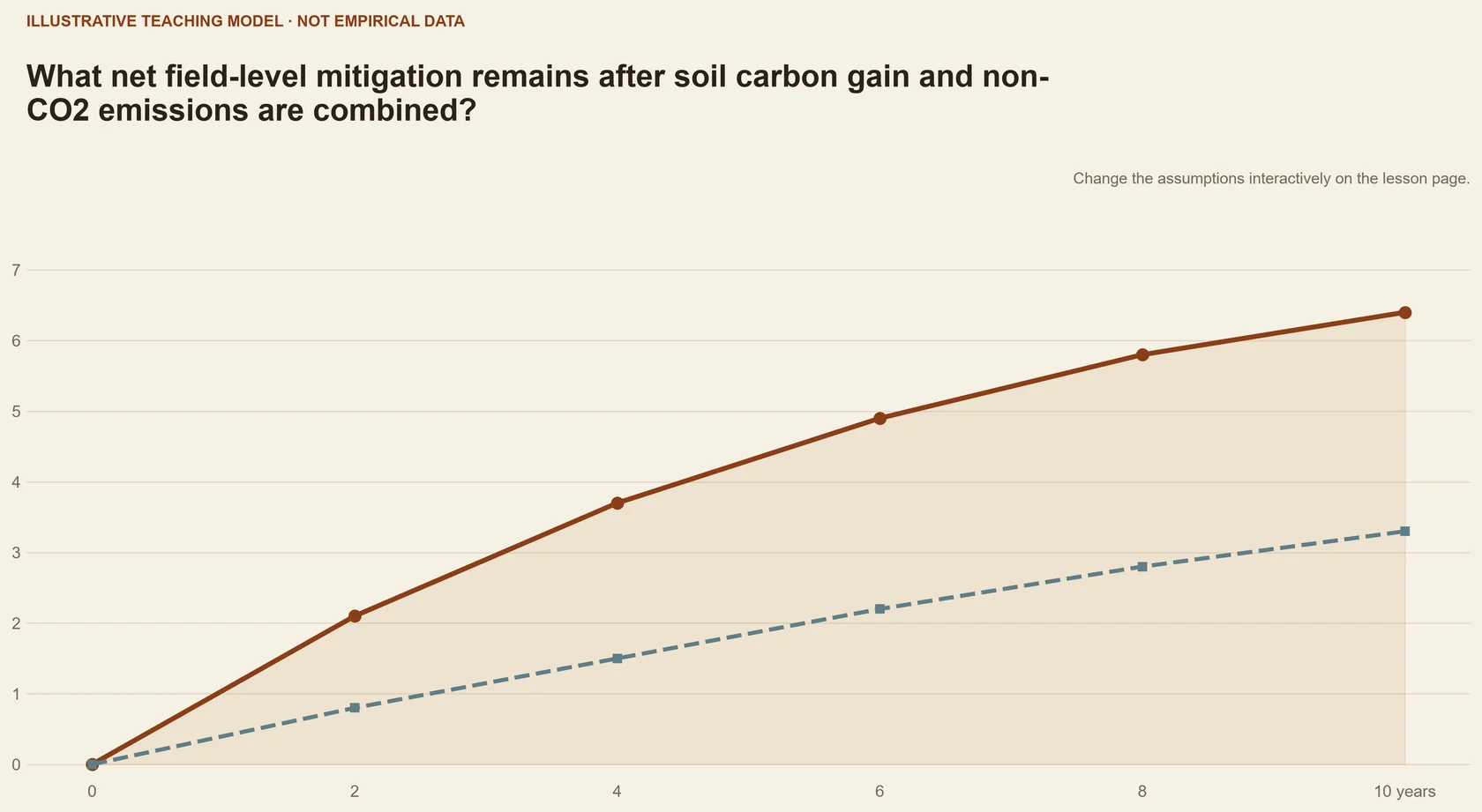
Explore · stock flux timeline
Separate carbon stocks from annual fluxes, baselines and saturation over time.
Compare management timelines and inspect why an early annual rate cannot be extrapolated indefinitely.
iIllustrative learning model — values are not scientific results or forecasts.
Existing practice
The baseline stock can rise, fall or remain stable; it must be measured or modelled.
- Claim
- Reference only
- Evidence
- History needed
Worked example
Residue retention versus removal
Two management scenarios differ in residue removal, fertilizer replacement and soil carbon response.
- 01
Define the same field, depth, time horizon and baseline management.
- 02
Track soil stock change, N₂O, fuel, replacement nutrients and biomass product effects.
- 03
Report a scenario range using measurements and a calibrated model.
The residue pathway’s climate result includes the soil debit or benefit, not only the conversion product.
Case file
DAYCENT model analysis of past and contemporary soil NO and net greenhouse gas flux for major crops in the USA
- Why it is here
- The paper demonstrates how a process model distinguishes soil pools and gas fluxes.
- What to inspect
- Inspect calibration context, flux definitions and comparison period.
- Limitation
- Model results remain conditional on parameterization, observations and model scope.
Tool in context
COMET-Farm
- Use it for this task
- Compare farm-management scenarios as a screening exercise.
- Limitation
- Screening estimates depend on user inputs and model applicability; they do not replace project-specific measurement and verification.
Inputs, outputs & scope
- What it is
- A web tool for estimating farm-scale greenhouse-gas emissions and soil-carbon changes under management scenarios.
- Problem it addresses
- How might a farm's current and alternative practices differ in GHG emissions and carbon sequestration?
- Inputs
- Location, soils, crops, livestock, energy use and detailed management histories or scenarios.
- Outputs
- Comparative farm GHG estimates and soil-carbon changes by scenario.
- Typical applications
- Management screening, farm carbon planning and contextualizing residue or soil-carbon decisions.
DayCent
- Use it for this task
- Use for calibrated daily carbon–nitrogen dynamics and long-term scenarios.
- Limitation
- Parameterization and validation determine credibility; model structure cannot replace field evidence.
Inputs, outputs & scope
- What it is
- A daily time-step ecosystem model for carbon and nitrogen flows among soil, vegetation and atmosphere.
- Problem it addresses
- How do management and environmental conditions affect soil carbon and greenhouse-gas fluxes?
- Inputs
- Climate, soil properties, vegetation, land use and management schedules.
- Outputs
- Carbon and nitrogen pools, productivity, water states and trace-gas fluxes.
- Typical applications
- Soil-carbon baselines, residue-removal scenarios and agricultural GHG accounting.
Core references
- DelGrosso et al. (2005). DAYCENT model analysis of past and contemporary soil NO and net greenhouse gas flux for major crops in the USA.https://doi.org/10.1016/j.still.2005.02.007 ↗
- Del Grosso et al. (2002). Simulated effects of dryland cropping intensification on soil organic matter and greenhouse gas exchanges using the DAYCENT ecosystem model.https://doi.org/10.1016/S0269-7491(01)00260-3 ↗
Further reading +5
- Natural Resource Ecology Laboratory, Colorado State University (2026). DayCent Model.Open source ↗
- Natural Resource Ecology Laboratory, Colorado State University (2026). CENTURY Model.Open source ↗
- Jones et al. (2003). The DSSAT cropping system model.https://doi.org/10.1016/S1161-0301(02)00107-7 ↗
- USDA NRCS and Colorado State University (2026). COMET-Farm.Open source ↗
- Stetson et al. (2012). Corn Residue Removal Impact on Topsoil Organic Carbon in a Corn-Soybean Rotation.https://doi.org/10.2136/sssaj2011.0420 ↗
Knowledge check
Key takeaway
Soil carbon is a measured and modeled stock-change question embedded in a broader greenhouse-gas and management system.
More carbon-rich material applied to soil guarantees an equal and permanent increase in soil carbon stock.
Baseline, sampling depth and mass, duration, stock and flux measurements, management records, model calibration and uncertainty.