MODULE 03

Deployment & Resource Allocation

What can move from a promising process to a functioning territorial system?

Connect laboratories to territories through logistics, siting, infrastructure, competition, optimization, markets and institutions. Optimal is not automatically deployable.

Open lesson
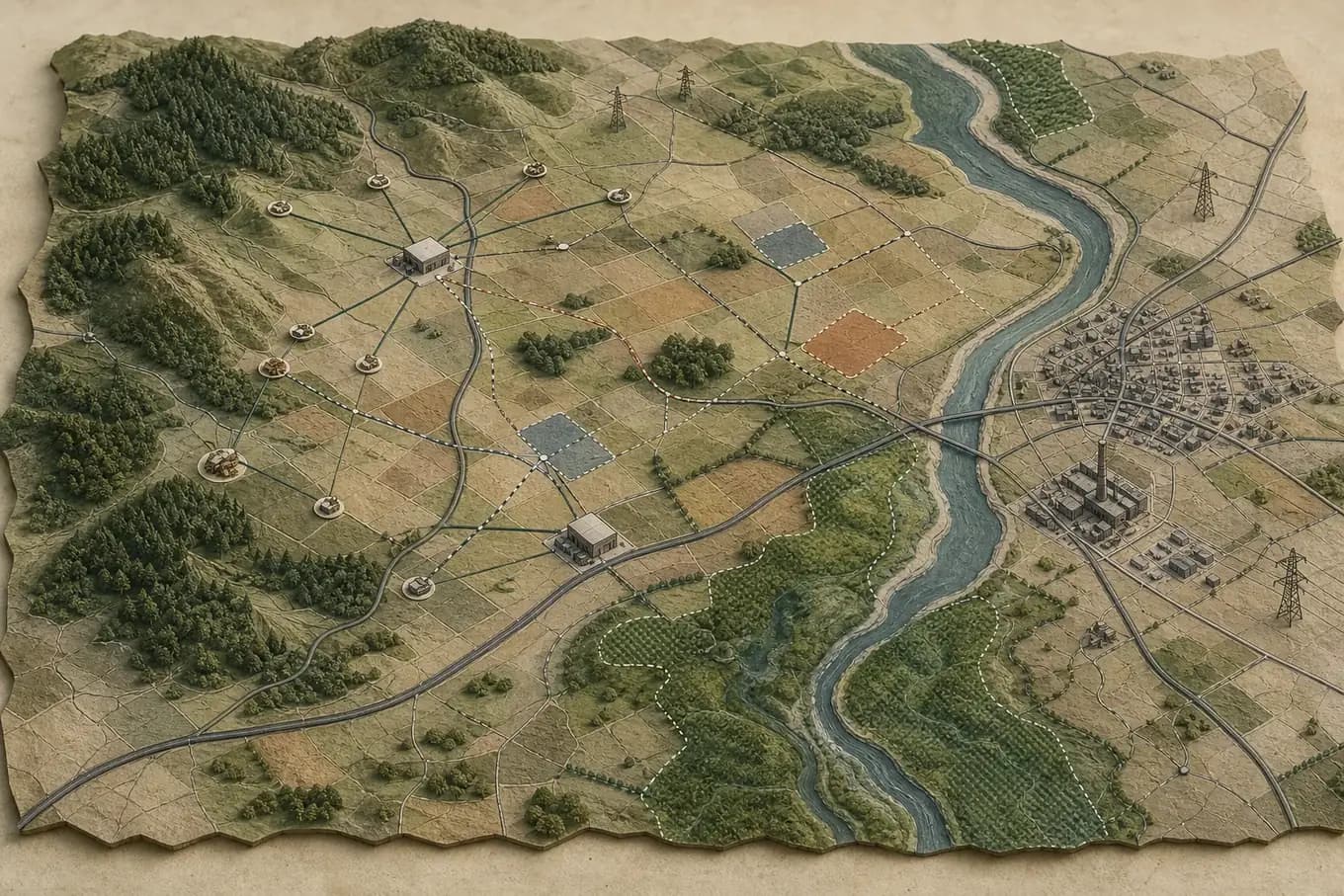
Oblique territorial map with dispersed resources, roads, depots, candidate facilities, river, protected areas, town and grid infrastructure.MODULE 03
01

Networks

  • Supply chains and transport
  • Facility siting and scale
  • Infrastructure and markets
02

Choices under scarcity

  • Allocation and competing uses
  • Cascading use
  • LP, MILP and spatial optimization

CURRICULUM

7 lessons

222 min

CONNECTED ROUTES

Learning paths

Bioeconomy 101

A guided first journey through the vocabulary, constraints and full system logic of the bioeconomy.

Territorial Bioeconomy

Design bioeconomy systems around place: spatial supply, networks, competing uses, infrastructure, institutions and outcomes.

Carbon Removal from Biomass

Evaluate biomass-based carbon removal from resource constraints and conversion yields to durability, additionality and system outcomes.

Plastic Waste to Renewable Carbon

Follow plastic wastes through classification, selective conversion, circular carbon choices, deployment constraints and life-cycle outcomes.

Sustainable Fuels & SAF

Compare sustainable aviation fuel pathways across feedstocks, process trains, logistics, carbon intensity, cost and scale-up.

EVIDENCE LIBRARY

Research, models & tools

A curated starting shelf for this teaching area.

TOOLS

Related tools

LBNL / JBEI

BioSiting

A geospatial platform for exploring U.S. bioeconomy resources, infrastructure and candidate sites.

Use it when
What resources and infrastructure surround a candidate facility location?
Limits
A screening map is not a permit, supply contract or deployability decision.
Inputs, outputs & scope
Inputs
Location, buffer radius, resource layers, infrastructure and pathway choices.
Outputs
Mapped inventories, buffer summaries and downloadable spatial data.
Typical applications
Facility screening, resource context and early TEA/LCA framing.
Pyomo project

Pyomo

An open-source Python environment for formulating and analysing optimization models.

Use it when
How can decisions, objectives and constraints be represented transparently?
Limits
A mathematically optimal result inherits every omission and bias in the model and data.
Inputs, outputs & scope
Inputs
Sets, parameters, variables, objectives, constraints and a compatible solver.
Outputs
Feasible or optimized decisions, objective values and diagnostic information.
Typical applications
LP/MILP allocation, siting, supply chains, scenarios and multi-objective analysis.
U.S. Department of Energy

TECHTEST

A spreadsheet-based early-stage tool combining simplified techno-economic and life-cycle analysis.

Use it when
Which performance factors dominate the potential cost and energy profile of an emerging technology?
Limits
A screening tool does not replace a detailed process design, project finance model or critical review.
Inputs, outputs & scope
Inputs
Technology performance, lifetime, energy and cost assumptions, and a benchmark.
Outputs
Screening-level cost, energy and scenario comparisons.
Typical applications
Early R&D prioritization, benchmark comparison and scenario screening.
CASE STUDIES

Examples from Wang Group

2025Deployment

Assessing the Techno-Economic Feasibility of Bamboo Residue-Derived Hard Carbon

Connects regional bamboo-residue supply, process assumptions and discounted cash flow to a deployability question for hard carbon.

2026Conversion

Ambient-pressure conversion of plastic waste to jet fuel cycloalkanes by tandem hydropyrolysis and vapour-phase hydrogenation

A plastic-to-jet-fuel conversion case for separating molecular feasibility from feedstock supply, hydrogen, certification and deployment questions.

REFERENCES

References & further reading

  1. Hamid Ghaderi, Mir Saman Pishvaee and Alireza Moini (2017). Biomass supply chain network design: An optimization-oriented review and analysis.https://doi.org/10.1016/j.indcrop.2016.09.027
  2. Welfle, Gilbert and Thornley (2014). Increasing biomass resource availability through supply chain analysis.https://doi.org/10.1016/j.biombioe.2014.08.001
  3. Gital Durmaz and Bilgen (2020). Multi-objective optimization of sustainable biomass supply chain network design.https://doi.org/10.1016/j.apenergy.2020.115259
  4. Noon and Daly (1996). GIS-based biomass resource assessment with BRAVO.https://doi.org/10.1016/0961-9534(95)00065-8
  5. Lawrence Berkeley National Laboratory / Joint BioEnergy Institute (2024). BioSiting Tool v2.Open source
  6. QGIS / OSGeo (2026). QGIS Documentation.Open source
  7. European Commission (2018). Guidance on cascading use of biomass with selected good practice examples on woody biomass.https://doi.org/10.2873/68553
  8. Keegan, Kretschmer, Elbersen and Panoutsou (2013). Cascading use: a systematic approach to biomass beyond the energy sector.https://doi.org/10.1002/bbb.1351
  9. Garcia et al. (2020). Accounting for biogenic carbon and end-of-life allocation in life cycle assessment of multi-output wood cascade systems.https://doi.org/10.1016/j.jclepro.2020.122795
  10. Hart, Watson and Woodruff (2011). Pyomo: modeling and solving mathematical programs in Python.https://doi.org/10.1007/s12532-011-0026-8
  11. Pyomo project (2026). Pyomo optimization modeling documentation.Open source
  12. Jarosch et al. (2020). A Regional Socio-Economic Life Cycle Assessment of a Bioeconomy Value Chain.https://doi.org/10.3390/su12031259
  13. Eason and Cremaschi (2014). A multi-objective superstructure optimization approach to biofeedstocks-to-biofuels systems design.https://doi.org/10.1016/j.biombioe.2014.02.010
  14. U.S. Department of Energy (2024). Feedstock-Conversion Interface Consortium: Crosscutting Analysis Research.Open source
  15. Senqiang Qin, Chenghao Yu, Yanghao Jin, Gaoyue Zhang, Wei Xu, Ao Wang, Mengmeng Fan, Kang Sun, Shule Wang (2025). Assessing the Techno-Economic Feasibility of Bamboo Residue-Derived Hard Carbon.https://doi.org/10.3390/app15137113
  16. Jia Wang, Zedong Zhang, Shule Wang, Ya-Fei Jiang, He Zhou, Wenhui Zhong, Yiyun Zhang, Dongxian Li, Wenjun Zhong, Shiyao Li, Daniel Sanchez, Dingsheng Wang, Jun Li, Jianchun Jiang, Yadong Li (2026). Ambient-pressure conversion of plastic waste to jet fuel cycloalkanes by tandem hydropyrolysis and vapour-phase hydrogenation.https://doi.org/10.1038/s41560-026-02078-7