Before you begin
Resource allocation and competing uses →The question
Which sequence preserves resource value for longer?
Learning objectives
- 01Explain cascading as sequential value retention rather than a rigid universal hierarchy.
- 02Identify substitution, quality loss and timing in cascade comparisons.
- 03Represent technology competition for resources, products and infrastructure.
Core explanation
Cascading use keeps biomass or recovered material in successive applications before final energy recovery or disposal, where feasible. The aim is to retain function, structure or material value. Examples can include solid wood before panels, fibres before lower-grade products, or polymer reuse before chemical conversion. But sequence alone does not prove a better outcome.
A defensible cascade specifies product quality, service duration, losses, collection, displaced alternatives and the future ability to recover the material. A high-value use with a tiny market or toxic additives may not dominate a larger lower-value use. Timing matters because delayed emissions, storage duration and future technology change the comparison.
Technologies compete not only for feedstock but for capital, electricity, hydrogen, skilled labor, permitting capacity and product demand. Portfolio analysis can retain multiple technologies where they fit different qualities, locations or time periods. A single winner is not always resilient or implementable.
Key concepts
Cascading use
Sequential use intended to retain material function and value across more than one life.
Substitution
The product or service actually displaced by a new option.
Downcycling
Recovery into a lower-quality use that may limit future cycles.
Technology portfolio
A mix of options chosen for complementary roles, constraints and risk.
Visual explanation
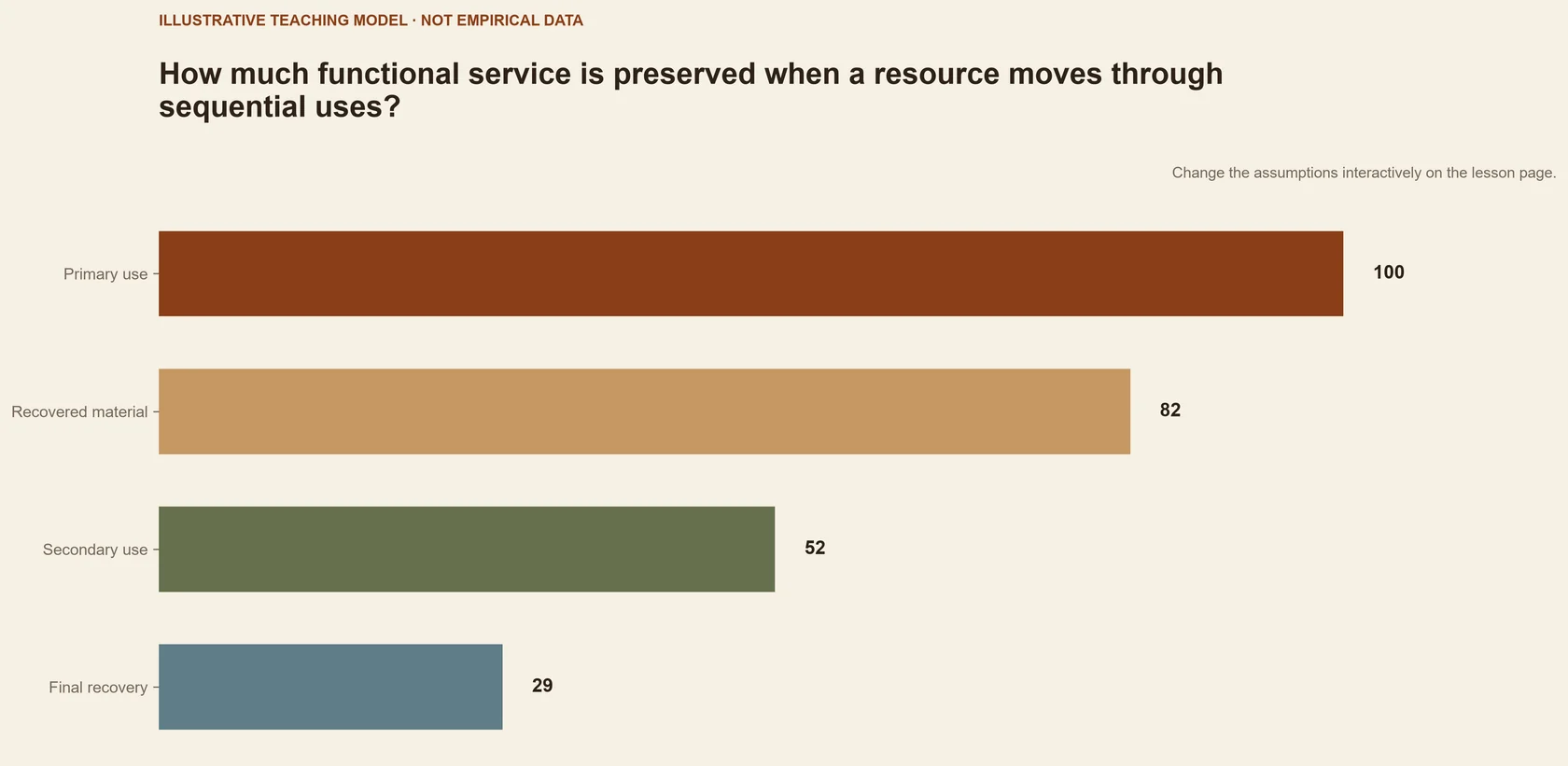
Explore · cascade timeline builder
Compare direct energy use with sequential material-and-energy cascades.
Select a cascade and inspect value retention, quality loss and end-of-life dependencies over time.
Direct energy
One conversion step; useful service is delivered quickly but material function ends.
- Material lives
- 0
- Key question
- Was reuse possible?
Worked example
Three lives for recovered fibre
Recovered fibre could enter a durable panel, short-lived packaging or direct energy recovery.
- 01
Define required quality, market capacity and service life for each use.
- 02
Track losses and whether another recovery step remains possible.
- 03
Compare displaced products and outcomes rather than product price alone.
A cascade is a tested sequence of services, not a label attached to any multi-output process.
Case file
Cascading use: a systematic approach to biomass beyond the energy sector
- Why it is here
- The paper provides a systematic basis for reasoning about cascading beyond a slogan.
- What to inspect
- Inspect the hierarchy criteria and where quality loss constrains another use.
- Limitation
- A preferred hierarchy can change with local markets, collection and outcome evidence.
Core references
- European Commission (2018). Guidance on cascading use of biomass with selected good practice examples on woody biomass.https://doi.org/10.2873/68553 ↗
- Keegan, Kretschmer, Elbersen and Panoutsou (2013). Cascading use: a systematic approach to biomass beyond the energy sector.https://doi.org/10.1002/bbb.1351 ↗
Further reading +1
- Garcia et al. (2020). Accounting for biogenic carbon and end-of-life allocation in life cycle assessment of multi-output wood cascade systems.https://doi.org/10.1016/j.jclepro.2020.122795 ↗
Knowledge check
Key takeaway
Cascading preserves value when quality, substitution, timing and next-life options support the sequence.
Material use must always precede energy use regardless of quality, market, risk or outcome.
Product quality, service life, market size, substitution, losses, recovery options and outcome comparison.