The question
What makes a bioeconomy territorial rather than merely regional?
Learning objectives
- 01Define a territory analytically rather than as an administrative label.
- 02Connect local resource–technology fit to trade, institutions and external effects.
- 03Recognize governance and learning as part of deployment capacity.
Core explanation
A territory is a functional system of resources, ecosystems, infrastructure, firms, workers, institutions and communities. Its boundary may follow a watershed, commuting area, supply shed, market or governance jurisdiction depending on the question. Administrative boundaries are useful datasets but not automatically the correct system boundary.
Territorial fit asks whether local resource qualities align with conversion options, infrastructure, skills, markets and safeguards. It also follows imports and exports: a local facility can shift land pressure, waste, emissions or value outside the mapped boundary. Place-based analysis therefore includes external connections and leakage.
Deployment capacity includes coordination, data sharing, permitting, procurement, finance, workforce, trust and the ability to learn from pilots. A technically similar project can perform differently across territories because these institutional conditions differ. Territorial bioeconomy is therefore a systems and governance practice, not localization for its own sake.
Key concepts
Territory
A place-based functional system whose boundary is selected for a question.
Supply shed
Area functionally connected to a facility or market by resource flows.
Leakage
Impact or activity shifted outside the assessed boundary in response to a decision.
Governance capacity
Institutions and relationships that coordinate evidence, authority, resources and accountability.
Visual explanation
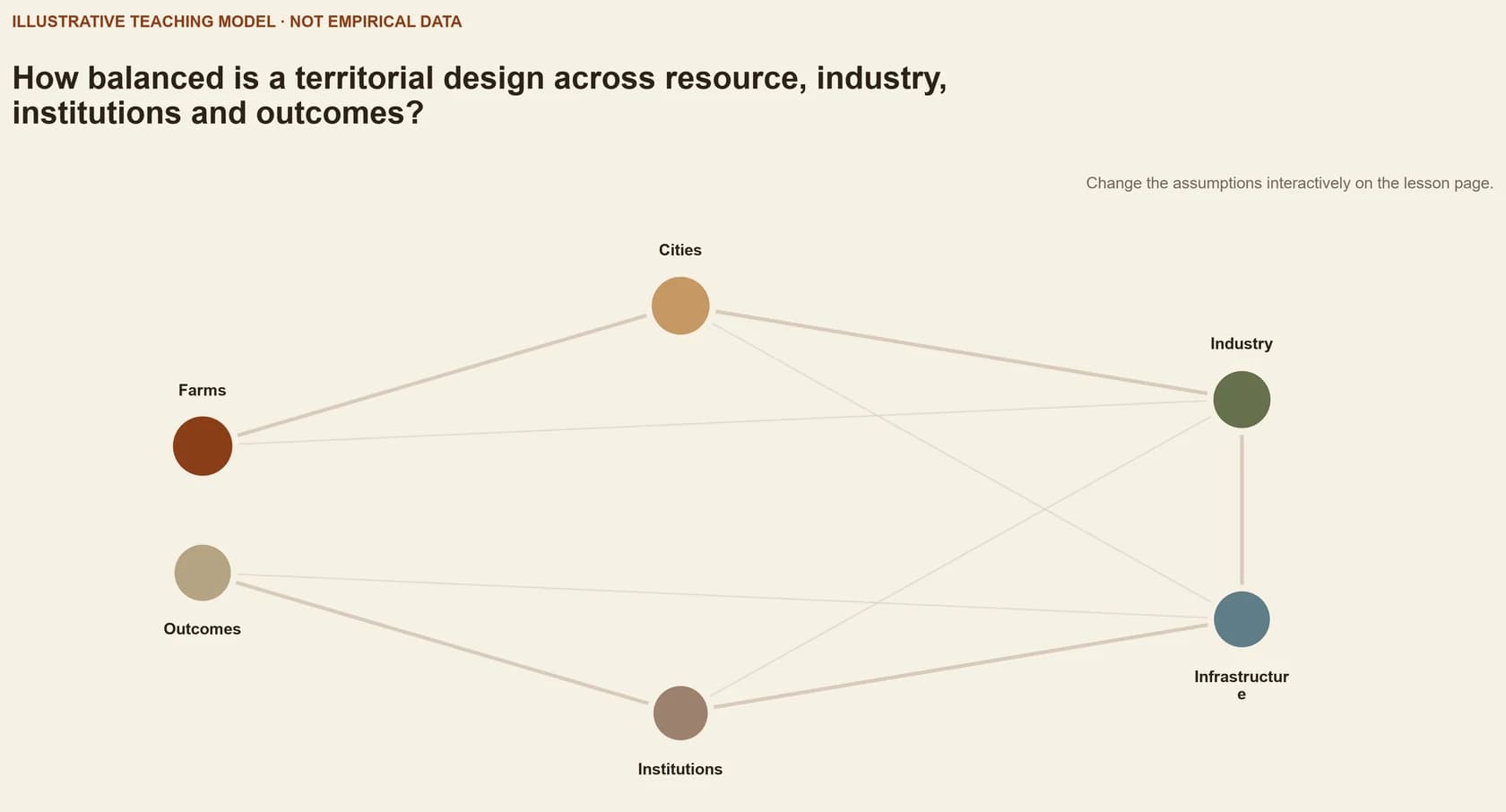
Explore · territory systems canvas
Connect place-specific resources, actors, infrastructures, institutions and outcomes.
Open each territorial layer and connect it to the decision it can enable—or block.
Situated resource
Quantity, quality and timing are geographically specific.
0/4 Complete
Worked example
Defining the right boundary
A proposed biorefinery sits in one municipality, sources across three districts and sells through a national market.
- 01
Use a supply-shed boundary for logistics and soil constraints.
- 02
Use jurisdictional boundaries for permits, tax and public authority.
- 03
Keep national product markets and displaced production connected to the outcome analysis.
One map boundary rarely answers every resource, deployment and outcome question.
Case file
Assessing the Techno-Economic Feasibility of Bamboo Residue-Derived Hard Carbon
- Why it is here
- This public product pathway helps ask what additional territorial evidence is needed beyond process and cost.
- What to inspect
- Inspect the boundary, then list missing suppliers, infrastructure, institutions and markets for a chosen territory.
- Limitation
- The publication is a teaching prompt here, not a completed territorial deployment study.
Core references
- Jarosch et al. (2020). A Regional Socio-Economic Life Cycle Assessment of a Bioeconomy Value Chain.https://doi.org/10.3390/su12031259 ↗
- Hamid Ghaderi, Mir Saman Pishvaee and Alireza Moini (2017). Biomass supply chain network design: An optimization-oriented review and analysis.https://doi.org/10.1016/j.indcrop.2016.09.027 ↗
Further reading +1
- QGIS / OSGeo (2026). QGIS Documentation.Open source ↗
Knowledge check
Key takeaway
Territorial bioeconomy aligns place-specific resources, conversion, deployment capacity and outcomes while keeping external connections visible.
Using local feedstock within an administrative border is sufficient to call a pathway a territorial bioeconomy.
Functional boundaries, resource and trade flows, institutions, infrastructure, actors, external effects and learning capacity.