The question
Is a waste stream a resource—or a management obligation?
Learning objectives
- 01Use current fate as the starting counterfactual for a waste pathway.
- 02Separate material value from avoided-treatment credit.
- 03Screen contamination, traceability and legal status before conversion fit.
Core explanation
A by-product is intentionally managed alongside a primary product; a waste is defined partly by the holder and legal context; a secondary feedstock is a functional description after recovery. These labels affect permits, liability, quality assurance and markets. They should not be interchanged merely to make a pathway appear more circular.
The environmental value of diversion depends on the prior fate. Avoiding landfill methane, hazardous treatment or low-efficiency disposal can matter; displacing effective recycling, soil amendment or nutrient recovery can create burdens. The credit is not a property of the material—it belongs to a stated comparison.
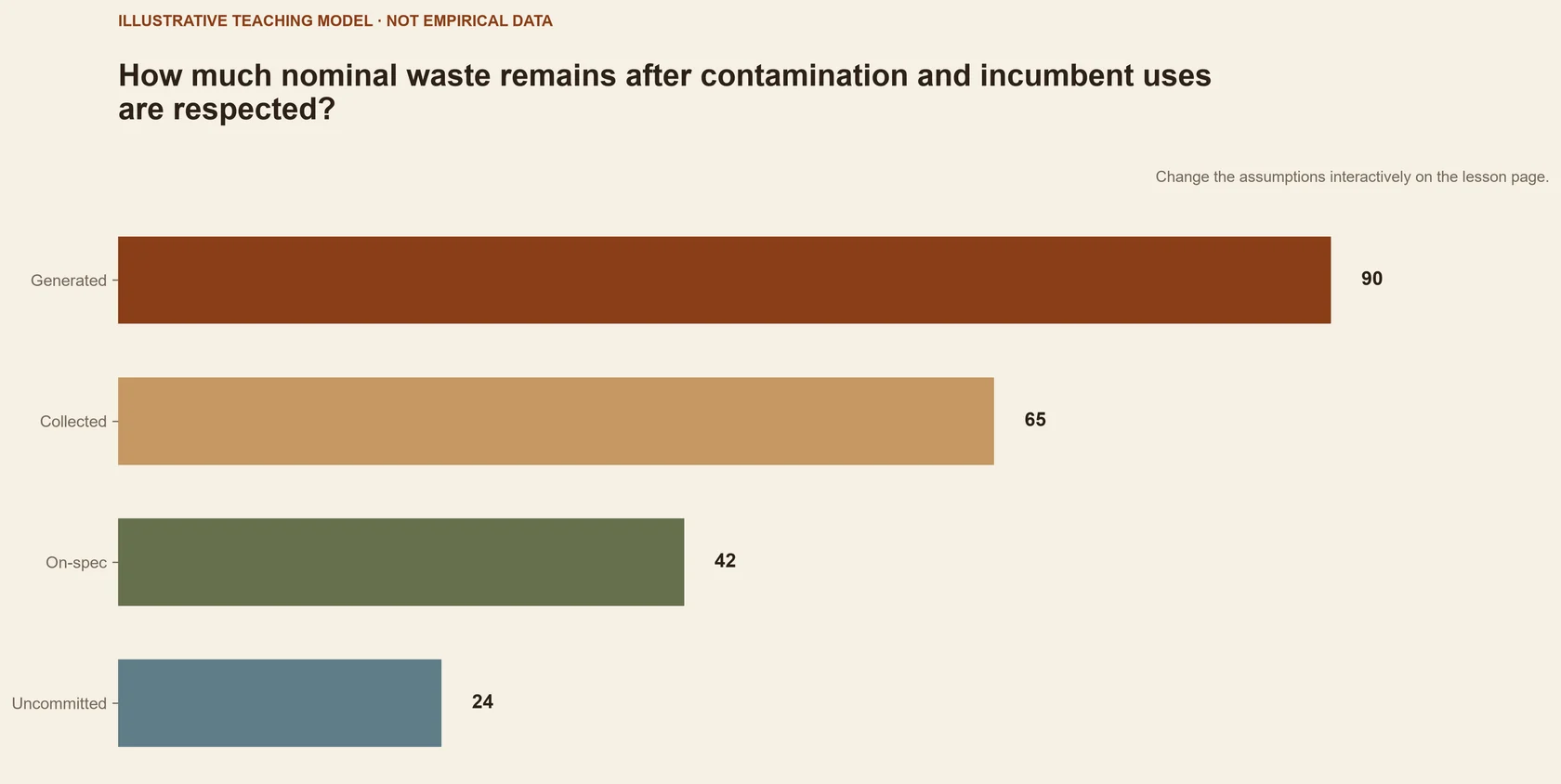
Waste-derived systems need traceability and acceptance criteria because contamination and composition can vary abruptly. Sorting, cleaning and separation consume energy and create rejects. A complete inventory follows those rejects and does not allocate all incoming mass to the desired product.
Key concepts
Current fate
What actually happens to the stream before the proposed intervention.
Avoided burden
An impact credited when a documented alternative process is displaced.
Contamination
Unwanted substances that change safety, processability, quality or legal status.
Traceability
Ability to follow origin, handling, composition and destination through the chain.
Visual explanation
Explore · fate contamination tree
Choose pathways only after testing contamination, legal status and credible alternative fates.
Follow the fate tree to determine whether reuse, recycling, recovery, treatment or disposal remains credible.
Is composition and hazardous contamination characterized?
Worked example
Mixed packaging entering an upcycling plant
The incoming bale contains target polymers, labels, food residue, metals and unknown additives.
- 01
Document the baseline destination of each major fraction.
- 02
Measure sorting yield, cleaning inputs and reject destinations.
- 03
Apply credits only where an alternative product or treatment is demonstrably displaced.
The useful feedstock is the accepted, characterized fraction—not the gross collected bale.
Case file
Mixed plastics wastes upcycling with high-stability single-atom Ru catalyst
- Why it is here
- Mixed plastics make contamination and composition central rather than peripheral.
- What to inspect
- Inspect feed preparation and how heterogeneity affects products.
- Limitation
- A controlled experimental mixture may under-represent real collection variability.
Core references
- Food and Agriculture Organization of the United Nations (2026). Sustainable and circular bioeconomy: glossary and key terms.Open source ↗
- International Organization for Standardization (2006). ISO 14040:2006 Environmental management — Life cycle assessment — Principles and framework.Open source ↗
Further reading +1
- European Commission (2018). Guidance on cascading use of biomass with selected good practice examples on woody biomass.https://doi.org/10.2873/68553 ↗
Knowledge check
Key takeaway
Waste-derived value is conditional on quality, law, current fate and the burdens of recovery.
Calling a material waste justifies zero upstream burden and full avoided-disposal credit.
Legal classification, composition distribution, chain of custody, current fate, recovery inputs and reject management.