Before you begin
Conversion pathways, mass and energy balances →The question
Where is the real bottleneck in a multi-step conversion train?
Learning objectives
- 01Compare biological and catalytic conversion windows.
- 02Recognize pretreatment, inhibition, catalyst lifetime and separation as system variables.
- 03Trace yield and selectivity through upgrading rather than stopping at the primary reaction.
Core explanation
Fermentation uses microorganisms or enzymes to convert accessible substrates into products. It can operate under relatively mild conditions and achieve high biochemical selectivity, but pretreatment must release suitable molecules without creating inhibitors. Sterility, residence time, nutrient demand, broth concentration and organism robustness affect the complete process.
Catalysis changes reaction rates and product pathways through an active material. Heterogeneous, homogeneous and enzymatic catalysts face different recovery and stability issues. Activity, selectivity and conversion should be reported with catalyst lifetime, regeneration, poisons, support materials and realistic feed impurities.
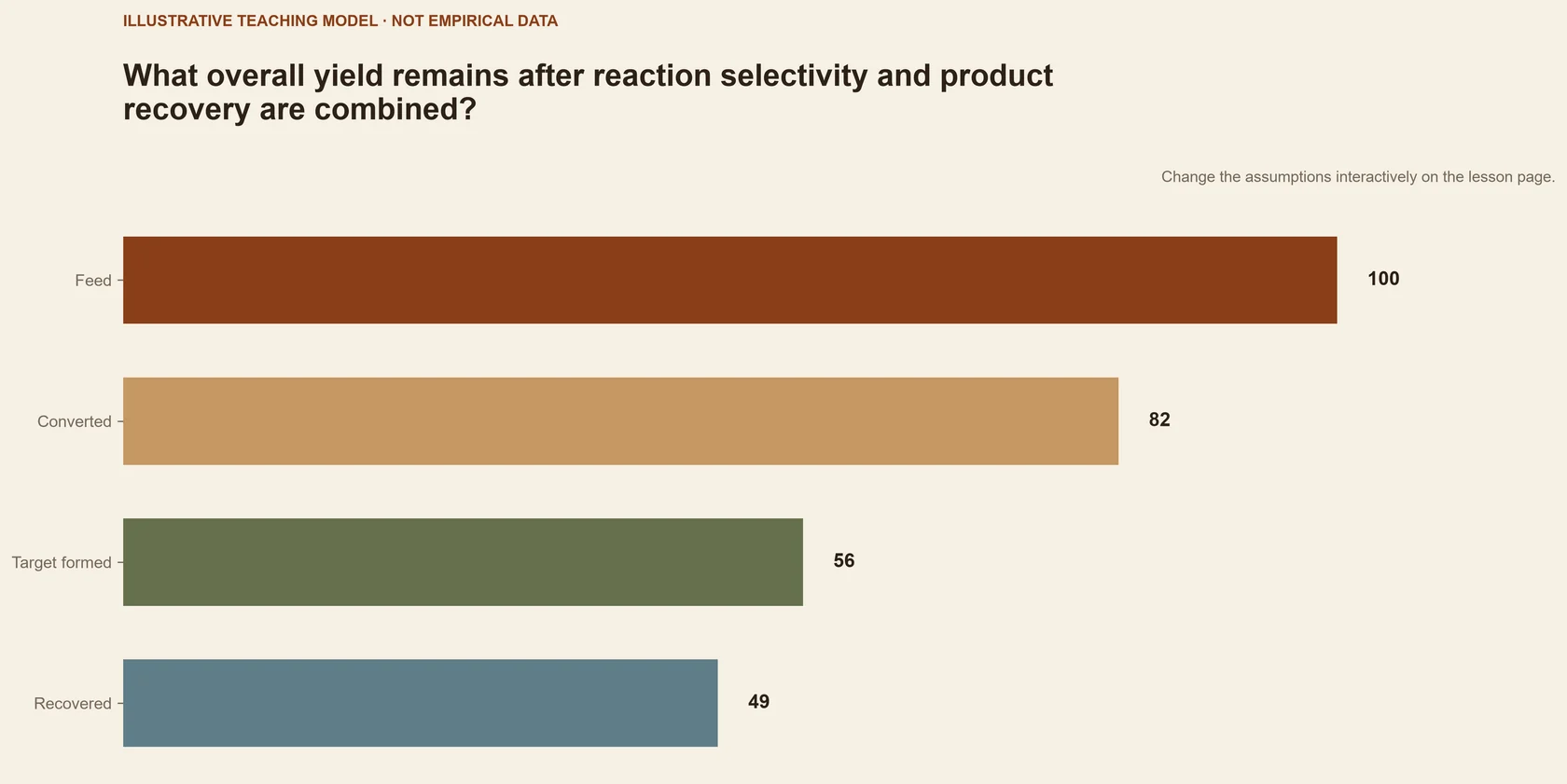
Upgrading and separation often determine energy and cost. Dilute fermentation products require concentration; complex oils need stabilization and fractionation; gas streams need purification. A pathway should be evaluated at product specification, not at the first detectable intermediate.
Key concepts
Fermentation
Biological conversion by cells or enzymes under controlled conditions.
Catalyst
A material that changes reaction rate or pathway without being consumed stoichiometrically.
Inhibition
Reduced biological or catalytic performance caused by feed or product components.
Upgrading
Operations that move an intermediate toward required composition, stability and performance.
Visual explanation
Explore · bottleneck process train
Trace selectivity, inhibition and separation through biochemical and catalytic steps.
Build the process train, then flag the stage whose limitation propagates downstream.
Build the process train, then flag the stage whose limitation propagates downstream.
Worked example
A dilute organic-acid product
A fermentation reaches high substrate conversion but produces a dilute broth with salts and residual sugars.
- 01
Calculate product mass at fermentation outlet and at final specification.
- 02
Add neutralization, recovery, water removal and solvent or membrane duties.
- 03
Track salt, wastewater and unrecovered carbon destinations.
High biological conversion can coexist with low overall recovery and high separation energy.
Case file
Breaking the yield–selectivity trade-off in polystyrene waste valorization via tandem depolymerization and hydrogenolysis
- Why it is here
- The public study makes conversion selectivity and system trade-offs visible together.
- What to inspect
- Inspect where experimental selectivity becomes a downstream environmental or economic assumption.
- Limitation
- The pathway is polymer- and catalyst-specific.
Core references
- Wyman, Spindler and Grohmann (1992). Simultaneous saccharification and fermentation of several lignocellulosic feedstocks to fuel ethanol.https://doi.org/10.1016/0961-9534(92)90001-7 ↗
- U.S. Department of Energy (2024). Feedstock-Conversion Interface Consortium: Crosscutting Analysis Research.Open source ↗
Further reading +1
- Cortes-Peña et al. (2020). BioSTEAM: A Fast and Flexible Platform for the Design, Simulation, and Techno-Economic Analysis of Biorefineries under Uncertainty.https://doi.org/10.1021/acssuschemeng.9b07040 ↗
Knowledge check
Key takeaway
Evaluate conversion at final product specification, including catalyst or organism robustness and separation burdens.
High reaction selectivity guarantees an efficient and economical complete process.
Realistic feed impurities, long-duration performance, product concentration, recovery yield and separation utilities.