The question
When does a conversion product become a credible material?
Learning objectives
- 01Distinguish recycling, depolymerization, upcycling and carbon-material production.
- 02Trace purity, yield, selectivity and product-performance requirements together.
- 03Test whether product markets and end-of-life support the circularity claim.
Core explanation
Carbon materials include biochar, activated carbon, graphite-like materials and hard carbon for electrochemical applications. Feedstock composition and thermal history shape porosity, surface chemistry, disorder, impurities and performance. Converting biomass carbon into a material may extend carbon residence and create high value, but high-temperature treatment, activation, washing and quality control can be demanding.
Plastic recycling retains polymer value when quality permits. Chemical recycling or depolymerization breaks polymers into monomers or intermediates; upcycling aims for products with improved function or value. Mixed polymers, additives, contamination, chlorine, sulfur and fillers affect reaction and separation. Selective chemistry on a clean model polymer does not represent mixed post-consumer feed.
A material pathway must meet specifications at useful scale and displace a credible alternative. Limited high-value markets can saturate, and downcycling can shorten future loops. Compare product lifetime, recyclability, energy, losses and avoided production rather than using the word ‘upcycling’ as the outcome.
Key concepts
Hard carbon
A non-graphitizing disordered carbon used in applications including sodium-ion batteries.
Depolymerization
Breaking a polymer into shorter molecules, oligomers or monomers.
Upcycling
Conversion into a product with demonstrably improved function or value relative to the input’s current fate.
Product specification
Measurable composition and performance required for a market or application.
Visual explanation
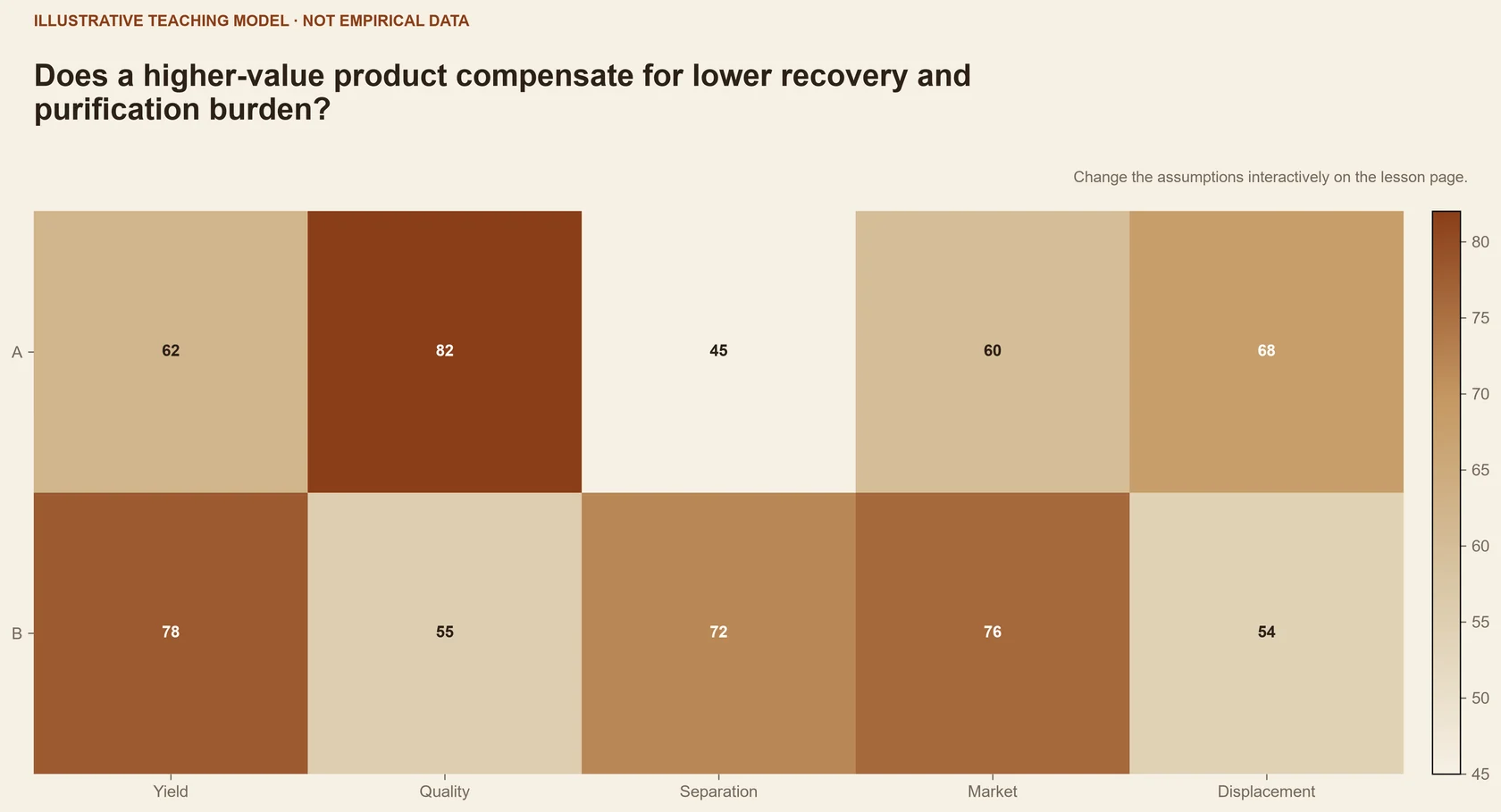
Explore · product specification gate
Move from conversion yield to product specification, consistency and market function.
Pass the material through composition, performance, consistency and end-use gates.
Composition
Impurities and molecular distribution are measured, not assumed.
Worked example
From mixed plastic to a qualified chemical
A catalyst produces a desired molecule from a selected polymer; real feed contains other polymers and additives.
- 01
Measure acceptance and sorting yield for the real feed.
- 02
Track catalyst lifetime, heteroatoms, separation and reject streams.
- 03
Verify final purity, market size and the displaced product pathway.
Selective conversion is necessary, while circular value is established at the qualified product and system comparison.
Case file
Breaking the yield–selectivity trade-off in polystyrene waste valorization via tandem depolymerization and hydrogenolysis
- Why it is here
- The public study connects selective transformation with environmental trade-offs.
- What to inspect
- Inspect product identity, selectivity and which benchmark is displaced.
- Limitation
- Bench-scale selectivity alone does not establish product qualification or market scale.
Core references
- U.S. Department of Energy (2024). Feedstock-Conversion Interface Consortium: Crosscutting Analysis Research.Open source ↗
- International Organization for Standardization (2006). ISO 14040:2006 Environmental management — Life cycle assessment — Principles and framework.Open source ↗
Further reading +1
- Garcia et al. (2020). Accounting for biogenic carbon and end-of-life allocation in life cycle assessment of multi-output wood cascade systems.https://doi.org/10.1016/j.jclepro.2020.122795 ↗
Knowledge check
Key takeaway
A material pathway succeeds when recovered carbon meets a real specification, market and next-life strategy with defensible balances.
A higher-value laboratory product automatically makes a waste-conversion route circular and scalable.
Real-feed acceptance, complete yield, catalyst stability, purification, product qualification, market and end-of-life.