Before you begin
Trade-offs, sensitivity and multi-objective outcomes →The question
Which uncertainty can change the decision?
Learning objectives
- 01Distinguish scenarios, sensitivity tests and uncertainty analysis.
- 02Design internally coherent scenarios.
- 03Use global sensitivity to identify influential inputs and interactions.
Core explanation
A scenario is a coherent possible future, not merely one parameter changed. It can combine policy, technology, market and resource assumptions to test strategic robustness.
Sensitivity analysis asks how outputs respond to inputs. One-at-a-time tests are readable but miss interactions; global methods sample several inputs across defined ranges.
Uncertainty analysis propagates plausible distributions or ranges. Its credibility depends on transparent sources, correlations and structural alternatives—not just many Monte Carlo draws.
Key concepts
Scenario
A coherent set of assumptions describing a possible future.
Local sensitivity
Response near a baseline, often varying one input.
Global sensitivity
Influence across the full joint input range.
Structural uncertainty
Uncertainty about model form, boundary or causal representation.
Visual explanation
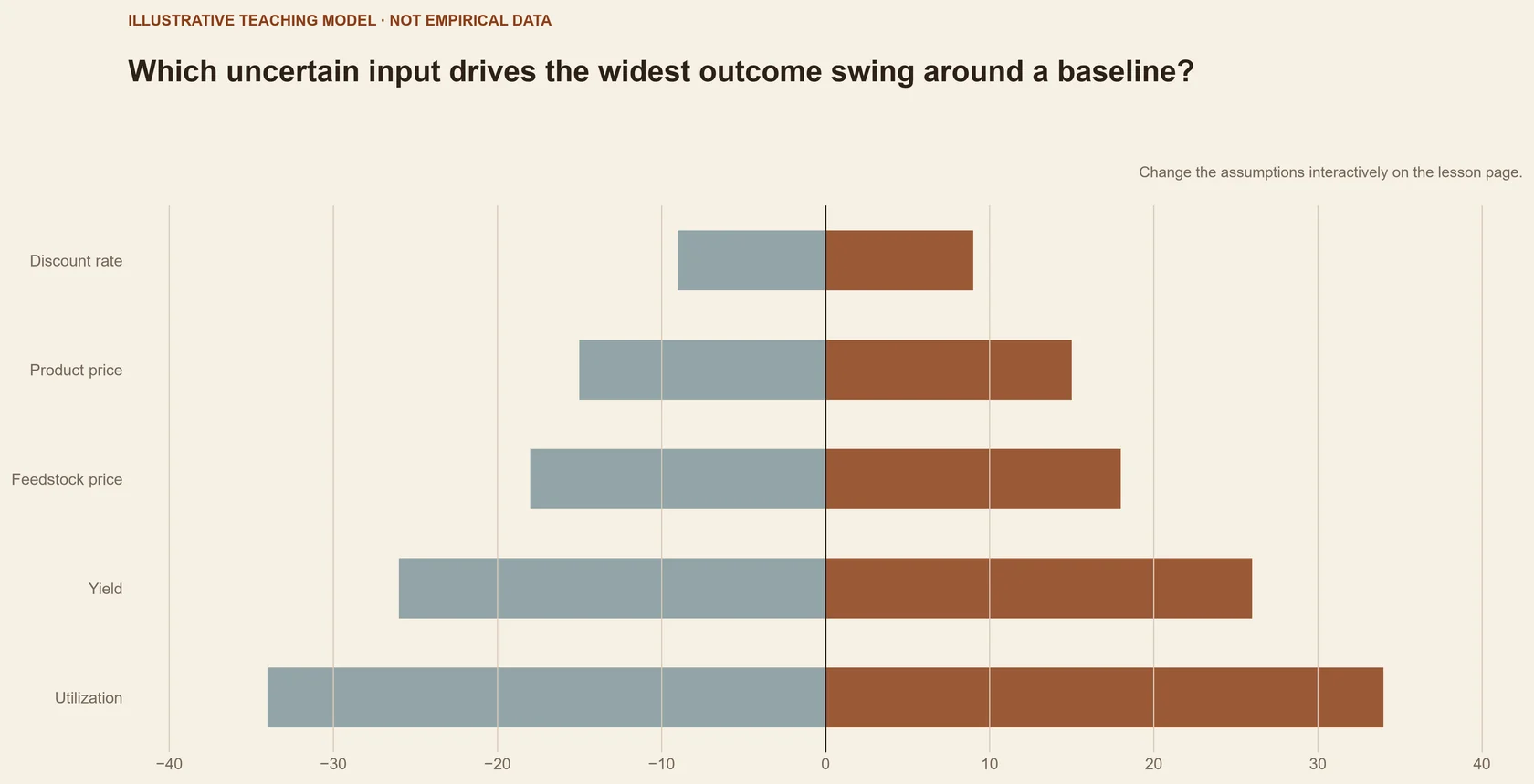
Explore · scenario tree tornado
Separate scenario uncertainty, parameter sensitivity and decision robustness.
Choose a future, then inspect a tornado ranking and whether the preferred option changes.
iIllustrative learning model — values are not scientific results or forecasts.
Stable market
Feed and product assumptions stay near the central case.
- Top driver
- Conversion yield
- Decision switch
- No
Worked example
Stress-test a fuel pathway
Feedstock price, electricity mix, yield and policy credit may change together.
- 01
Build coherent low-carbon, constrained-supply and high-cost scenarios.
- 02
Sample uncertain parameters within each scenario.
- 03
Identify decisions that remain acceptable across futures.
Robust choices can be preferable to the single optimum under one forecast.
Case file
New stochastic simulation capability applied to the GREET model
- Why it is here
- This paper demonstrates stochastic capability in an established life-cycle model.
- What to inspect
- Inspect uncertainty distributions, propagation and interpretation of outputs.
- Limitation
- A stochastic result reflects the specified distributions and correlations, not all unknowns.
Tool in context
SALib
- Use it for this task
- Design reproducible global sensitivity analyses and distinguish methods by question.
- Limitation
- Method choice, sampling design, model cost and correlated inputs require deliberate treatment; rankings are conditional on specified ranges.
Inputs, outputs & scope
- What it is
- An open-source Python library for global sensitivity analysis, including Sobol, Morris and FAST methods.
- Problem it addresses
- Which uncertain inputs drive model-output variation, interactions or screening priorities?
- Inputs
- A defined parameter problem, sampled input sets and corresponding model outputs.
- Outputs
- Method-specific sensitivity indices, confidence intervals and screening rankings.
- Typical applications
- Global sensitivity analysis for process, TEA, LCA and system models.
Core references
- Subramanyan et al. (2007). New stochastic simulation capability applied to the GREET model.https://doi.org/10.1065/lca2007.07.354 ↗
- Yao, Staples, Malina and Tyner (2017). Stochastic techno-economic analysis of alcohol-to-jet fuel production.https://doi.org/10.1186/s13068-017-0702-7 ↗
Further reading +2
- SALib project (2026). SALib documentation.Open source ↗
- U.S. Department of Energy (2024). Feedstock-Conversion Interface Consortium: Crosscutting Analysis Research.Open source ↗
Knowledge check
Key takeaway
Scenarios, sensitivity and uncertainty answer different questions and work best together.
Changing one input by plus or minus ten percent is a complete uncertainty analysis.
Scenario coherence, range sources, distributions, correlations, structural alternatives, sampling and decision robustness.