The question
Which Pareto option is robust enough to discuss with decision-makers?
Learning objectives
- 01Construct and interpret a Pareto frontier.
- 02Separate physical performance from stakeholder preferences.
- 03Use robustness and constraints to narrow a transparent choice set.
Core explanation
Bioeconomy decisions rarely have one objective. Minimizing cost can raise emissions or concentration risk; maximizing carbon removal can increase land, water or capital demands.
A Pareto frontier contains non-dominated alternatives: improving one represented objective requires worsening another. It reveals the shape and opportunity cost of trade-offs.
Weights, thresholds and rankings embed preferences. Decision support should disclose them, test multiple viewpoints, show uncertainty and retain alternatives rather than declaring an algorithmic winner.
Key concepts
Objective
A performance measure to minimize, maximize or satisfy.
Non-dominated solution
No other feasible solution improves an objective without worsening another.
Preference
A value judgment about acceptable outcomes or trade-offs.
Robustness
Acceptable performance across plausible conditions.
Visual explanation
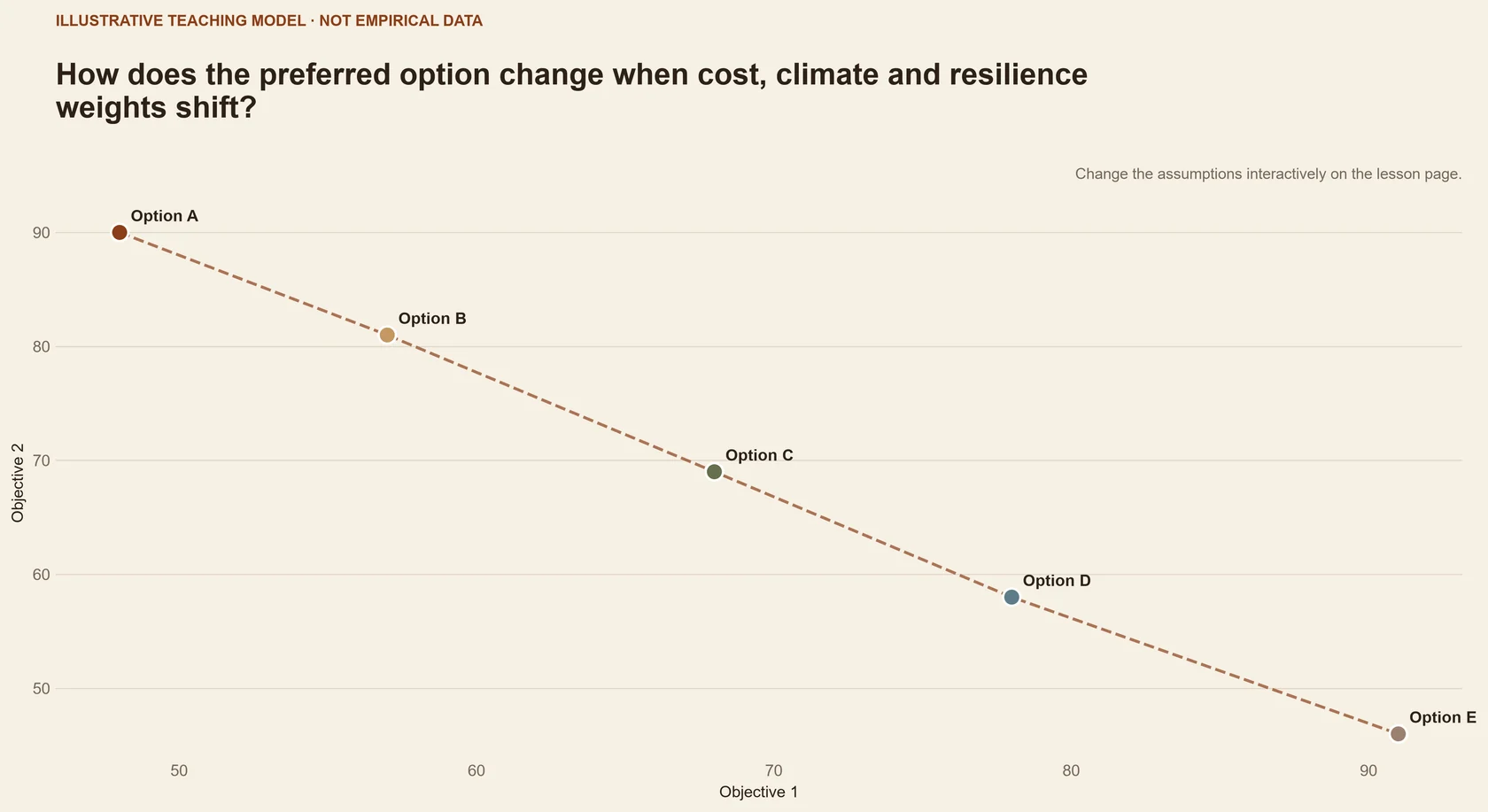
Explore · pareto set navigator
Navigate a Pareto set without pretending that the model chooses social priorities.
Compare three non-dominated designs, then apply a robustness lens before selecting one for discussion.
iIllustrative learning model — values are not scientific results or forecasts.
Compact network
Lower logistics exposure; fewer sites and less redundancy.
- Cost
- Medium
- Resilience
- Low
Worked example
Choose a territorial portfolio
A territory compares cost, net GHG, employment distribution and supply resilience.
- 01
Generate feasible portfolios under shared resource constraints.
- 02
Map non-dominated alternatives and uncertainty bands.
- 03
Apply stakeholder thresholds as explicit filters, not hidden weights.
The result is a defensible choice set plus consequences, not one universal optimum.
Case file
A multi-objective superstructure optimization approach to biofeedstocks-to-biofuels systems design
- Why it is here
- The study provides a biofeedstock-to-fuels example where competing objectives reshape system design.
- What to inspect
- Inspect decision variables, objective definitions and the diversity of non-dominated designs.
- Limitation
- Pareto optimality is conditional on model boundaries and does not resolve value judgments.
Tool in context
pymoo
- Use it for this task
- Explore multi-objective algorithms, test problems and Pareto-set diagnostics.
- Limitation
- Algorithm output depends on formulation, scaling and convergence checks; the software does not choose social preferences.
Inputs, outputs & scope
- What it is
- An open-source Python framework for single-, multi- and many-objective optimization, visualization and decision support.
- Problem it addresses
- How can a set of non-dominated alternatives be generated and diagnosed under conflicting objectives?
- Inputs
- Decision variables, objective functions, constraints, algorithms and termination criteria.
- Outputs
- Candidate Pareto sets, convergence diagnostics and visualizations for comparison.
- Typical applications
- Technology portfolios, supply networks, process design and other multi-objective system choices.
Core references
- Eason and Cremaschi (2014). A multi-objective superstructure optimization approach to biofeedstocks-to-biofuels systems design.https://doi.org/10.1016/j.biombioe.2014.02.010 ↗
- Gital Durmaz and Bilgen (2020). Multi-objective optimization of sustainable biomass supply chain network design.https://doi.org/10.1016/j.apenergy.2020.115259 ↗
- Kanzian et al. (2013). Design of forest energy supply networks using multi-objective optimization.https://doi.org/10.1016/j.biombioe.2013.10.009 ↗
Further reading +2
- pymoo project (2026). pymoo: Multi-objective Optimization in Python documentation.Open source ↗
- Hart, Watson and Woodruff (2011). Pyomo: modeling and solving mathematical programs in Python.https://doi.org/10.1007/s12532-011-0026-8 ↗
Knowledge check
Key takeaway
Good decision support clarifies feasible choices, trade-offs and values; it does not erase them.
One composite score can make a multi-objective decision objective.
Objectives and units, feasible set, constraints, uncertainty, dominance, weights or thresholds, affected actors and robustness.