The question
Who should receive a finite resource—and what objective decides?
Learning objectives
- 01Frame allocation using resources, users, constraints, objectives and time.
- 02Distinguish physical competition from market and policy competition.
- 03Expose distributional effects instead of reporting only total system value.
Core explanation
Allocation decides which quantity of each resource goes to which use, place and period. Constraints can represent supply, quality, capacity, soil retention, contracts, demand, infrastructure and policy. Objectives may minimize cost or emissions, maximize value or resilience, or balance several outcomes. The formulation is a statement of priorities, not a neutral calculation.
Competition can be direct—two plants request the same residue—or indirect through land, water, electricity, hydrogen, transport or product markets. Existing users should be represented, including low-visibility uses such as bedding, nutrient return or small local industries. Ignoring them converts occupied supply into fictional surplus.
A system optimum can redistribute costs and benefits unevenly. Farmers, waste holders, transporters, communities, investors and consumers may face different outcomes. Report resource rents, unmet demand, displaced users, regional concentration and sensitivity to policy or price—not only the objective value.
Key concepts
Allocation
Assignment of finite resources among uses, places and times.
Competing use
A use that draws on the same constrained resource or enabling input.
Opportunity cost
Value of the best alternative forgone when a resource is assigned.
Distributional effect
How costs, benefits and risks differ among people, sectors or regions.
Visual explanation
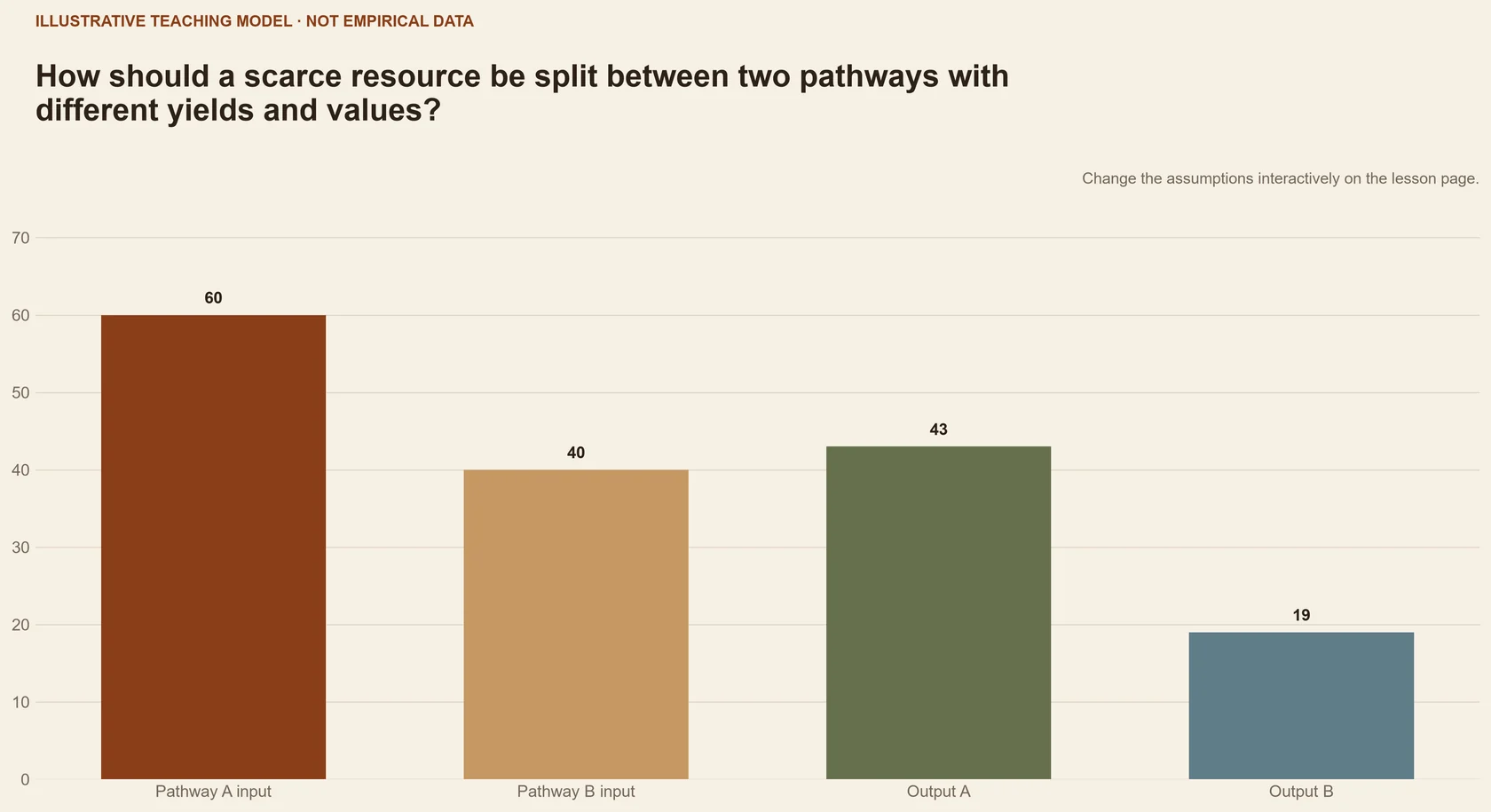
Explore · competing use board
Allocate a fixed resource while preserving existing services and exposing trade-offs.
Distribute twelve tokens among uses; constraints and consequences update after every choice.
iIllustrative learning model — values are not scientific results or forecasts.
Remaining
Soil function
0/5Existing material use
0/5Fuel pathway
0/6Carbon storage
0/6Distribute twelve tokens among uses; constraints and consequences update after every choice.
Worked example
One residue, four claimants
A region can supply a limited residue for soil retention, livestock bedding, a material plant and SAF feedstock.
- 01
Set mandatory soil and contractual minimums before discretionary allocation.
- 02
Compare cost, GHG, value and resilience objectives separately.
- 03
Report displaced demand and actor-level changes for each solution.
There is no allocation without priorities; making them explicit enables a legitimate discussion.
Case file
Multi-objective optimization of sustainable biomass supply chain network design
- Why it is here
- The study shows how multiple objectives alter network and allocation choices.
- What to inspect
- Inspect objectives, constraints and the reported Pareto alternatives.
- Limitation
- Modelled alternatives depend on specified objectives and data; they are not stakeholder decisions.
Core references
- Gital Durmaz and Bilgen (2020). Multi-objective optimization of sustainable biomass supply chain network design.https://doi.org/10.1016/j.apenergy.2020.115259 ↗
- European Commission (2018). Guidance on cascading use of biomass with selected good practice examples on woody biomass.https://doi.org/10.2873/68553 ↗
Further reading +1
- Hamid Ghaderi, Mir Saman Pishvaee and Alireza Moini (2017). Biomass supply chain network design: An optimization-oriented review and analysis.https://doi.org/10.1016/j.indcrop.2016.09.027 ↗
Knowledge check
Key takeaway
Resource allocation is where finite supply becomes a transparent choice among uses and stakeholders.
A new high-value use can be evaluated as if existing users and enabling resources do not respond.
Existing demand, minimum obligations, shared enabling inputs, objective priorities, prices and actor-level outcomes.