Before you begin
What is the bioeconomy? →The question
Which constraint becomes binding first?
Learning objectives
- 01Explain why renewable does not mean unlimited.
- 02Identify ecological, logistical and competing-use constraints.
- 03Treat waste and secondary resources as first-class but heterogeneous feedstocks.
Core explanation
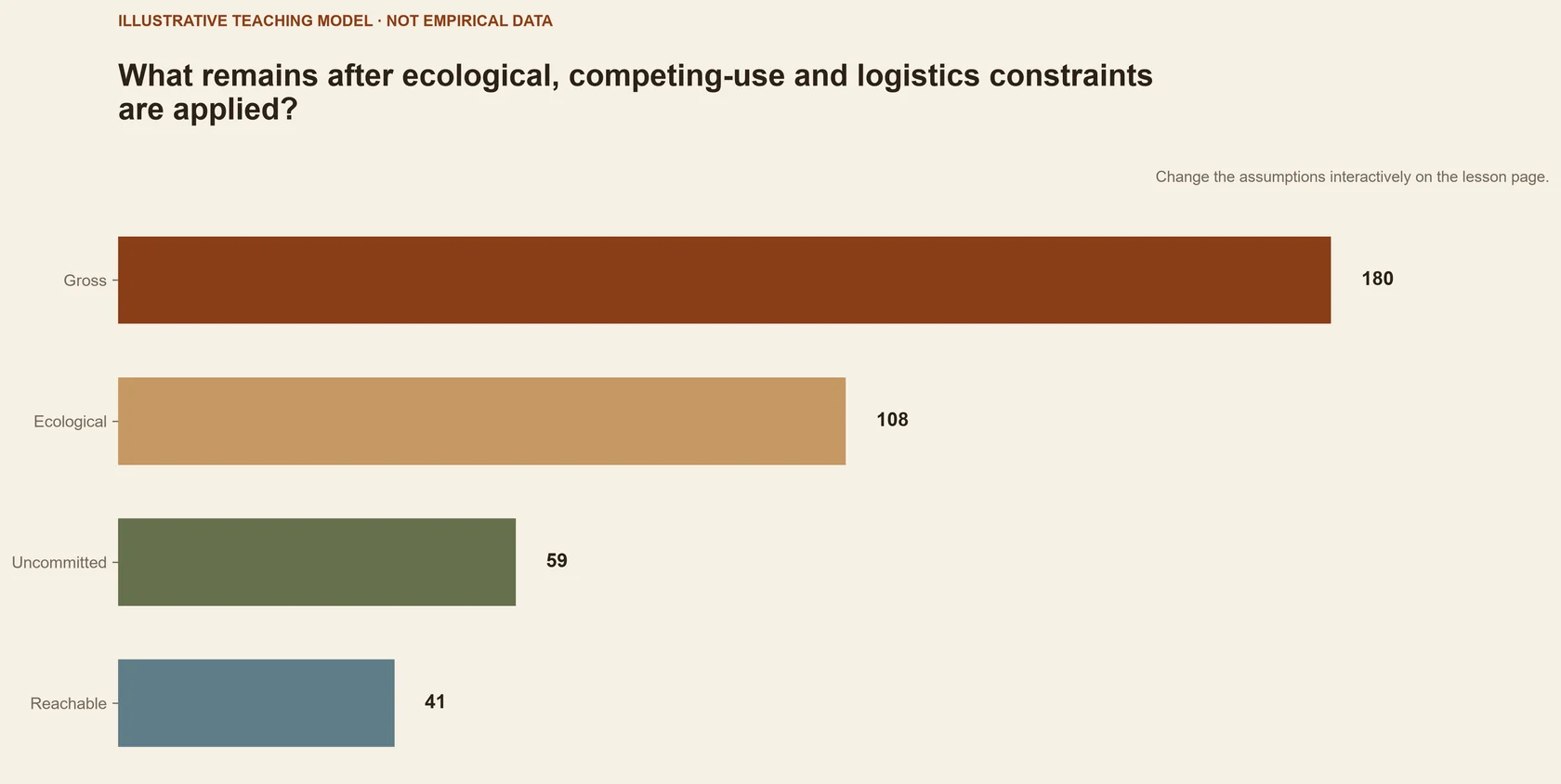
A resource is not simply the mass shown in a production statistic. Some material must remain to protect soil, nutrients, habitat or existing products; some is dispersed, contaminated or too seasonal to collect reliably; and some already has users. Resource assessment therefore asks what can be mobilized, at what quality, when, where, at what cost and under which safeguards.
Waste is not costless or impact-free. A waste stream can have avoided-treatment value, hazardous components, legal classifications and an existing fate such as recycling, composting, land application or energy recovery. Diverting it creates both benefits and burdens relative to that counterfactual.
The finite-resource perspective changes the decision from ‘Can this material be converted?’ to ‘Which share can be responsibly supplied, and which use creates the strongest value under local constraints?’ That question is central to territorial bioeconomy.
Key concepts
Availability
Material that exists before sustainability, cost and competition filters are applied.
Competing use
An existing or plausible alternative use that changes what can be claimed as available.
Secondary resource
A material recovered from a prior production or consumption system.
Mobilization
The practical act of collecting, conditioning and delivering a resource under constraints.
Visual explanation
Explore · constraint stack
Experience how a large theoretical resource shrinks under linked constraints.
Advance through each gate and decide what evidence is needed before material can pass.
Physical stock
Is the material present in the place and period studied?
Worked example
One hundred units of crop residue
A region reports 100 mass units of residue production. Treat the number only as the opening inventory.
- 01
Reserve material needed for soil protection and current agronomic functions.
- 02
Remove inaccessible, wet, contaminated or highly dispersed fractions.
- 03
Compare remaining supply with feed, bedding, materials and energy users over the year.
The deployable quantity is an evidence-based subset, not a fixed percentage that transfers between territories.
Case file
2023 Billion-Ton Report: An Assessment of U.S. Renewable Carbon Resources
- Why it is here
- The Billion-Ton assessment separates resource quantities by assumptions and constraints.
- What to inspect
- Inspect scenario definitions before comparing totals.
- Limitation
- National scenarios do not replace site-specific ecological or market evidence.
Tool in context
BioenergyKDF
- Use it for this task
- Use mapped datasets to inspect where an apparent resource is actually located.
- Limitation
- Datasets differ in date, resolution and assumptions and must be reconciled before use.
Inputs, outputs & scope
- What it is
- A discovery portal for U.S. biomass resource data, analyses and bioenergy tools.
- Problem it addresses
- Where can analysts find documented resource and pathway data?
- Inputs
- Search terms, geography, resource classes and analysis needs.
- Outputs
- Datasets, metadata, reports and links to analysis tools.
- Typical applications
- Resource assessments, supply curves, scenario framing and provenance discovery.
Core references
- U.S. Department of Energy (2024). 2023 Billion-Ton Report: An Assessment of U.S. Renewable Carbon Resources.https://doi.org/10.23720/BT2023/2316165 ↗
- Ericsson and Nilsson (2006). Assessment of the potential biomass supply in Europe using a resource-focused approach.https://doi.org/10.1016/j.biombioe.2005.09.001 ↗
Further reading +1
- Food and Agriculture Organization of the United Nations (2026). Sustainable and circular bioeconomy: glossary and key terms.Open source ↗
Knowledge check
Key takeaway
A responsible resource inventory includes what must stay, what is already used and what cannot be reliably mobilized.
All generated residue or waste is an unclaimed, zero-cost feedstock.
Spatial and seasonal inventory, current uses, sustainability safeguards, quality and delivered cost.