Before you begin
What is the bioeconomy? →The question
Which lens answers which systems question?
Learning objectives
- 01State the central question asked by each concept.
- 02Recognize where the concepts overlap and where they do not.
- 03Use renewable-carbon language without obscuring resource constraints.
Core explanation
The bioeconomy asks how biological resources, knowledge and processes can provide goods and services. The circular economy asks how value, products and materials can remain in use while waste and virgin extraction are reduced. Renewable carbon asks which non-fossil carbon sources—biomass, captured carbon dioxide and recycled carbon—can supply products that still require carbon.
A pathway can belong to one lens without satisfying the others. Burning virgin biomass may be bio-based but not strongly circular. Mechanically recycling a fossil plastic is circular in one sense but does not make its carbon renewable. A captured-CO₂ fuel can use renewable carbon yet still require careful energy and climate accounting.
Use the three concepts as complementary questions, not interchangeable labels. Always specify carbon origin, material loops, resource regeneration, the displaced alternative and the outcomes being claimed.
Key concepts
Circularity
Strategies that retain product, component and material value through reduction, reuse, repair, remanufacture and recycling.
Renewable carbon
Carbon from biomass, captured CO₂ or recycling used in place of additional fossil carbon.
Fossil carbon
Geological carbon introduced into the active carbon cycle through extraction.
Value retention
Keeping the function, structure or embodied effort of products and materials for longer.
Visual explanation
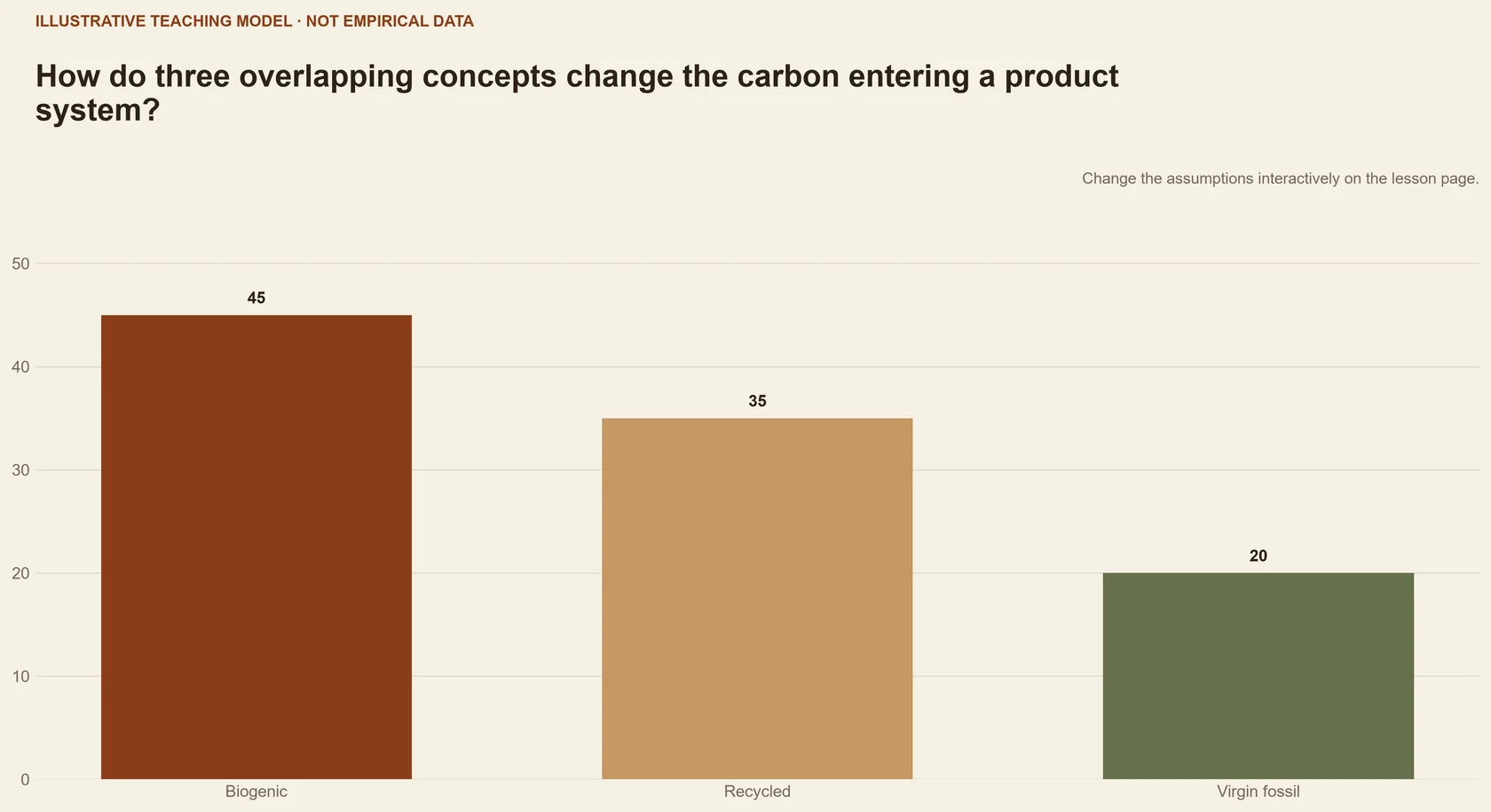
Explore · three lens map
Separate three overlapping ideas without treating them as synonyms.
Switch between the three lenses and reveal where their questions overlap—or diverge.
Where does the resource originate?
Bioeconomy foregrounds biological resources, knowledge and value creation.
0/4 Complete
Worked example
Four carbon routes for a polymer
Compare virgin fossil resin, mechanically recycled resin, biomass-derived resin and resin made from captured CO₂.
- 01
Classify the carbon origin for each route.
- 02
Identify which route retains existing material value.
- 03
Ask which evidence is still needed to compare impacts.
No single label ranks all four routes; the answer depends on function, energy, losses, counterfactuals and end-of-life.
Case file
The 2025 EU Bioeconomy Strategy
- Why it is here
- The EU strategy shows how policy combines biological resources with circularity and resilience.
- What to inspect
- Inspect scope, priorities and the outcomes used to justify action.
- Limitation
- A strategy is a policy frame, not an empirical comparison of every pathway.
Core references
- Food and Agriculture Organization of the United Nations (2026). Sustainable and circular bioeconomy: glossary and key terms.Open source ↗
- European Commission (2025). The 2025 EU Bioeconomy Strategy.Open source ↗
Further reading +1
- International Organization for Standardization (2006). ISO 14040:2006 Environmental management — Life cycle assessment — Principles and framework.Open source ↗
Knowledge check
Key takeaway
Bioeconomy identifies a resource system, circularity asks how value circulates, and renewable carbon identifies alternatives to new fossil carbon.
Bio-based, circular and renewable-carbon are synonyms that imply the same environmental result.
Carbon origin, number and quality of material loops, displaced production, energy and end-of-life.