Before you begin
Conversion pathways, mass and energy balances →The question
Where does a flowsheet fail to close or converge?
Learning objectives
- 01Define components, streams, unit operations and recycle loops.
- 02Use balances before trusting simulator outputs.
- 03Explain how simulation feeds TEA and LCA inventories.
Core explanation
A process model links feed composition, unit operations, reactions, separations and utilities. Its purpose is to make assumptions and conservation constraints computable.
Mass and elemental balances are primary diagnostics. Energy duties, recycle convergence and property methods add complexity but do not replace conservation checks.
Simulation outputs can size equipment, estimate utilities and populate economic or environmental inventories. Uncertain yields and scale factors should be carried forward as ranges.
Key concepts
Unit operation
A modeled transformation, separation or transfer step.
Recycle
A downstream stream returned to an earlier process step.
Utility
Heat, cooling, electricity, water or other service consumed.
Scale factor
Relationship used to estimate how equipment cost changes with capacity.
Visual explanation
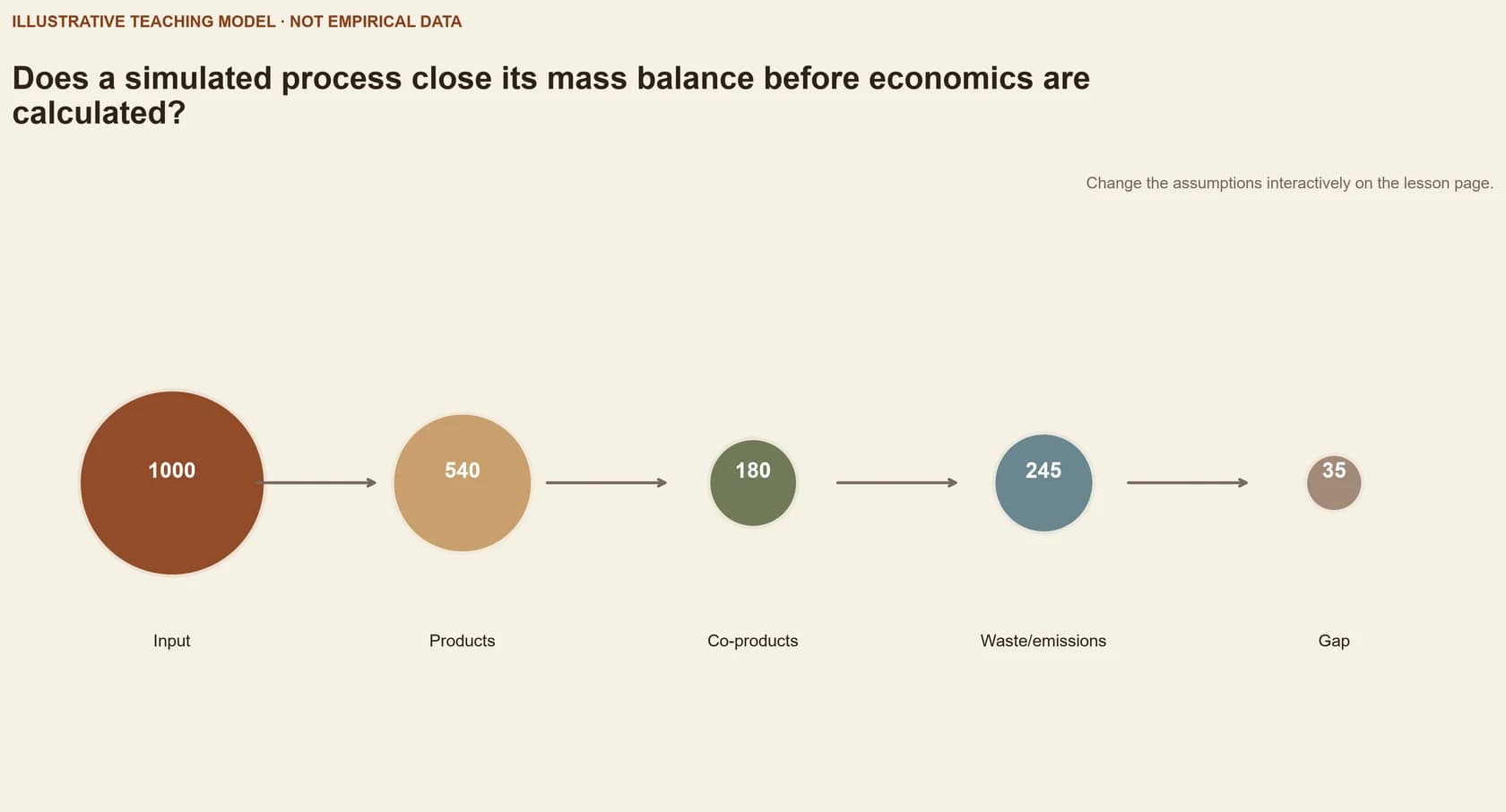
Explore · flowsheet debugger
Debug a process model by tracing specifications, recycles and conservation laws.
Build the flowsheet, then select the likely cause of each balance or convergence warning.
Build the flowsheet, then select the likely cause of each balance or convergence warning.
Worked example
Screen a conversion train
A dry feed is converted, separated and upgraded with recycle.
- 01
Specify feed composition and a transparent reaction basis.
- 02
Close component and elemental balances before adding costs.
- 03
Pass utilities and equipment duties to TEA and LCA with uncertainty.
A converged flowsheet can still be unrealistic if kinetics, separations or scale assumptions are weak.
Case file
Novel carbon-negative methane production via integrating anaerobic digestion and pyrolysis of organic fraction of municipal solid waste
- Why it is here
- The public waste-to-methane system gives a concrete multi-stream process to reconstruct.
- What to inspect
- Inspect feed, energy recovery, process losses and the system boundary.
- Limitation
- Published system results do not expose every parameter needed for an independent flowsheet.
Tool in context
BioSTEAM
- Use it for this task
- Build a reproducible flowsheet with linked balances, TEA and LCA.
- Limitation
- Outputs are only as credible as property methods, scale-up rules and input evidence.
Inputs, outputs & scope
- What it is
- An open-source process simulation framework with integrated TEA, LCA and uncertainty workflows.
- Problem it addresses
- How do unit operations combine into material, energy, cost and impact results?
- Inputs
- Thermodynamics, streams, reactions, unit operations, design and economic assumptions.
- Outputs
- Flowsheets, mass and energy balances, equipment sizes, costs and life-cycle indicators.
- Typical applications
- Biorefineries, separation trains, plastic upcycling and early-stage process comparison.
Core references
- Cortes-Peña et al. (2020). BioSTEAM: A Fast and Flexible Platform for the Design, Simulation, and Techno-Economic Analysis of Biorefineries under Uncertainty.https://doi.org/10.1021/acssuschemeng.9b07040 ↗
- Préat et al. (2020). Identification of microalgae biorefinery scenarios and development of mass and energy balance flowsheets.https://doi.org/10.1016/j.algal.2019.101737 ↗
Further reading +1
- BioSTEAM project (2026). BioSTEAM process simulation, TEA and LCA documentation.Open source ↗
Knowledge check
Key takeaway
Simulation organizes conservation-based evidence; it does not manufacture missing experimental validity.
A converged process model proves the technology is feasible.
Feed basis, property methods, yields, balance closure, recycle convergence, utilities, scale and validation data.