Before you begin
Resources → Conversion → Deployment → Outcomes →The question
What decision must the method support?
Learning objectives
- 01Translate a decision into an answerable analytical question.
- 02Match spatial, process, economic and environmental questions to suitable methods.
- 03Recognize when several linked methods are necessary.
Core explanation
A method is useful only in relation to a decision. LCA can compare environmental burdens, TEA can expose cost structure, GIS can locate resources, and optimization can allocate them—but none answers every question.
Define the unit of analysis, boundary, time horizon, alternatives and decision-maker first. These choices determine what evidence and resolution are required.
Integrated studies need explicit hand-offs: units, geography, uncertainty and scenario assumptions must remain consistent as outputs from one model become inputs to another.
Key concepts
Decision question
The choice or action the analysis must inform.
Boundary
What processes, places, actors and times are included.
Resolution
The spatial, temporal or technological detail represented.
Model coupling
Structured exchange of variables and assumptions between methods.
Visual explanation
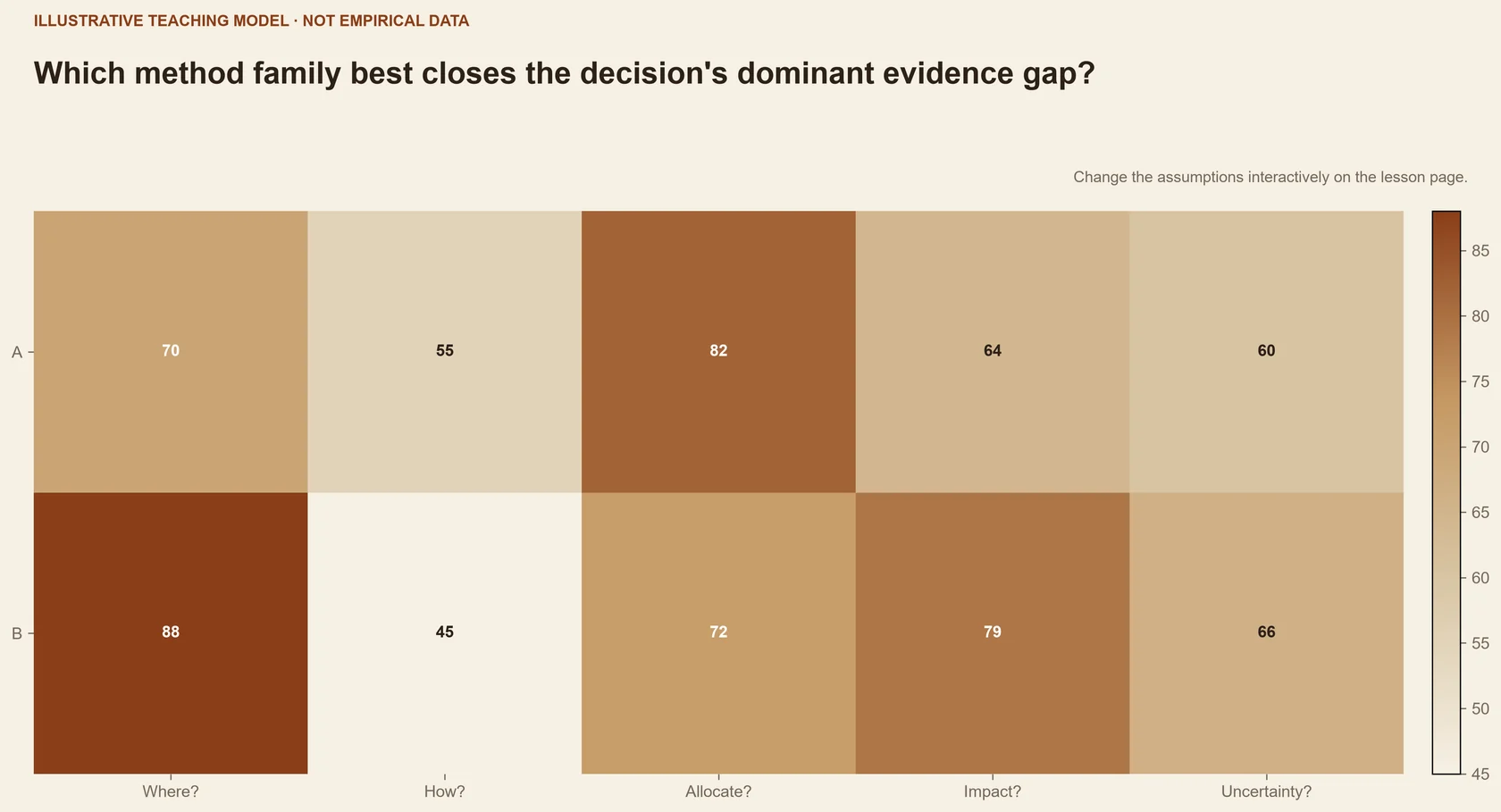
Explore · method decision tree
Choose a method from the decision and evidence need—not from familiarity.
Answer the decision-tree questions to identify a primary method and what it cannot answer alone.
Is the decision primarily about where?
Worked example
Where should a residue biorefinery be built?
The decision depends on resource location, process yield, logistics, cost and emissions.
- 01
Use GIS to estimate spatial supply and candidate locations.
- 02
Use process simulation and TEA for yields, equipment and costs.
- 03
Use optimization and LCA to compare network choices and consequences.
The workflow is stronger than declaring one method the complete answer.
Case file
Feedstock-Conversion Interface Consortium: Crosscutting Analysis Research
- Why it is here
- FCIC illustrates why cross-disciplinary questions require linked methods.
- What to inspect
- Inspect which method answers each interface question.
- Limitation
- A programme structure is not a universal method-selection rule.
Core references
- U.S. Department of Energy (2024). Feedstock-Conversion Interface Consortium: Crosscutting Analysis Research.Open source ↗
- International Organization for Standardization (2006). ISO 14040:2006 Environmental management — Life cycle assessment — Principles and framework.Open source ↗
Further reading +2
- Hart, Watson and Woodruff (2011). Pyomo: modeling and solving mathematical programs in Python.https://doi.org/10.1007/s12532-011-0026-8 ↗
- Cortes-Peña et al. (2020). BioSTEAM: A Fast and Flexible Platform for the Design, Simulation, and Techno-Economic Analysis of Biorefineries under Uncertainty.https://doi.org/10.1021/acssuschemeng.9b07040 ↗
Knowledge check
Key takeaway
Select methods from the decision and evidence gap, not from software familiarity.
A more complex model is automatically more decision-relevant.
Decision-maker, alternatives, boundary, resolution, data quality, hand-offs and uncertainty.