Before you begin
Why biomass and waste are finite resources →The question
What evidence moves a resource from possible to deployable?
Learning objectives
- 01Distinguish the four potential categories.
- 02Name the evidence that moves an option from one rung to the next.
- 03Use the ladder for both resources and technologies.
Core explanation
Technical potential describes what appears physically or technically possible under stated assumptions. Sustainable potential applies ecological and social safeguards. Economic potential adds costs, prices and financial conditions. Deployable potential adds timing, institutions, infrastructure, supply contracts, markets, workforce, permitting, acceptance and implementation risk.
The rungs are analytical filters, not universal databases. A resource can be economically attractive but environmentally unacceptable; a technology can be sustainable in principle yet lack certification or infrastructure; a project can be financeable at one scale and fragile at another. Each transition needs evidence that matches the decision.
Report both the potential label and its assumptions. Saying ‘technical potential under scenario A’ is more useful than presenting a single large number. Where evidence is incomplete, retain a range and mark the unresolved filters.
Key concepts
Technical potential
Physical or technical possibility under stated performance assumptions.
Sustainable potential
Technical potential after ecological and social safeguards.
Economic potential
Sustainable options that meet defined cost, price or return conditions.
Deployable potential
Options that can plausibly be implemented within real infrastructure, institutions, time and risk.
Visual explanation
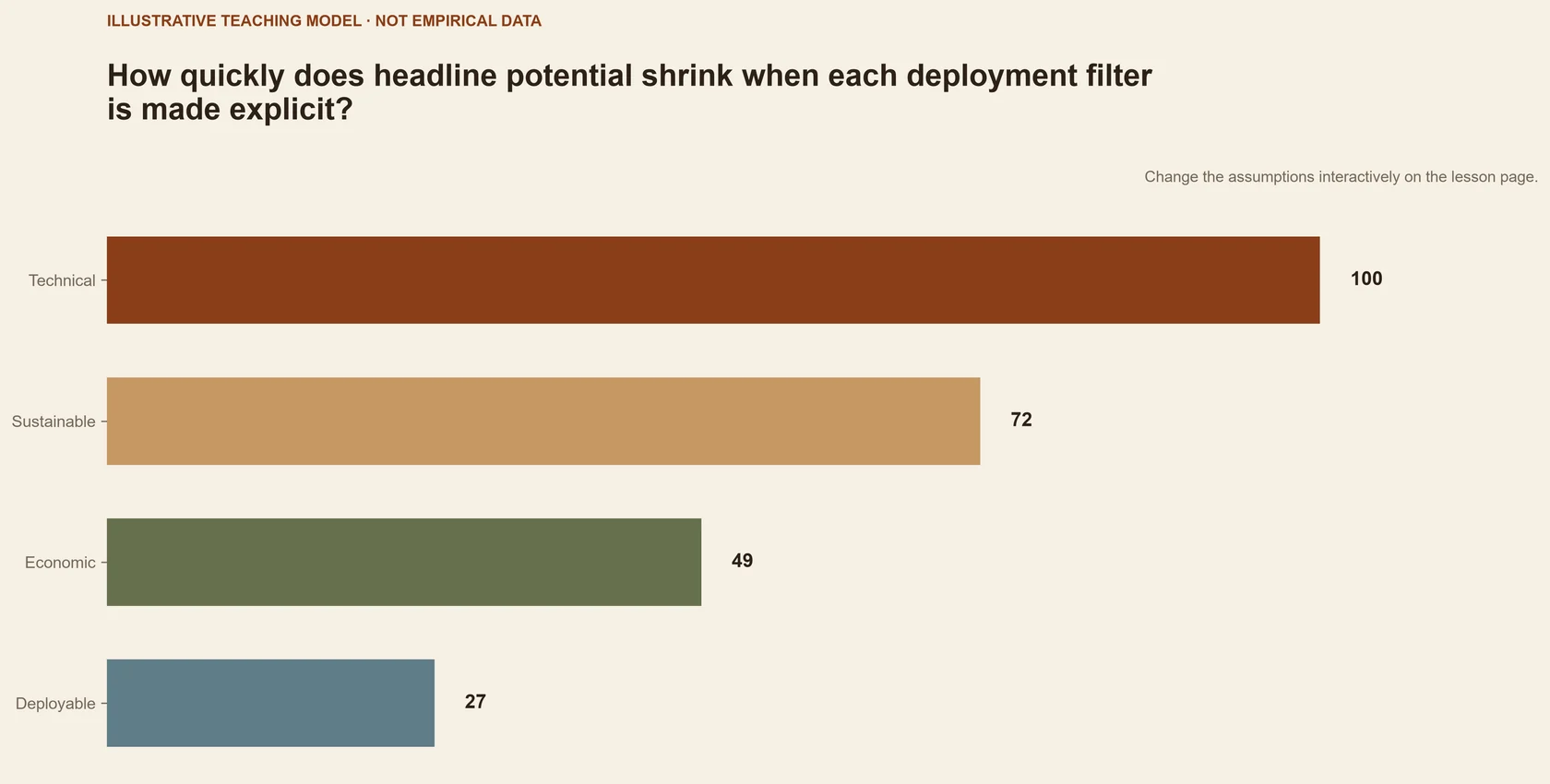
Explore · evidence ladder
Distinguish technical, sustainable, economic and deployable potential.
For each rung, select the new evidence that must be added; skipping a rung leaves the claim incomplete.
Technical
Physical and engineering feasibility under stated assumptions.
Worked example
A promising residue-to-fuel pathway
A process accepts a regional residue and performs well in a pilot. Walk it through the four filters.
- 01
Technical: verify conversion, balances and operability across feedstock variability.
- 02
Sustainable and economic: apply removal safeguards, life-cycle accounting and delivered-cost scenarios.
- 03
Deployable: test contracts, seasonal storage, permitting, infrastructure, markets and downside cases.
Passing the first filter justifies more analysis; it does not justify a deployment claim.
Case file
Feedstock-Conversion Interface Consortium: Crosscutting Analysis Research
- Why it is here
- FCIC demonstrates why feedstock and conversion assumptions must be joined.
- What to inspect
- Inspect where interface data changes a downstream estimate.
- Limitation
- Crosscutting analysis still requires local deployment evidence.
Core references
- U.S. Department of Energy (2024). 2023 Billion-Ton Report: An Assessment of U.S. Renewable Carbon Resources.https://doi.org/10.23720/BT2023/2316165 ↗
- U.S. Department of Energy (2024). Feedstock-Conversion Interface Consortium: Crosscutting Analysis Research.Open source ↗
Further reading +1
- Welfle, Gilbert and Thornley (2014). Increasing biomass resource availability through supply chain analysis.https://doi.org/10.1016/j.biombioe.2014.08.001 ↗
Knowledge check
Key takeaway
Potential is always potential under filters and assumptions; deployability is the most demanding rung.
Technical potential is a forecast of how much will be built or supplied.
Named filters, scenario assumptions, resource safeguards, delivered costs and implementation constraints.