Before you begin
Feedstock characteristics and conversion fit →The question
Can you close the carbon flow before comparing pathways?
Learning objectives
- 01Draw a conversion system from feedstock reception to products and residuals.
- 02Close mass, energy and carbon balances before comparing pathways.
- 03Separate conversion efficiency from carbon efficiency and product value.
Core explanation
Conversion transforms a feedstock through physical, biological, thermal or chemical operations. A flowsheet should include reception, conditioning, reaction, separation, upgrading, utilities, storage and treatment. Drawing only the main reactor hides energy demand, solvent or catalyst use, recycle loops and residual management.
A mass balance states that input mass equals products, coproducts, emissions, wastewater, solids, inventories and losses over a defined period. Carbon and elemental balances test whether the proposed product distribution is plausible. Energy balances connect feedstock energy, heat, electricity, work, recovery and losses. All streams need consistent wet/dry bases and boundaries.
High conversion can still send carbon to low-value gas or require large external energy. Carbon efficiency tracks feedstock carbon retained in desired products; energy efficiency tracks useful energy; yield tracks product per feedstock; selectivity describes product distribution. State the metric, numerator, denominator and basis every time.
Key concepts
Mass balance
Conservation accounting for all material entering, leaving or accumulating in the boundary.
Energy balance
Accounting for energy inputs, outputs, recovery, accumulation and losses.
Carbon efficiency
Share of input carbon retained in specified useful outputs.
Selectivity
Preference for desired products among converted material or reaction products.
Visual explanation
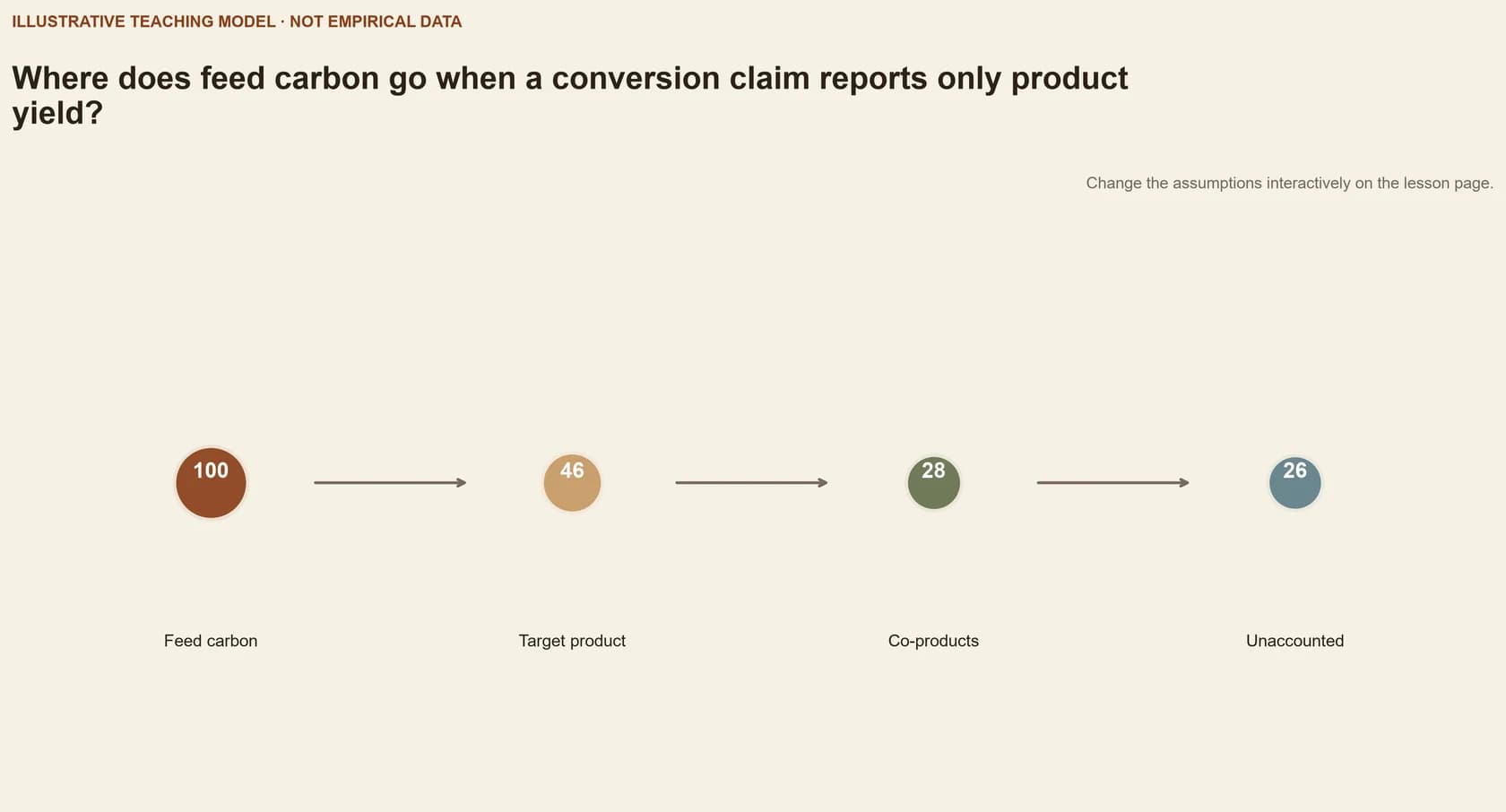
Explore · carbon flow builder
Assemble a traceable feed-to-products balance including losses and co-products.
Add stages in process order, then inspect where unaccounted carbon remains.
iIllustrative learning model — values are not scientific results or forecasts.
Add stages in process order, then inspect where unaccounted carbon remains.
Worked example
Closing a 100-unit carbon balance
A process report assigns carbon to product, coproduct and gas but leaves an unreported difference.
- 01
Put every stream on the same carbon and time basis.
- 02
Add wastewater organics, solids, purge streams and inventory change.
- 03
Report the remaining closure error and measurement uncertainty explicitly.
An unexplained balance gap is a data-quality signal, not a product yield.
Case file
A novel three-stage ex-situ catalytic pyrolysis process for improved bio-oil yield and quality from lignocellulosic biomass
- Why it is here
- The staged process is a useful case for tracking products across sequential operations.
- What to inspect
- Inspect what is measured at each stage and whether totals close.
- Limitation
- Do not transfer the reported distribution to other feedstocks or reactors without evidence.
Core references
- U.S. Department of Energy (2024). Feedstock-Conversion Interface Consortium: Crosscutting Analysis Research.Open source ↗
- Préat et al. (2020). Identification of microalgae biorefinery scenarios and development of mass and energy balance flowsheets.https://doi.org/10.1016/j.algal.2019.101737 ↗
Further reading +1
- Cortes-Peña et al. (2020). BioSTEAM: A Fast and Flexible Platform for the Design, Simulation, and Techno-Economic Analysis of Biorefineries under Uncertainty.https://doi.org/10.1021/acssuschemeng.9b07040 ↗
Knowledge check
Key takeaway
Close the balances before interpreting the performance headline.
Reactor conversion alone describes whole-process material and energy performance.
Complete stream table, consistent basis, closure error, utility demand, recycle and residual destinations.