Before you begin
No prior technical training required
The question
What belongs inside a bioeconomy system?
Learning objectives
- 01Define the bioeconomy without reducing it to bioenergy or agriculture.
- 02Distinguish a biological resource base from a sustainability claim.
- 03Place products, services, knowledge and ecosystem limits within one system boundary.
Core explanation
The bioeconomy concerns the production, use, conservation and regeneration of biological resources, together with the knowledge and innovation used to create products, processes and services. Its scope reaches across food, feed, forestry, materials, chemicals, energy, health and ecosystem services. A useful definition therefore starts with a resource system rather than a catalogue of technologies.
Biological origin does not guarantee a lower impact. Land, water, nutrients, biodiversity, previous uses, processing energy and end-of-life all matter. The adjective ‘sustainable’ must be demonstrated through explicit boundaries, evidence and comparison with a relevant alternative.
This portal uses a four-part reading: what resources exist, how they can be converted, how options can be deployed under real constraints, and what outcomes follow. Methods such as LCA, TEA, GIS and optimization connect those questions but do not replace them.
Key concepts
Biological resources
Living or recently living materials and associated biological knowledge; fossil carbon is excluded.
Bio-based
Wholly or partly derived from biomass; this describes origin, not performance.
System boundary
The processes, places, times and consequences included in an analysis.
Sustainable bioeconomy
A bioeconomy whose environmental, social and economic conditions are assessed rather than assumed.
Visual explanation
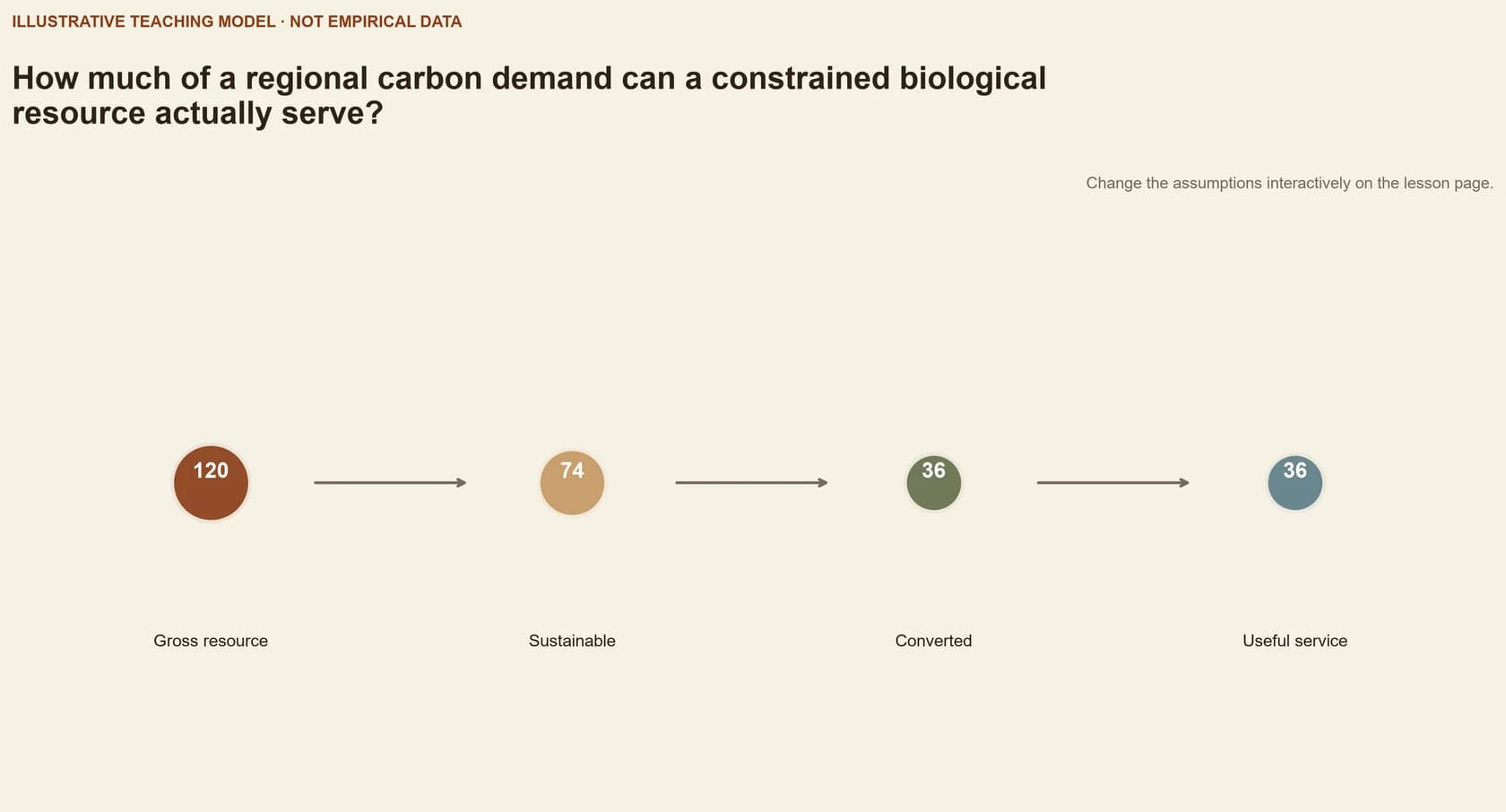
Explore · system boundary builder
Build a system boundary before attaching labels or claims.
Open each system layer, then connect the four stages into one defensible boundary.
Biological & secondary carbon
Start with material origin, quality and realistic availability.
0/4 Complete
Worked example
Reading a bio-based cup as a system
A cup is labelled ‘made from plants’. The label identifies an origin but leaves the system question open.
- 01
Identify the crop, residue or waste and its prior use.
- 02
Trace conversion energy, additives, manufacturing and transport.
- 03
Compare reuse, recycling, composting and disposal in the actual location.
Only after these checks can ‘bio-based’ be connected to an environmental or circularity claim.
Case file
Sustainable and circular bioeconomy: glossary and key terms
- Why it is here
- FAO supplies a public vocabulary anchor.
- What to inspect
- Inspect which resource and value-chain elements are included.
- Limitation
- A glossary defines terms; it does not prove sustainability.
Core references
- Food and Agriculture Organization of the United Nations (2026). Sustainable and circular bioeconomy: glossary and key terms.Open source ↗
- European Commission (2025). The 2025 EU Bioeconomy Strategy.Open source ↗
Further reading +1
- Intergovernmental Panel on Climate Change (2022). Climate Change 2022: Mitigation of Climate Change — Chapter 6, Energy Systems.Open source ↗
Knowledge check
Key takeaway
Bioeconomy describes a resource-and-knowledge system; sustainability remains a question to be demonstrated.
Anything made from biomass is automatically renewable, circular and low-carbon.
Resource origin, counterfactual use, process inputs, system boundary and measured outcomes.